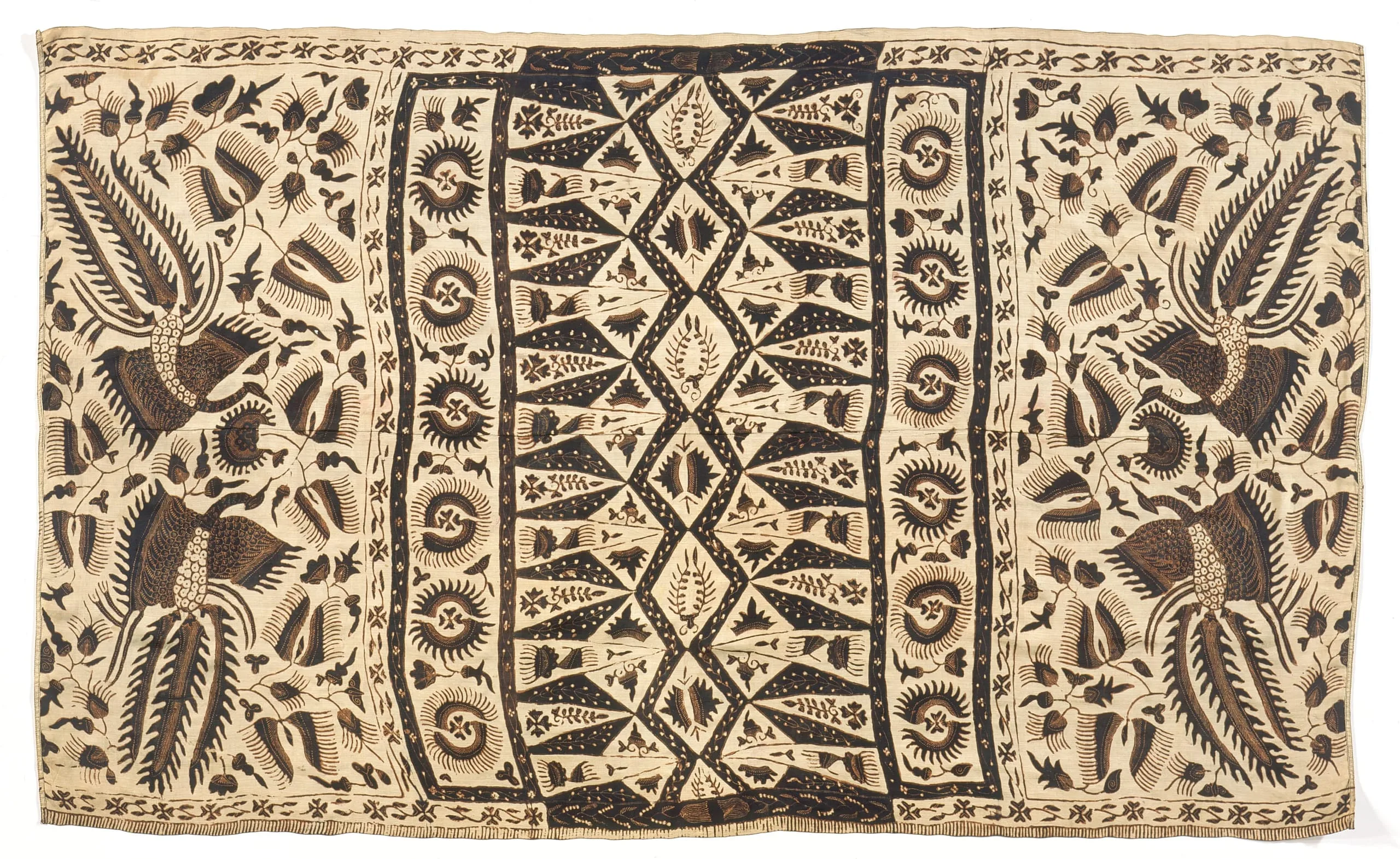
Hip wrapper, m.91.184.550
Overview
Excerpted from Herina, Rens, and Harmen C. Veldhuisen. Fabric of Enchantment: Batik from the North Coast of Java. Los Angeles: Los Angeles County Museum of Art; New York: Weatherhill, Inc., 1996, Catalogue no. 15.
The classic bisected badan of this silk cloth is decorated with robust birds of paradise, which fly in pairs among large, densely packed floral motifs. The spiky ¬ outlines of the motifs, called ren (thorns), which are typical of the eastern Pasisir style, are clearly visible in this quickly drawn cloth, intended for export to Sumatra or Bali. The cocohan layer was omitted, and all motifs are much larger than in the daintily drawn styles of more luxurious cloths. The kepala shows a simplified version of the gigi balang, with three rows of diamonds, two of which form an underlying layer for the traditional rows of triangles. The borders are decorated with a basic version of the floral creeper; the edges are asymmetrical. The motifs of the badan and papan in brownish-black on a cream ground contrast with the kepala with its dark ground. Indigo was top-dyed with kayu tingi (Ceriops candolleana) to produce the brown-black soga.
Maker
Batiks on silk were produced in Juana and Rembang by Peranakan entrepreneurs for Peranakan clients and for export to Sumatra or Bali.
Wearer
Although this type of batik was used on the Pasisir, most were exported to the Lampong area of southern Sumatra and to Bali, where they functioned as dancer’s costumes.1 Speedily executed batik work was less important to the Balinese than the silk base.
Note
1. Beryl de Zoete and Walter Spies, Dance and Drama in Bali (Kuala Lumpur: Oxford University Press, 1973), pl. 105.