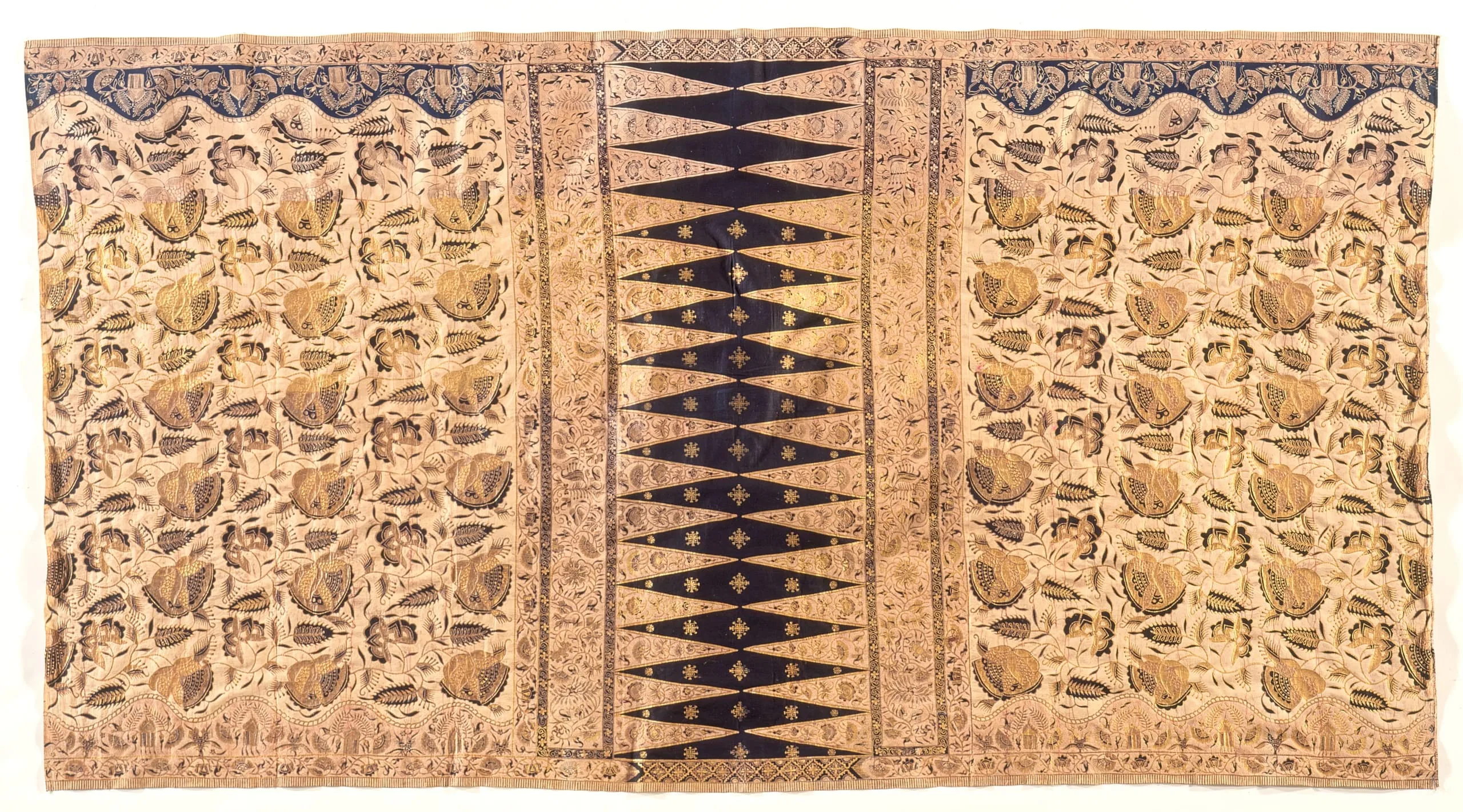
Hip wrapper, m.91.184.296
Overview
Excerpted from Herina, Rens, and Harmen C. Veldhuisen. Fabric of Enchantment: Batik from the North Coast of Java. Los Angeles: Los Angeles County Museum of Art; New York: Weatherhill, Inc., 1996, Catalogue no. 7.
Elements of this early twentieth-century sarung are axiomatic for cloths belonging to a much earlier period. First, it has a kepala in the middle. While originally the classic kepala contained a plain, black central section, in this cloth starflowers were applied in gold leaf. The large, fluidly depicted florals, fruits, and leaves of the badan are neatly arranged in alternating rows. This structured combination of free style and abstracted motifs was another feature regularly found on earlier cloths as well. The red cocohan, which form a background layer in the badan and light border, were believed in Indramayu to have their origin in Lasem.1 Third, the floral creepers in the papan, tumpal, and borders are of a smaller, more traditional size. The borders in the kepala section form a single unit and end at both sides in a kind of inverted tassel. A more recent development is the third, undulating border. Here, its form appears closer to the Indo-European bow border (m.91.184.22) than to the original Pasisir-style serpentine. Unusual is its occurrence in both the upper and lower borders of the cloth and the differing colors, blue-black and cream. The bang biru, with the deep blue-black tones characteristic of Indramayu, is brightened by red and blue accents.
Maker
Made in a Peranakan workshop, this batik is a mixture of an older style (the kepala with plain field between the elongated triangles in the middle of the cloth) and innovations (a wavy line at the top and bottom of the badan and borders with different color schemes). The result was a batik suitable for all ages; it could be worn “right side up” or “upside down,” with red symbolizing youth and blue maturity. For the entrepreneur this was an advantageous sales point.
Wearer
Like the previous examples of sumptuously gilded cloth, this probably was a wedding gift. The unusual amount of gold decoration and the choice for the more appropriate light border to remain visible at the lower, gilded edge suggest its use by a Peranakan bride. The kelengan (blue-and-cream) border as a covering for the lower body, that is, the womb, may well have been intended to impart protective properties. A second possibility is that the cloth was meant to be worn at festive occasions by a grandmother. Not only are the dark tones and predominantly old-fashioned style of the cloth appropriate for an elderly woman, the separate rows of fruits and flowers can also be seen as a metaphor for a grandmother’s position as the source for several successive generations.2
Notes
1. Paramita Rahayu Abdurachman, “Dermayu Batiks: A Surviving Art in an Ancient Trading Town,” Spafa Digest 8 (1987): 5.
2. “Tilling the Cloth and Weaving the Land: Textiles, Land and Regeneration in an East Javanese Area,” in Weaving Patterns of Life: Indonesian Textile Symposium (1991), eds., Marie-Louise Nabholz-Kartaschoff et al. (Basel: Museum of Ethnography, 1993), 161.