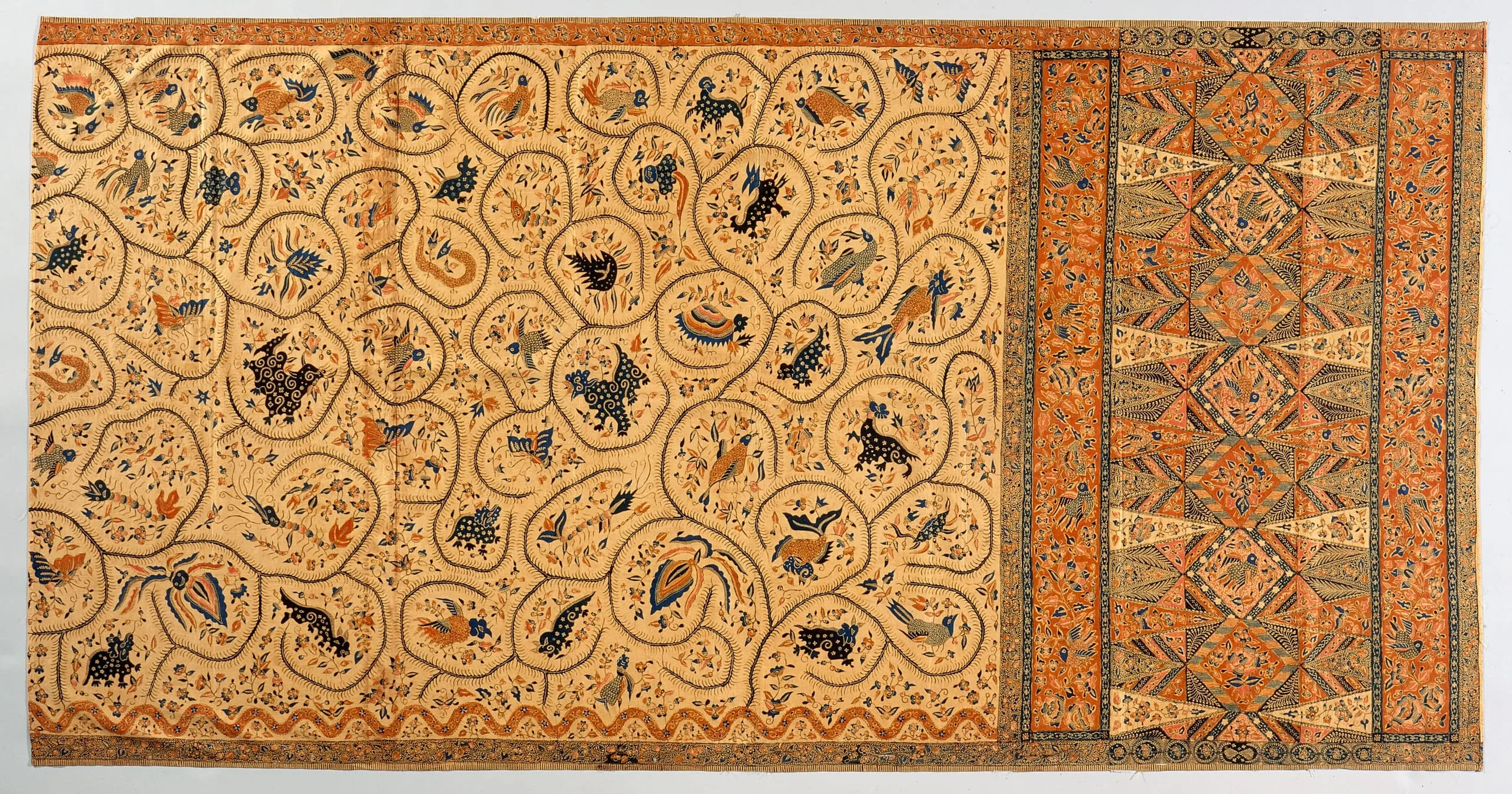
Hip wrapper, m.91.184.493
Overview
Excerpted from Herina, Rens, and Harmen C. Veldhuisen. Fabric of Enchantment: Batik from the North Coast of Java. Los Angeles: Los Angeles County Museum of Art; New York: Weatherhill, Inc., 1996, Catalogue no. 14.
Mammals, and fish, surrounded by vegetal elements, fill the roundels of this late example of the traditional Pasisir ganggeng motif. The mythical Chinese qilin and dragon mingle with a scorpion and sea creatures that are fitting for a fishing town like Cirebon. Shrimp, the local emblem, a lobster, and a variety of fish are recognizable. The rather bold size and sparse filler motifs are also typical of Cirebon. The background is plain (cocohan were not normally used in Cirebon). Birds and fish alternate in the diamonds of the Peranakan-style kepala gigi balang. The traditional tumpal triangles provide a counterpoint in the heavily decorated space. The main colors are naturally dyed blue and a shade of red that verges on orange due to the preliminary oiling, a treatment that had its effect on the cream ground as well. This effect is exclusive to Cirebon. Accents of synthetic pink, bright blue, and green were painted by hand, thus transforming the bang biru into a multicolored cloth.
Maker
The illegible remnants of a paper sticker probably bear the name of a Peranakan entrepreneur. Colored weftlines are visible in one end border. These were applied in Indian cotton mills to mark the start of a bolt, with the number of yards on the bolt embroidered near one of the selvages at the left or right side of the weftlines. Dutch textile mills adopted these markings in the headings of bolts made for export to Java.1 Often either the number or the weftlines or both were removed in the batik workshop. In this case the weftlines remain, although they differ from those applied to Dutch cloth, so probably the cotton was woven in India.
Wearer
This was likely a gift for a Peranakan bride, to be worn on formal occasions after she had borne children. As the design is not oriented toward a particular border, this cloth could be worn with either border down. To the Javanese ganggeng refers to fertility-giving water and implicitly to women, whose role is to care for all living things, expressed by the creatures of land, sea, and sky enclosed by the roundels. The mythical animals and the venomous scorpion are apotropaic symbols.
Note
1. Piet den Otter and Mienke Simon Thomas, “Twentse tjaps,” Textielhis¬ torische Bijdragen 34 (1994): 107. In Dutch textile mills an ink stamp and/or paper sticker was also added in the heading. This gave information about the firm that imported the cloth into Java, the quality, and the number of yards.