Excerpted from Herina, Rens, and Harmen C. Veldhuisen. Fabric of Enchantment: Batik from the North Coast of Java. Los Angeles: Los Angeles County Museum of Art; New York: Weatherhill, Inc., 1996, Catalogue no. 9.
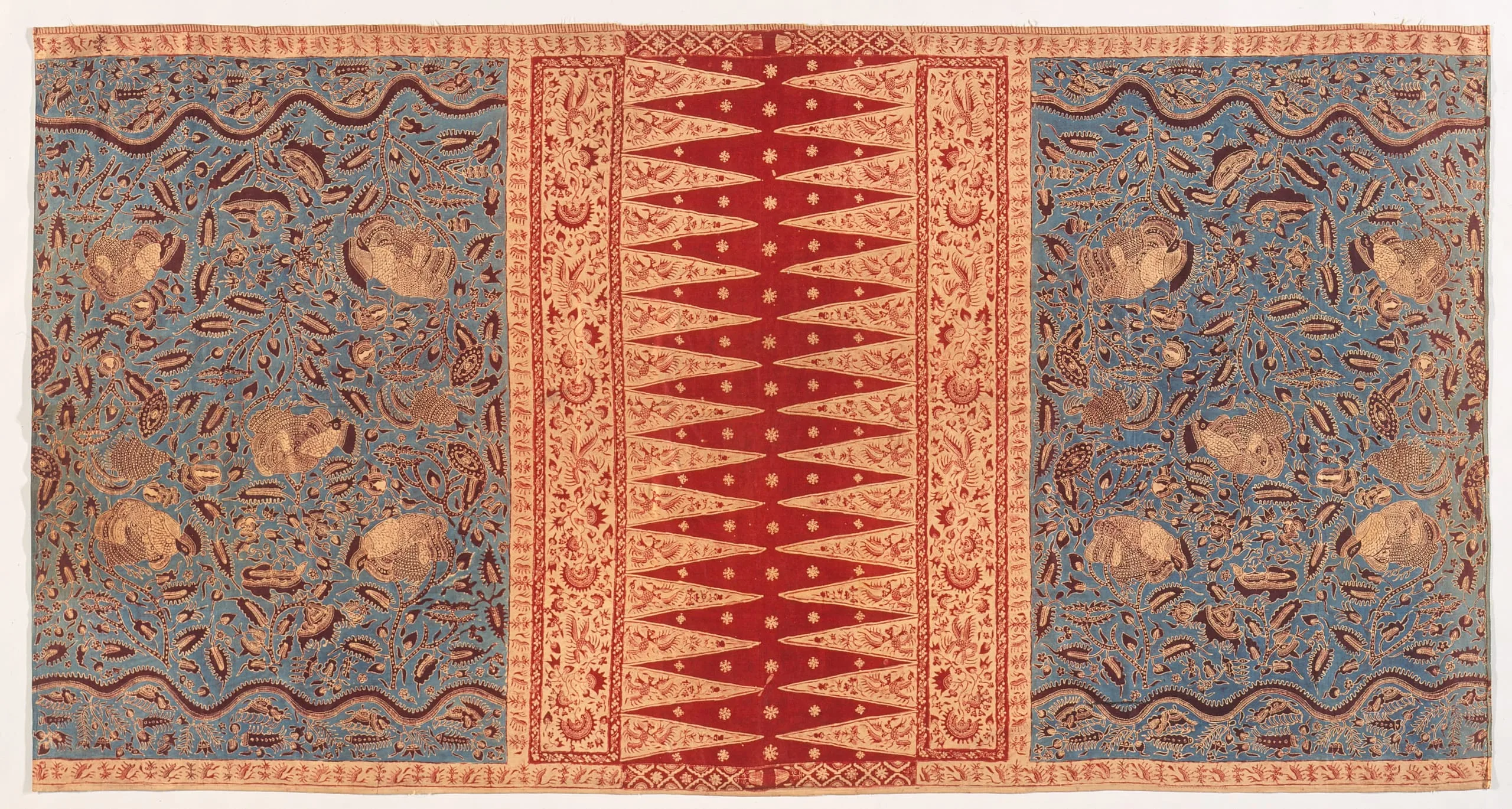
The two badan sections, divided by the kepala, each show five stout gamecocks seated on comparatively delicate branches on a plain, blue ground. Although a horizontal division seems to have been intended, the placement of the central bird in each half undermines this concept. The borders and kepala were executed in Semarang in the traditional Lasem style and contain dainty red flowers and birds with a background of cocohan. The kepala border includes the classical tassels. A rather unusual version of the third border undulates along the upper as well as the lower edge of the cloth, climbing higher toward its ends. The design is a hybrid of motif types, a feature that also emerges in the color treatment. The traditional red-and-cream bang-bangan of Semarang contrasts with a now slightly faded combination of blue and brown in the badan, which continues, somewhat unusually, in the third border.
Maker
This type of sarung, with the kepala in the middle, was made in large quantities in Peranakan workshops in Semarang and Lasem until the end of the last century. Most were exported to Sumatra, and until recently they could still be found in antique shops in Lampong and Palembang. The drawing in the badan is fairly bold, while the kepala and borders are refined. It is clear that this batik was either made by different workers within a single shop or by workers in more than one shop. Both parts, however, are in the nineteenth-century style of Semarang, so shops in two different batik centers can be ruled out.
Wearer
A hybrid cloth of this commercial type was generally meant for export to Sumatra, where the appreciation of good-quality batik was not as highly developed as in Java. The patterns and combination of colors may have reminded the Sumatrans of textiles imported from India in a time long past. The design does indeed resemble the imitations of this style that were made during the same period in the Netherlands. The Sumatrans probably associated the third border with the meandering rivers that were the actual and symbolic arteries of their community. A similar theme is encountered on batik Jambi.1 The gamecocks (jago) stand for and provide a colloquial term for male prowess.
Note
1. Rens Heringa, Een ¬ schitterende geschiedenis: Weefsels en batiks van Palembang en Djambi, exh. cat. (The Hague: Museon, 1993), 26, 43.