Excerpted from Herina, Rens, and Harmen C. Veldhuisen. Fabric of Enchantment: Batik from the North Coast of Java. Los Angeles: Los Angeles County Museum of Art; New York: Weatherhill, Inc., 1996, Catalogue no. 24.
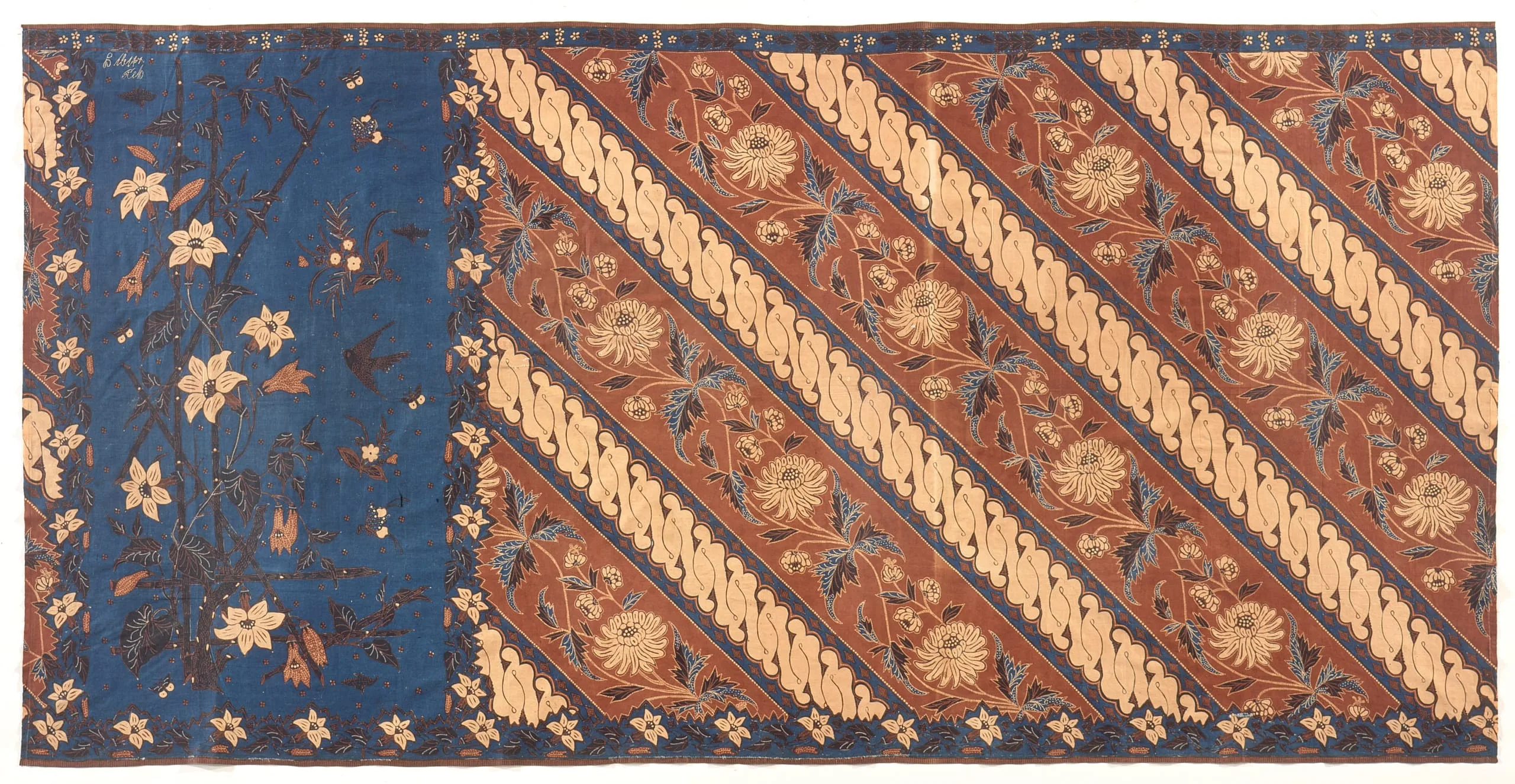
The badan shows a variant of the central Javanese geblak, or dlorong, style, alternating diagonal bands decorated with garlands of chrysanthemums in blue, cream, and black on a soga ground, and a central Javanese parang rusak in traditional colors but slightly altered for wear by nonaristocrats. The kepala, a combination of art nouveau and Japanese design influences, shows a bamboo trellis with white lilies. Rudimentarily drawn birds and butterflies complete the design on a ground of dark blue with a sprinkling of small, four-petaled flowers. The lilies along the lower edge, complementing those of the badan, form an imitation-lace border. The upper border contains a very simple row of clustered flowers.
Maker
The signature on this batik is “L Metz Pek” (for Lien Metzelaar Pekalongan), an abbreviation she adopted around 1890. This batik shows a new and recurrent Metzelaar motif in the upper border: four tiny flowers and seven leaves on a twig. The quality of drawing in the borders (which was delegated to younger, less ¬ experienced hands) fails to match that of the rest of the cloth, a result of specialization. Many of Metzelaar’s batiks before 1890 show only the badan with a pattern and color combination—blue, brown, and cream—from the Principalities. The brown areas were dyed by Marjati, a Pekalongan specialist patronized by both Metzelaar and Lies van Zuylen.1
These batiks look like batik dua negeri in which kepala and pinggir were made in red with cream on the Pasisir and the badan in blue, brown, and cream in the Principalities. This method was used by Peranakan entrepreneurs, while Indo-European entrepreneurs from Pekalongan designed and executed the whole batik themselves. In this case Metzelaar used one color scheme for the badan, kepala, and borders. The chick in the right middle and lower right-hand corner of the kepala was one of her recurrent motifs, as was the lily, for which she and her friend Tina van Zuylen had a predilection.
Wearer
With its combination of European and central Javanese motifs and subdued color combination, this cloth is meant to be worn by an older Indo-European or possibly Peranakan woman. The chrysanthemum, flowering in autumn, is suitable for this time of life. The fragrant, white lilies, called kerklelies (church lilies) in Dutch, stand for purity and devotion. During the last quarter of the nineteenth century the simple lines of central Javanese design attracted a great deal of interest among Indo-Europeans.
Note
1. M. J. de Raadt-Apell, De batikkerij Van Zuylen te Pekalongan (Zutphen: Terra, 1980), 44.