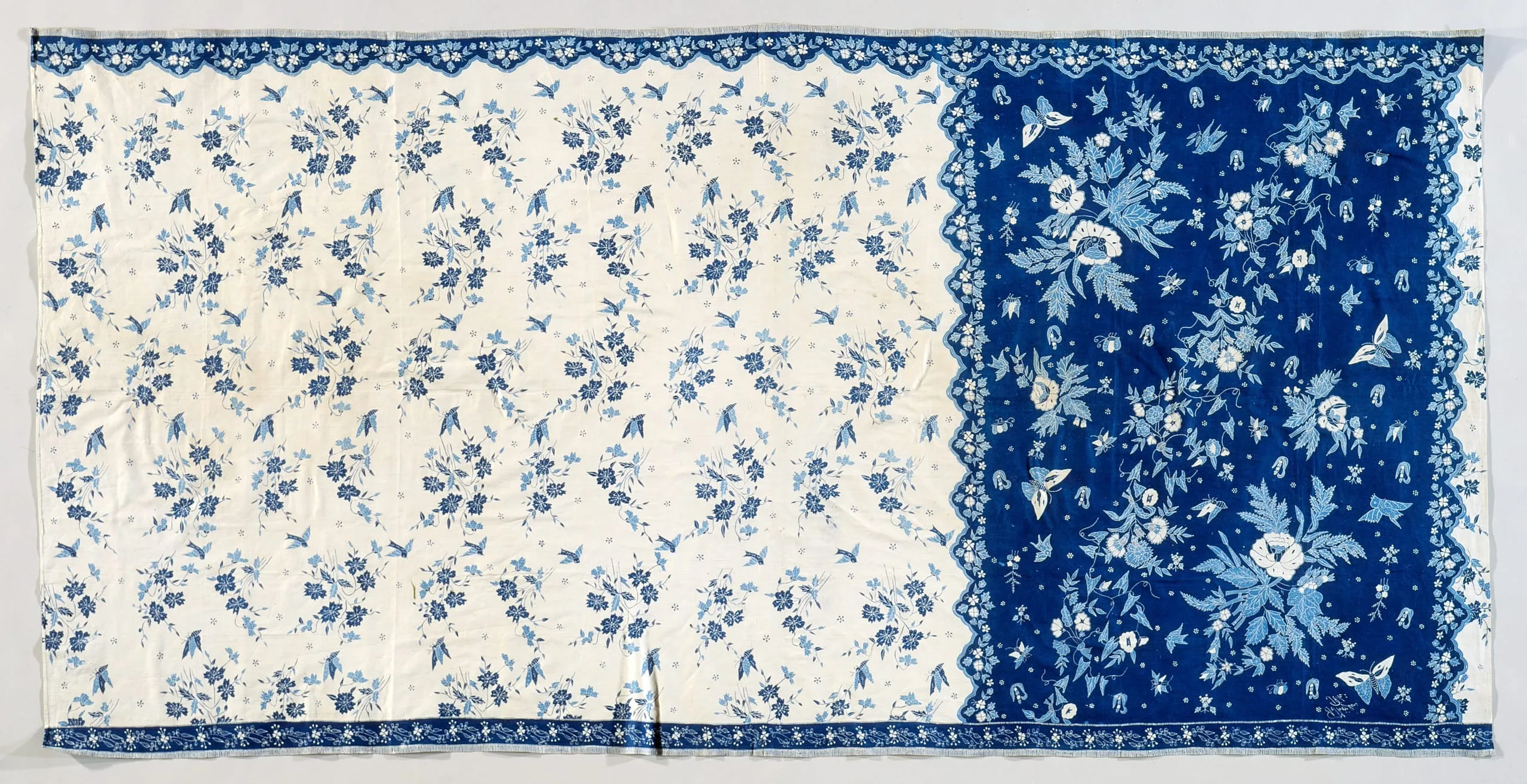
Hip wrapper, m.91.184.474
Overview
Excerpted from Herina, Rens, and Harmen C. Veldhuisen. Fabric of Enchantment: Batik from the North Coast of Java. Los Angeles: Los Angeles County Museum of Art; New York: Weatherhill, Inc., 1996, Catalogue no. 25.
This dainty batik is covered with nosegays in several tints of blue, arranged diagonally across the plain, white badan, giving a traditional Pasisir impression. Rows of small swallows form a horizontal counterpoint. A garland of carnations, morning glory, and bindweed runs diagonally across the kepala. In each corner a sprig of poppies, decorated with colored pinpricks, similar in technique to traditional cocohan, is surrounded by butterflies on the dark blue ground. The asymmetrical borders consist of closely striped selvage edges and clover leaves along the top and a finely delineated bow border of white flowers at the bottom.
Maker
The signature of Tina van Zuylen, “T v Zuijlen Pk. [Pekalongan],” appears beneath the upper border in the kepala. The floral pattern on the badan closely resembles those on sarung kelengan produced by A. J. F. Jans as well as one known to be from A. Wollweber, both contemporaries in Pekalongan.1 The kepala includes the rudimentarily drawn little bird (to the left and right of the broad, diagonal band), which Lien Metzelaar depicted in many of her batiks. Copying was a common practice among the entrepreneurs. What is more, Van Zuylen began her own workshop around 1880 with batik makers lent to her by Metzelaar, so it is not unlikely that the person who drew the chick in Metzelaar’s workshop drew it for Van Zuylen as well. The embroidered number 16 in a corner of the cloth (not visible here) indicates that Van Zuylen used the best-quality cotton, machine-woven in the Netherlands.
Wearer
The gentle kelengan color scheme was worn by Indo-European brides on their wedding nights. Afterward such cloths were carefully stored and kept for funerary use. Though a batik kelengan could also serve as Peranakan mourning wear, the motifs here do not seem appropriate for that purpose. The fragrant, early summer flowers of the badan suit a young woman on the verge of mature life. The upper border of clover leaves stands for luck and married happiness. The swallow in the badan is the messenger of approaching summer. Although ¬ nineteenth-century wearers probably were not aware of this, in both Europe and China swallow’s eggs were eaten during fertility rites in earlier times.2
Notes
1. H. C. Veldhuisen, Batik Belanda 1840–1940 (Jakarta: Gaya Favorit, 1993), nos. 38, 40.
2. Jean Chevalier and Alain Gheerbrant, Dictionnaire des Symboles (Paris: Robert Laffont/Jupiter, 1988), 506.