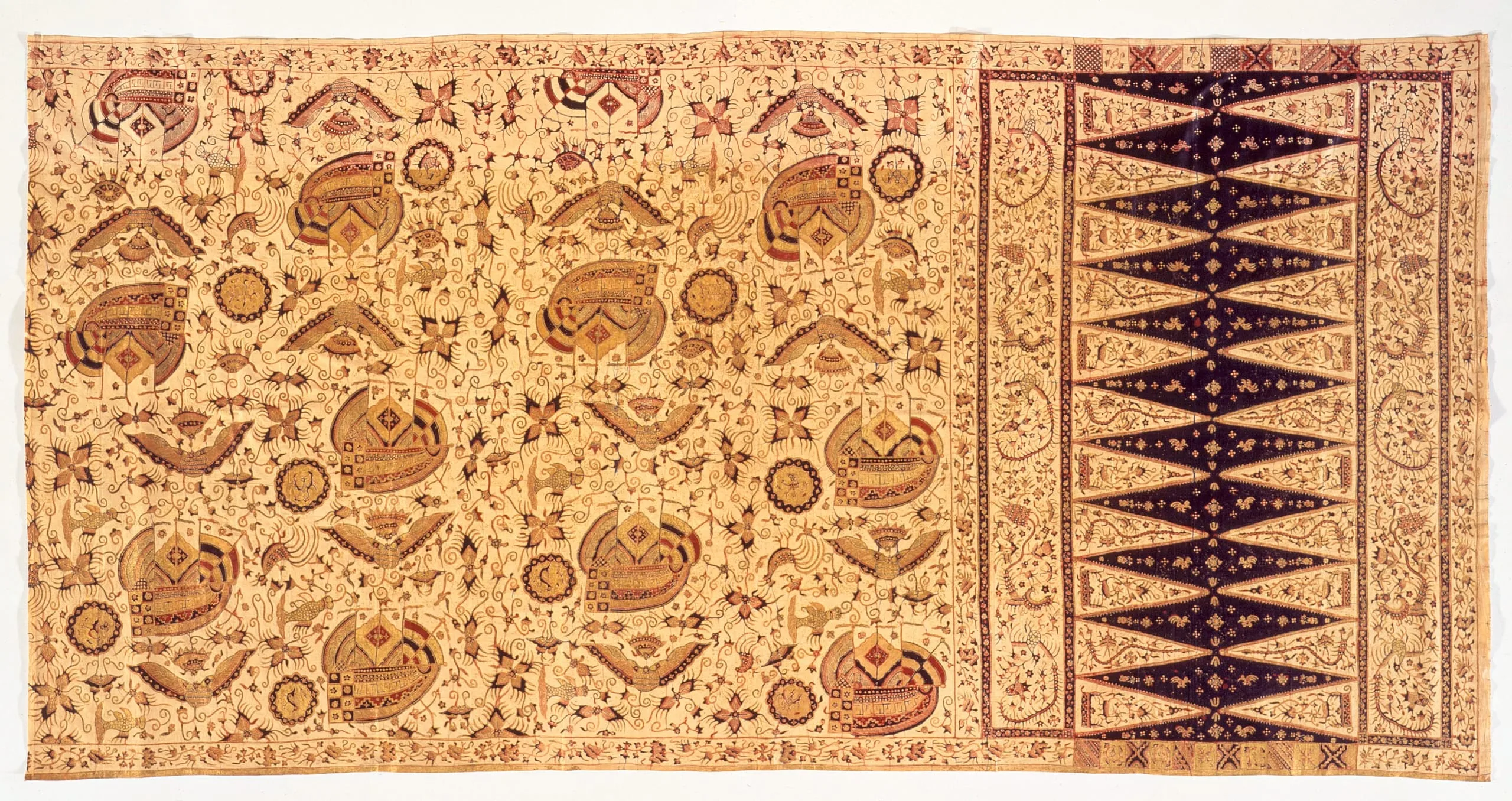
Hip wrapper, m.91.184.339
Overview
Excerpted from Herina, Rens, and Harmen C. Veldhuisen. Fabric of Enchantment: Batik from the North Coast of Java. Los Angeles: Los Angeles County Museum of Art; New York: Weatherhill, Inc., 1996, Catalogue no. 1.
In the badan of this asymmetrical cloth three types of heavily stylized, blue, cream, and black rosettes are arranged in diagonal bands on a red ground with banji (swastika) motifs. Until the 1870s such petite designs were the fashion. In Sumatra, however, this early style persisted into the twentieth century. The colors and motifs in each section of the kepala and the borders divide the cloth into two sections, characteristic of a kain sisihan. This particular color combination is named bang biru: one end section has a red ground; the other, blue-black. Centipedes and jellyfish wind their way among floral elements on a white-based papan. At the other end abstracted birds nip at clustered flowers, set off by feathery, white accents that add a vibrant effect against the bright blue ground. The same feature occurs in one of the borders. Rows of small, white starflowers fill the end sections of the kepala, running into the spaces between the triangles.
Maker
This type of kain panjang kepala tumpal was originally produced on the north coast for local consumption. During the nineteenth century an increasing quantity of these cloths was made for export to Sumatra. One of the most important centers for making kain panjang kepala tumpal for the Sumatran market was Lasem. Part of this cloth was decorated in Sumatra with gold leaf following the batik pattern.
In one corner are remnants of the number 16, embroidered in chain stitch with a tambour needle. In Indian and Dutch textile mills this was done to indicate that the length of the bolt of cotton was sixteen yards. This information was important to the batik entrepreneur who had to decide the size and number of kain panjang or sarung to be cut from the bolt.
The end borders are hand-hemmed, the custom in Java, but not Sumatra. Most likely an antique dealer in Jakarta bought this batik in Sumatra and had the end borders hemmed; the more refined the stitching of the hem, the more valuable the batik to dealers and contemporary collectors.1
Wearer
Highly abstracted rosettes were suitable for Muslim Sumatrans, who used cloths such as this as part of the bridal gift or ceremonial dress. The venomous centipedes provide protection during momentous changes in life. On the north coast the banji motif had similar apotropaic functions and was found carved on doorposts. In this case it forms a protective barrier for the bride’s lower body. According to Chinese belief, it also functioned as a harbinger of prosperity and progeny. Birds, creatures of the sky, in one end section contrast with jellyfish, creatures of the sea, in the other. Thus placed, they symbolize the groom and bride, who are as yet separate. These symbolic concepts were probably largely unfamiliar to Sumatrans. To them the golden embellishment was the most important aspect of the cloth, an indication of its use by the ratu sehari, the bride who was “queen for a day.”
Note
1. H. C. Veldhuisen, ¬ interview with Adrian Idris, Jakarta, 1979.