Excerpted from Herina, Rens, and Harmen C. Veldhuisen. Fabric of Enchantment: Batik from the North Coast of Java. Los Angeles: Los Angeles County Museum of Art; New York: Weatherhill, Inc., 1996, Catalogue no. 4.
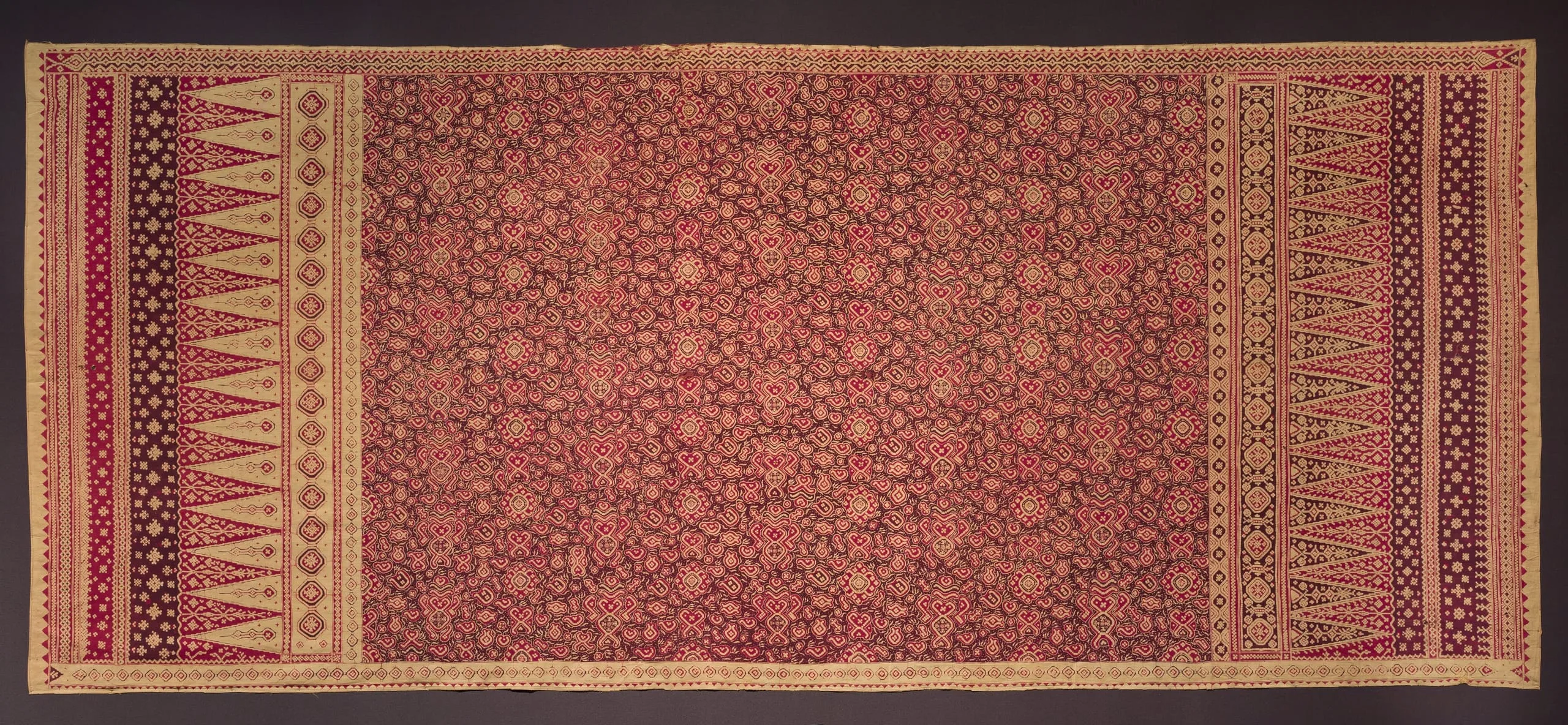
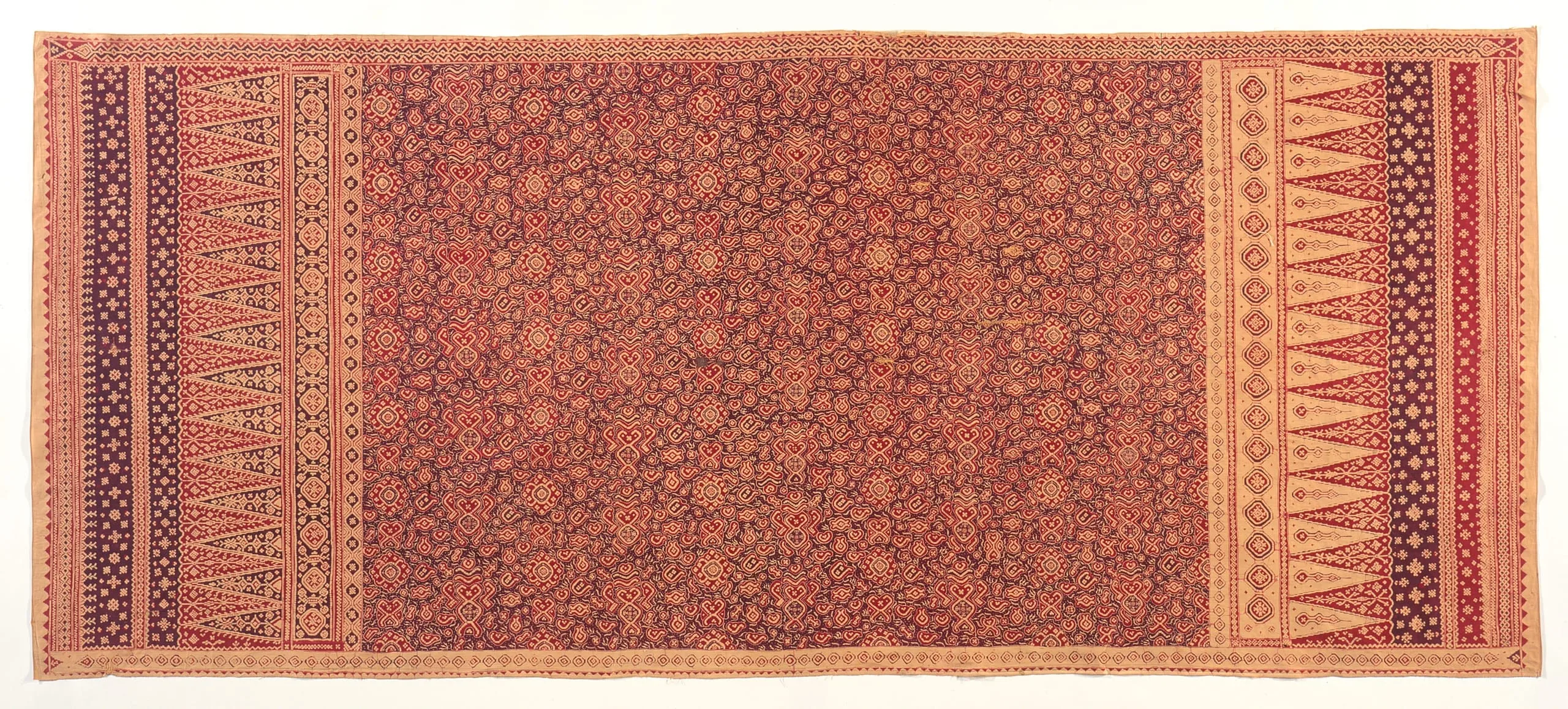
This cloth is an unusual variant of the asymmetrical kain sisihan. The stylized, bright red floral motifs show a strong cinde inspiration. The neat rows of larger florals contrast with the white wos utah (scattered rice) on a wungon (purplish) ground. The end sections, which are usually of a single, contrasting color without decoration are here densely covered with a series of vertical bands, in which the contrasting reds reappear in combination with black. Gold-decorated cloths woven in silk in Sumatra or Bali come to the mind. Both the triangles and their negatives are filled with motifs, which gives the effect of a double tumpal row. The triangles and their intermediate spaces are alternately decorated with small trees and a motif that may represent a crayfish. The latter resembles a motif that is found on Indian cloth for the Thai market. The selvage borders, consisting of a geometric decoration and a row of small triangles, gigi walang (cricket’s teeth), continue till the corner of the cloth. The bright red and purple on this heavily pre-oiled piece combine natural mengkudu dye and purple aniline dye, one of the first synthetic dyes to come on the market around the turn of the century. As these early synthetic dyes were not colorfast, the purple is somewhat faded.
Maker
Indo-Arabians in Pekalongan specialized in creating batiks with nitik motifs, a design greatly appreciated by their Muslim customers. Around 1890 Indo-European batik entrepreneurs in Pekalongan also started to include such designs in the kepala and borders. The work, however, was generally sent out to Indo-Arabian workshops.
Wearer
This is a rare example of the strongly stylized motifs and deep colors that were predominantly worn by Indo-Arabian women on Java but also by a widely dispersed clientele of devout Muslim women throughout the archipelago and possibly mainland Southeast Asia. This partially explains the varied design influences that can be noticed in this cloth. The stylized floral motifs may represent stars in the sky (bintang) or flowers in the Muslim garden of paradise. The same style was exported to Sumatra, where it was also used as a head covering (kudhung).