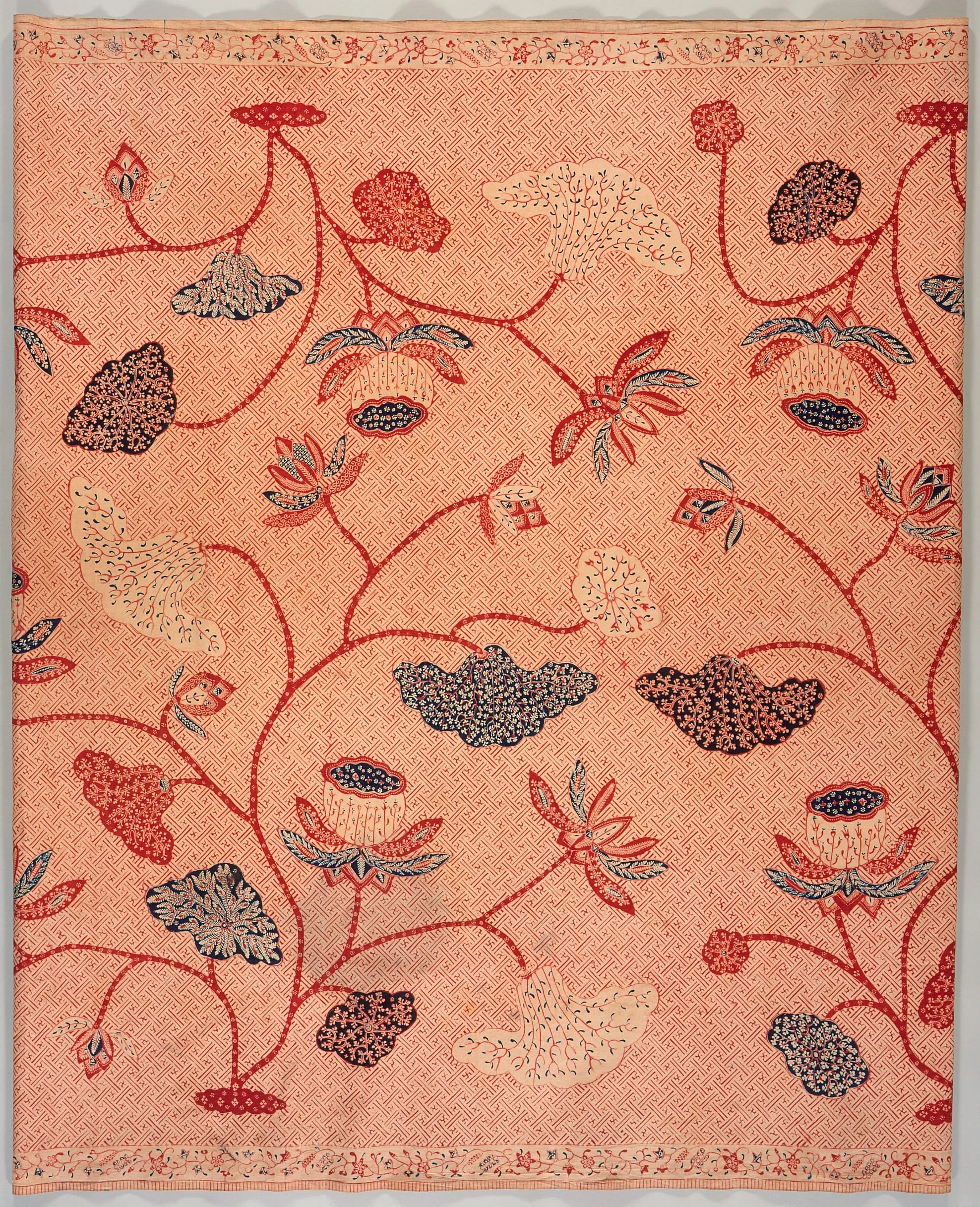
Hip wrapper, m.91.184.73
Overview
Excerpted from Herina, Rens, and Harmen C. Veldhuisen. Fabric of Enchantment: Batik from the North Coast of Java. Los Angeles: Los Angeles County Museum of Art; New York: Weatherhill, Inc., 1996, Catalogue no. 12.
The subject of this tubular sarung is similar to that of the preceding batik. Only the colors differ. Two pairs of lotus trees, one smaller than the other, sprout from a tiny rock or island. Various sources for this often-used motif are known. On Indian chintz the tree of life usually stands on a small mountain or rock formation, while Chinese porcelains show a tiny, rocky island. On Pasisir batik the tree is depicted with one type of flower and loosely hanging roots. The papan, borders, and several of the diamonds in the Peranakan-style kepala gigi balang show detailed natural motifs in the Lasem style. The bang biru combination of red and blue is used to particularly good effect in the kepala. A wide, transparent band of red appears to be inserted between the diamonds and the abundantly embellished triangles. The contrast between the simplicity of a badan and complexity of a kepala reaches a climax in this cloth.
Maker
The Peranakan maker of this batik as well as m.91.184.44 and m.91.184.309 used the same style for depicting the lotus flower and leaves. Only the filler motifs ¬ differ. The same type of abstraction was applied to lotuses depicted on Chinese porcelains.1
Wearer
According to Pasisir tradition, the bang biru color scheme was intended for married women with children.2 The lotus tree designates this cloth for Peranakan use; its details stress the hopes appropriate for a married woman: the flower is the emblem of summer and fertility; the pods, of abundant progeny. The tree, with white, blue, and red flowers growing from a single stem, indicates prosperity and marital happiness.3 The cloth may have been a treasured heirloom, as its original, perfectly hand-sewn seam is still intact.
Notes
1. J. Rawson, Chinese Ornament: The Lotus and the Dragon (New York: Holmes and Meier, 1984), 14.
2. Rens Heringa, “Dye Process and Life Sequence: The Coloring of Textiles in an East Javanese Village,” in To Speak with Cloth: Studies in Indonesian Textiles, ed. Mattiebelle Gittinger (Los Angeles: Museum of Cultural History, University of California, Los Angeles, 1989), 123.
3. Jean Chevalier and Alain Gheerbrant, Dictionnaire des Symboles (Paris: Robert Laffont/Jupiter, 1988), 581; C. A. S. Williams, Outlines of Chinese Symbolism and Art Motives, 3d ed. (New York: Dover, 1976), 258.