Excerpted from Herina, Rens, and Harmen C. Veldhuisen. Fabric of Enchantment: Batik from the North Coast of Java. Los Angeles: Los Angeles County Museum of Art; New York: Weatherhill, Inc., 1996, Catalogue no. 21.
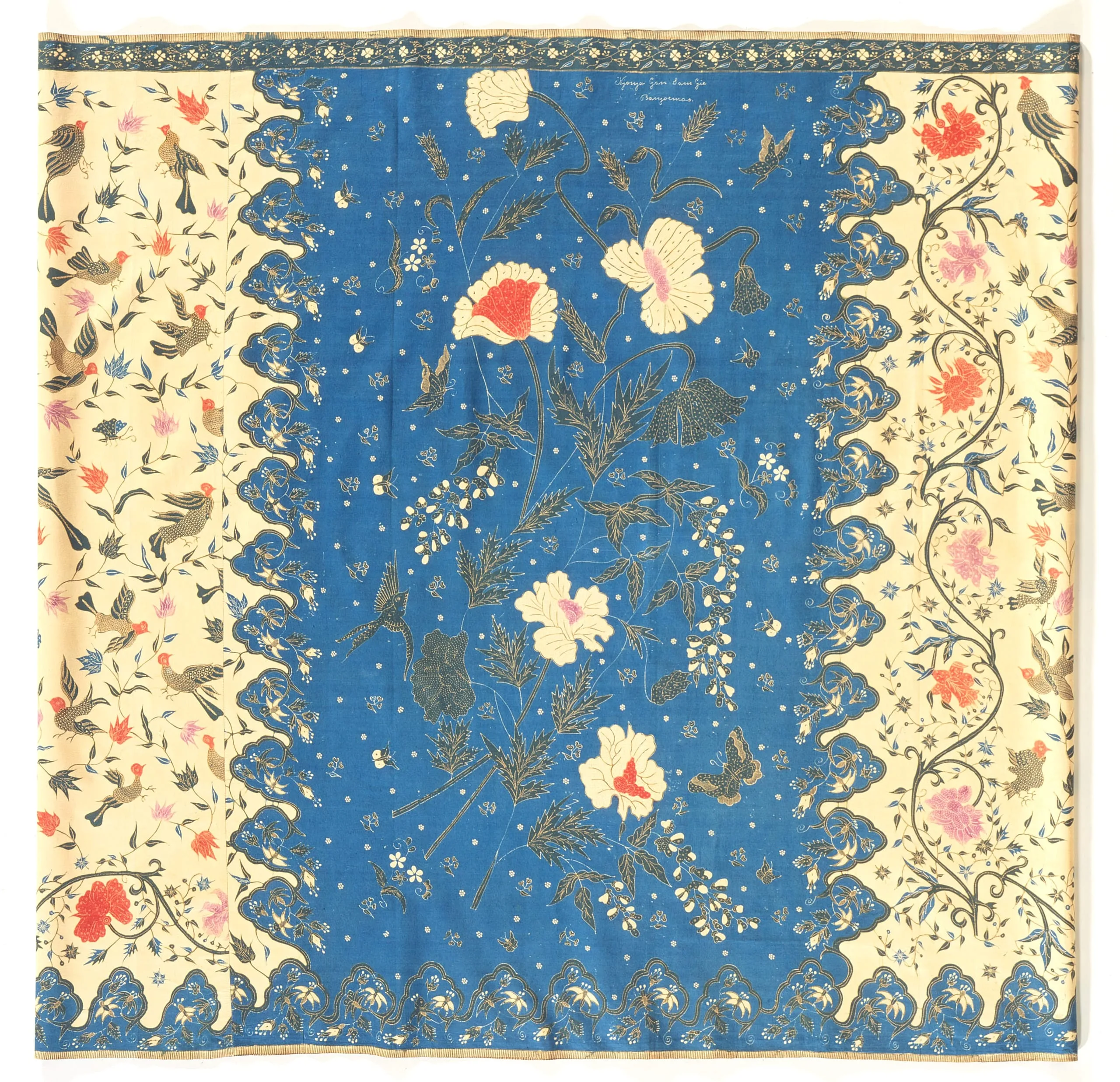
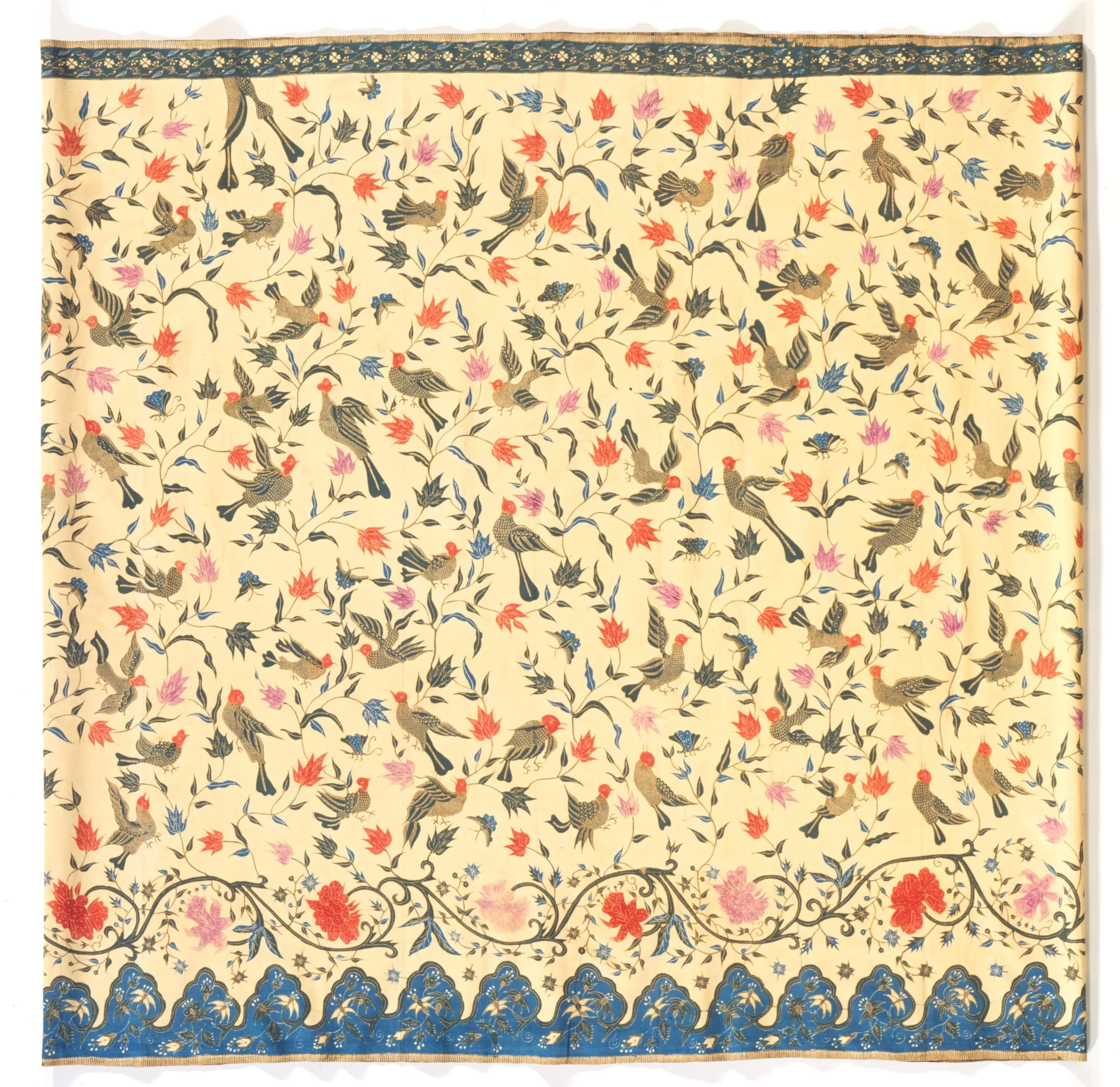
Floral vines in pastel colors wind diagonally across the plain, cream field of this tubular sarung in a style that largely follows the prescripts of traditional Pasisir design. Birds, each slightly different (doves and a cock are recognizable) and drawn in a European manner, flutter among the vines. In the kepala European flowers of the field—poppies, ears of corn, and trailing vetch—are loosely gathered on a blue ground sprinkled with tiny, six-petaled starflowers. Butterflies, drawn in the European style with fully opened wings, and a swallow nip at the honey. Along the lower border and one side of the kepala is a bold but finely depicted arabesque of orchids and roses in a style called terang bulan (full moon). The borders show the asymmetrical Indo-European treatment, though the bow borders are reminiscent of small mountains in Peranakan decorative style. The addition of purple accents, painted in diluted aniline ink on the otherwise red and blue cloth, results in a multicolored effect.
Maker
The maker who signed the kepala ofthis batik “Njonja Gan Sam Gie Banjoemas” used her husband’s name, Gan Sam Gie. (Njonja is Malay for Mrs.) This batik, though made in Banyumas (Banjoemas), follows an older Indo-European style used in Pekalongan about twenty years earlier; the colors are in the Peranakan taste. The kepala could have been copied from a design of Lien Metzelaar; the leaf in the upper border is also typical of her batik. Mrs. Gan must have been one of the earliest Peranakan entrepreneurs with a workshop in Banyumas. At that time, about 1890, workshops there were Indo-European, some even owned by male entrepreneurs, and Javanese.1 Batik Banyumas with a pronounced European influence became popular after 1900 in Bandung and thus throughout Java and abroad.2
Wearer
Poppies and other European summer flowers, together with ears of corn, refer to harvest time. (To those unfamiliar with corn, this motif was perceived as a rice stalk, carrying its own symbolic meaning.) The luxurious orchids and fragrant red roses of the inner border both stand for the fullness of life and regeneration. The cloth is therefore suited to married women in the prime of life, either Indo-European or Peranakan.
Notes
1. H. C. Veldhuisen, Batik Belanda 1840–1940 (Jakarta: Gaya Favorit, 1993), 122–24.
2. P. de Kat Angelino, Batikrapport (Batavia: Landsdrukkerij, 1930–31), 2: 5–12.