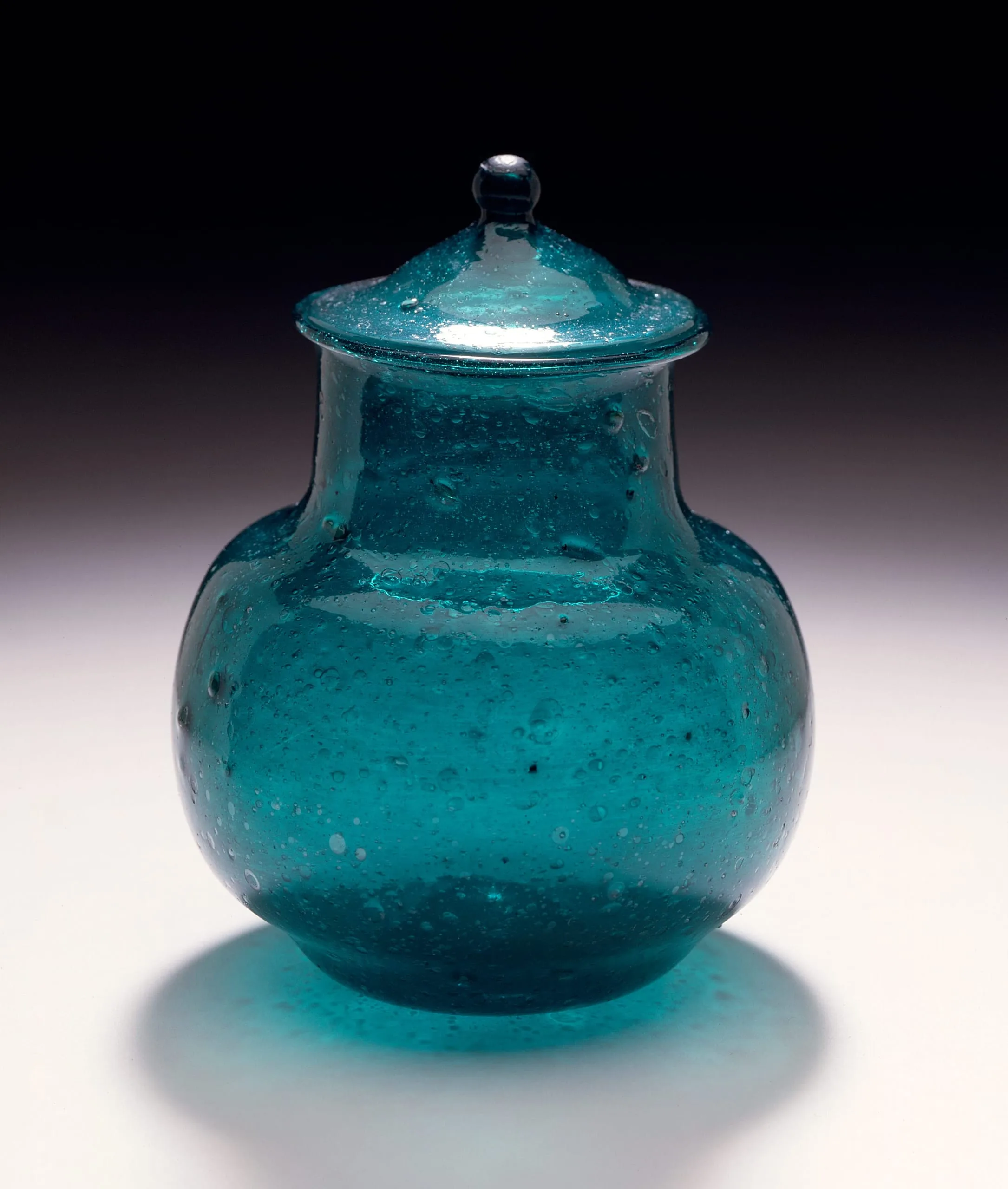
Large numbers of rich monochrome glass vessels were produced in the city kilns of Kapadwanj near Ahmedabad during the 17th through early 19th centuries. The most common colors are peacock blue, dark blue, and deep green, with amber, violet, and wine red also featured. Kapadwanj glass is characteristically opaque or translucent with noticeable impurities. Elegant and graceful forms distinguish Kapadwanj glass, with rosewater sprinklers, wine cups, water tumblers, and spouted pouring vessels being the most popular. The glass vessels typically derive their shapes from forms found in earlier Timurid and Mughal metalware and hardstone carving. Extensive glass production continued at the site until the early 19th century when technically superior English lead glass began to be favored in the Indian marketplace.
LACMA has ten Kapadwanj glass vessels (M.89.83.1a-b–.10). Five are dark blue, four peacock blue, and one amber. The peacock blue lidded jar illustrated here resembles the covered tankards of 15th-century Iranian metalware. The remaining vessels include four water jars, two pouring vessels (a dark blue urn with a long S-curved spout and a peacock blue lidded teapot), a dark blue teacup and saucer, and two container vessels (a small peacock blue flask with a stout neck reminiscent of unguent vessels found throughout the ancient world, and a dark blue rosewater sprinkler with a tall ribbed neck used in religious and domestic ceremonies in the Middle East and India).