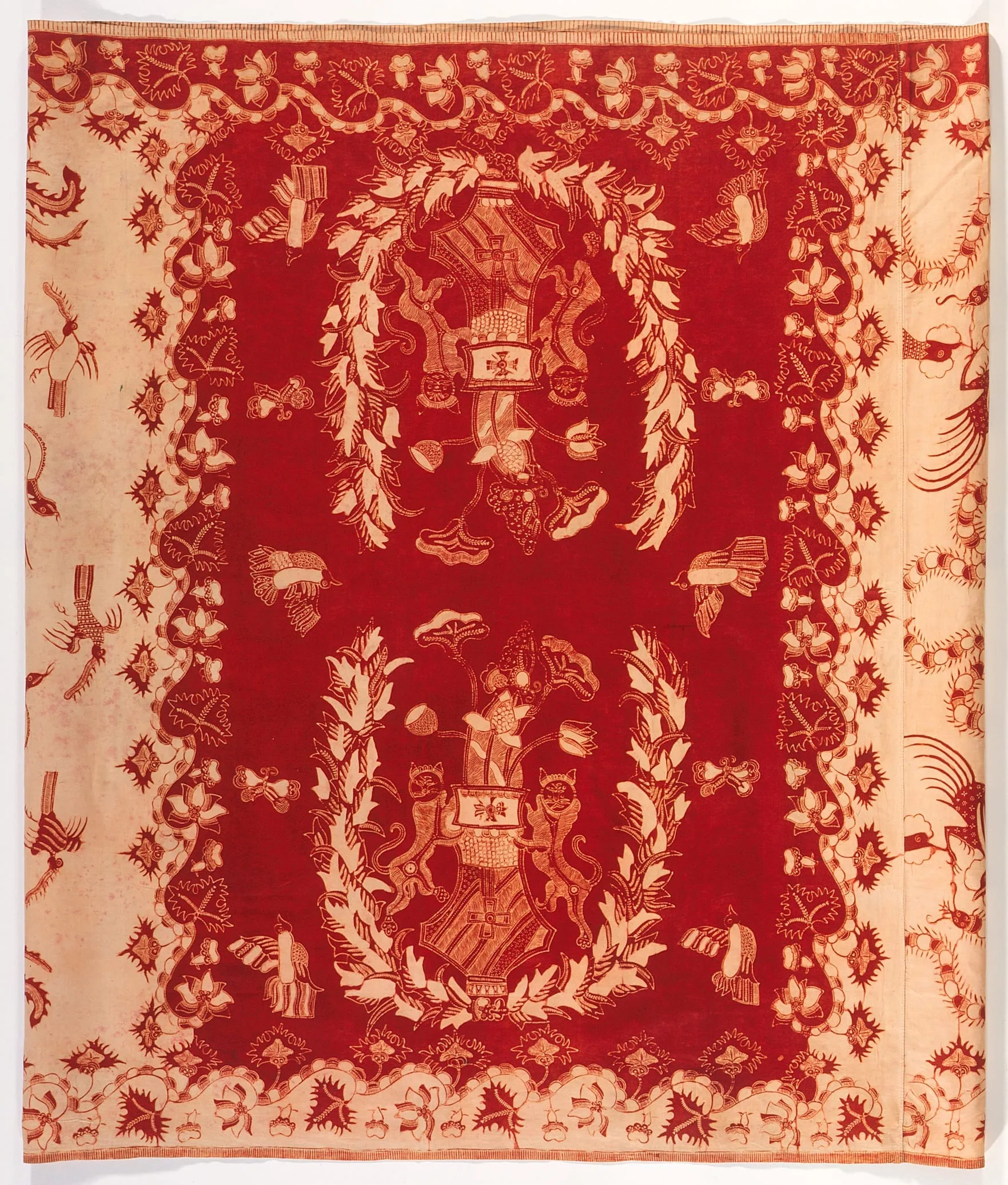
Hip wrapper, m.91.184.76
Overview
Excerpted from Herina, Rens, and Harmen C. Veldhuisen. Fabric of Enchantment: Batik from the North Coast of Java. Los Angeles: Los Angeles County Museum of Art; New York: Weatherhill, Inc., 1996, Catalogue no. 20.
The horizontally mirrored halves of this tubular sarung’s badan teem with amphibians, birds, and other creatures, captured in lively poses. The kepala, once more with papan replaced by a border motif, is decorated with a coat-of-arms, similarly mirrored, with peculiar elements due perhaps to the unfamiliarity of the subject to the woman who drew the design. The escutcheon has become a vase of lotus flowers, embellished with a cross that resembles a medal. Like the Dutch coat-of-arms, it is supported by rampant lions that here look more like cats with swishing tails. The image is enclosed by an acanthus wreath. The asymmetrical borders are based on traditional Pasisir floral motifs, which have been combined into a lacy design in Indo-European style. The bang-bangan color scheme is reversed on the kepala.
Maker
From the hybrid character of the design we may deduce that the batik was made by a Peranakan entrepreneur in Batavia, some of whom combined stylistic aspects from several batik centers. In this case the bow borders are in the Indo-European style of Pekalongan, while the row of upright leaves are known from batiks of Catharina van Oosterom, who worked first in Semarang and later in Banyumas. She also depicted many different animals in her badan,1 which she copied from Dutch illustrations. In contrast, the animals on this batik were chosen for their Javanese symbolic meanings.
Wearer
The motifs of this interesting cloth are depicted in Europeanized style and combined with Peranakan and Pasisir elements. The cloth seems to depict a confrontational universe, not only among predators and their prey—the peacock and the worm, the snake and the bird—but also intraspecies—the gamecocks. The chickens alone move freely, being the only species that are reputedly immune to snake venom.2 Apotropaic and medicinal powers are represented by the centipede and turtle. This powerful cloth may have been worn by a male of mixed descent who had overcome many of life’s difficulties.3 The fanciful coat-of-arms evokes the crests found in the four corners of Indian export textiles and on the carriage doors of Batavia’s wealthy citizens. Many Europeans, the black sheep of aristocratic families as well as those of lowly birth, passed themselves off as aristocratic scions once they had made good.
Notes
1. H. C. Veldhuisen, Batik Belanda 1840–1940 (Jakarta: Gaya Favorit, 1993), no. 21.
2. Inger McCabe Elliott, Batik: Fabled Cloth of Java (New York: Clarkson N. Potter, 1984), 159.