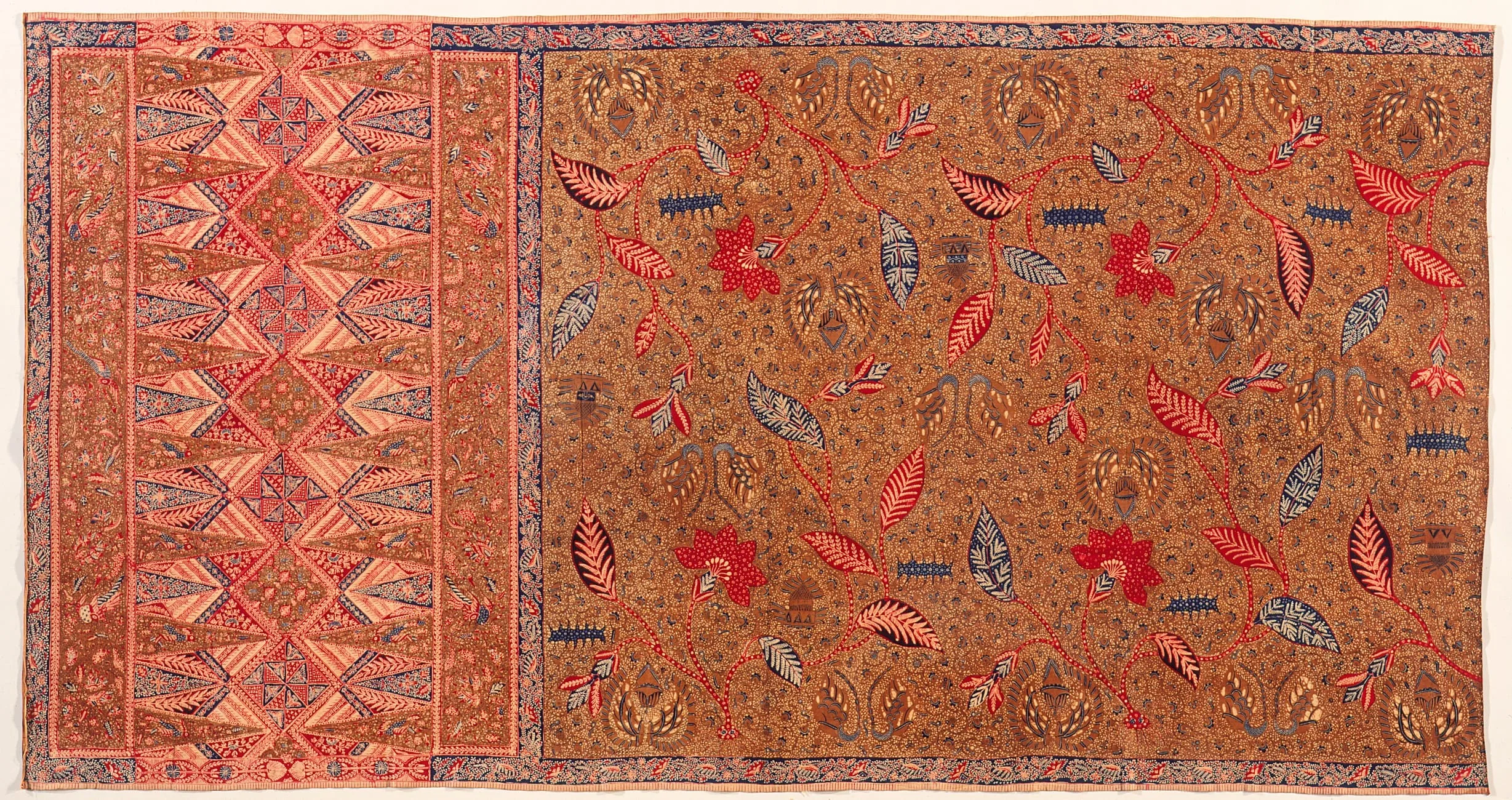
Hip wrapper, m.91.184.85
Overview
Excerpted from Herina, Rens, and Harmen C. Veldhuisen. Fabric of Enchantment: Batik from the North Coast of Java. Los Angeles: Los Angeles County Museum of Art; New York: Weatherhill, Inc., 1996, Catalogue no. 13.
The upper layer of this tiga negeri textile consists of two sets of flowering trees in Lasem red and Kudus blue, one set somewhat smaller than the other. Their roots grow in clumps of rocky soil. (Two branches intrude from one edge, suggesting a continuation of the pattern.) The secondary central Javanese semen motif is itself made up of three layers: the large, double wings (sawat), an exuberantly meandering creeper, and a tangle of tiny tendrils (ukel). The kepala gigi balang in the Peranakan style is predominantly red on brown with blue and white accents and a background of ukel. The borders are decorated in typical Kudus style: scintillating white accents on bright blue. An obvious discrepancy exists between the bold and quickly drawn Pasisir styles and the minutely executed central Javanese work, especially noticeable in the filler motifs.
Maker
This tiga negeri shows how difficult it is to work on one batik in three batik centers. The first of three Peranakan entrepreneurs established the basic pattern of flowering trees in red (hardly discernible because the traditional central Javanese secondary motifs dominate). The final entrepreneur, in Surakarta, had significant freedom to apply his background motifs in both brown and blue.
Wearer
The semen motif, originally restricted to members of the Surakarta court, was adapted for wear by outsiders. A cloth such as this, intended for an affluent, ¬middle-aged Peranakan client, would have indicated she was part of a family ¬network with branches across Java. This elaborate and most expensive of styles would have engendered pride of ownership in later hands.