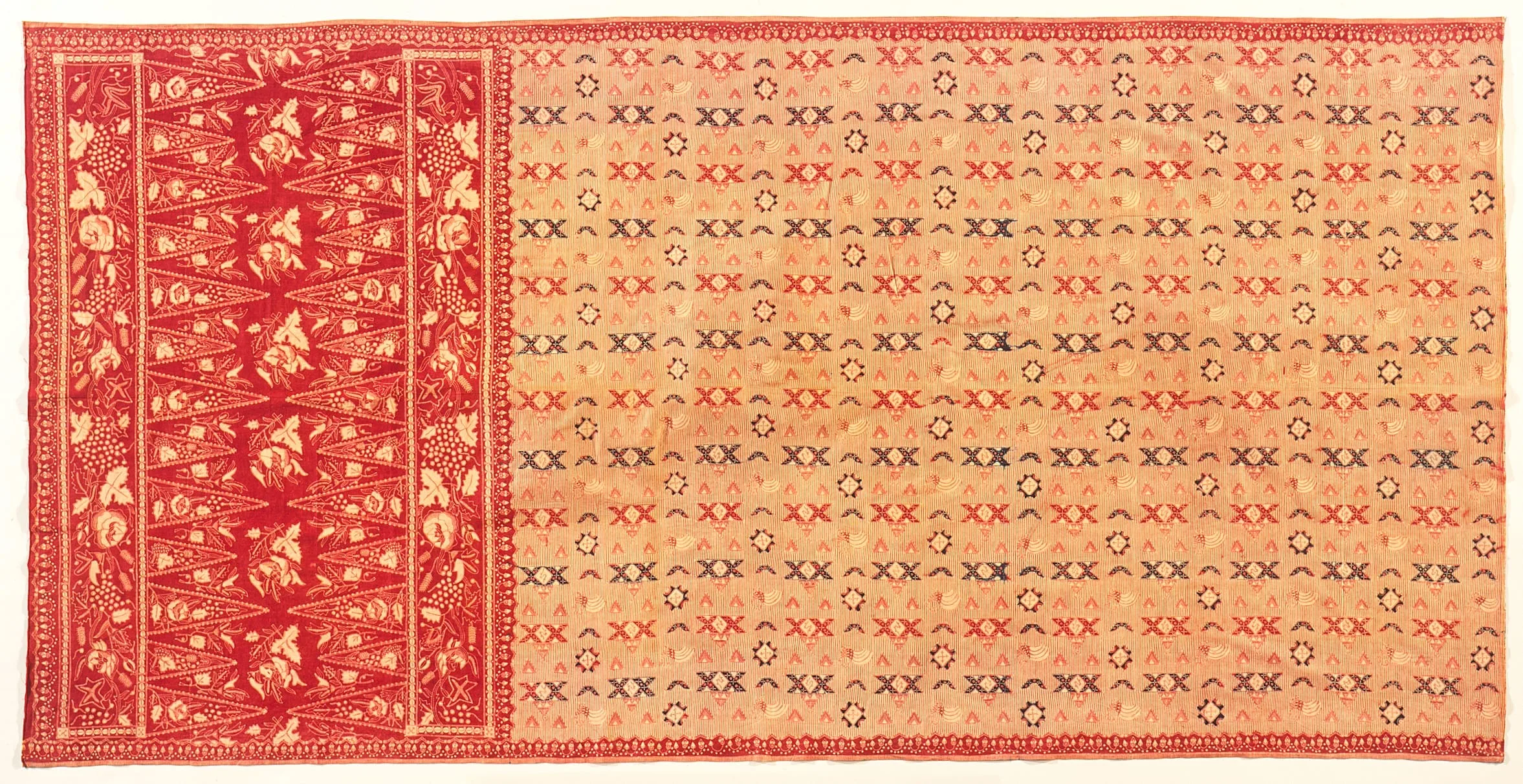
Hip wrapper, m.91.184.22
Overview
Excerpted from Herina, Rens, and Harmen C. Veldhuisen. Fabric of Enchantment: Batik from the North Coast of Java. Los Angeles: Los Angeles County Museum of Art; New York: Weatherhill, Inc., 1996, Catalogue no. 19.
An interesting combination of Pasisir, Indo-European, and central Javanese elements marks this cloth. The badan is adorned with a variation upon a traditional motif from Banyumas,1 known as ayam puger and consisting of a series of abstracted and naturalistic elements, including small chickens, double crosses, and stylized flowers, arranged in geometric precision on a background of very fine diagonal lines (galaran). The kepala is ¬ executed in the color style of Semarang and shows combined traditional Pasisir and Indo-European motifs. Rice stalks (often found on batik from Batavia), budding roses, and grapes on the vine fill the papan and the central area between the rows of triangles. Roses and grapes were well known in Batavia. White scallops delineate the triangles. A small, lacy border in Indo-European style, edged by a tiny seret, surrounds the cloth on three sides. The gandawari motifs bordering the kepala in earlier cloths have disappeared, a development that early on was encountered on cloths made in Batavia. The color is red with a few blue accents in the badan, an adaption of Pasisir bang biru, but the overall impression is that of a predominantly red and white (bang-bangan) cloth.
Maker
Because Batavia did not have a local batik tradition, we can detect influences introduced by entrepreneurs from north coast centers who settled in Batavia. Possibly the Peranakan entrepreneur who made this cloth came from Semarang, where he had already made sarung with kepala in the Indo-European style for his European and Indo-European clientele. He then may have repeated the style for his clientele in Batavia. The pattern in the badan is known from batik Banyumas and was also executed by Indo-European entrepreneurs in Pekalongan. Around 1880 A. J. F. Jans depicted the same pattern on a sarung but in the Banyumas ¬ colors: blue and brown.2 The imitation lace border on both selvages occurs in sarung from Batavia and differs from those used elsewhere.
Batiks with a fine galaran were among the most expensive. The time-consuming work was done by the best makers, often added to order on a finished batik without a background motif. In big workshops where both hand-drawn and stamped batiks were made, backgrounds were sometimes stamped. This could be done with intricate motifs but seldom with galaran because the breaking point of the lines was impossible to conceal.
Wearer
This cloth was probably meant for a marriageable girl of mixed European-Javanese descent, who, like a chicken in a coop (ayam puger), was confined inside the walls of her father’s compound. This ¬ custom was widely followed among affluent families as late as the early twentieth century.3
Notes
1. Nian S. Djumena, Batik dan Mitra; Batik and Its Kind (bilingual) (Jakarta: Penerbit Djambatan, 1990), 16.
2. H. C. Veldhuisen, Batik Belanda 1840–1940 (Jakarta: Gaya Favorit, 1993), no. 37.
3. Kartini, Brieven aan Mevrouw Abendanon-Mandri, ed. F. G. P. Jacquet (Dordrecht: Foris, 1987).