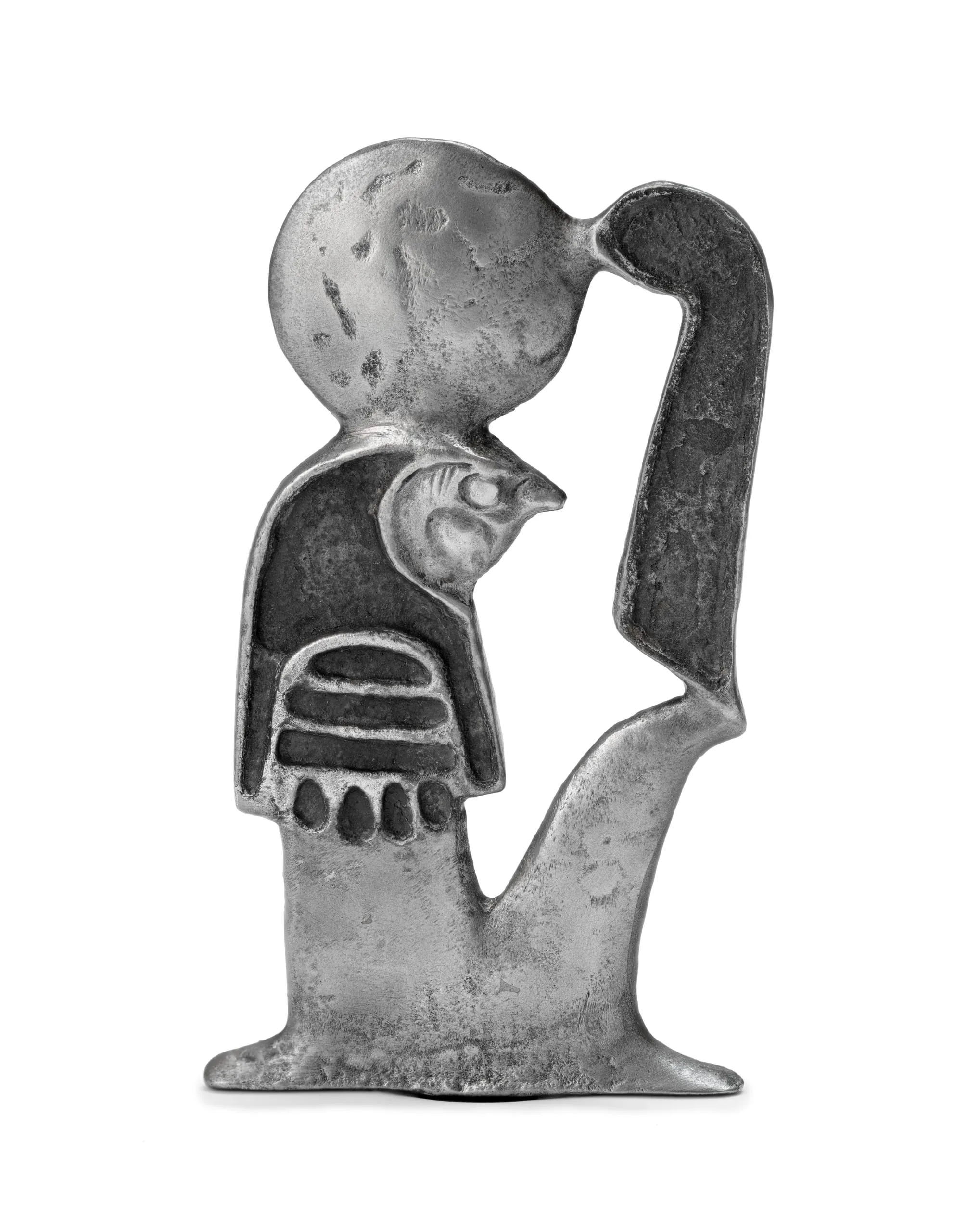
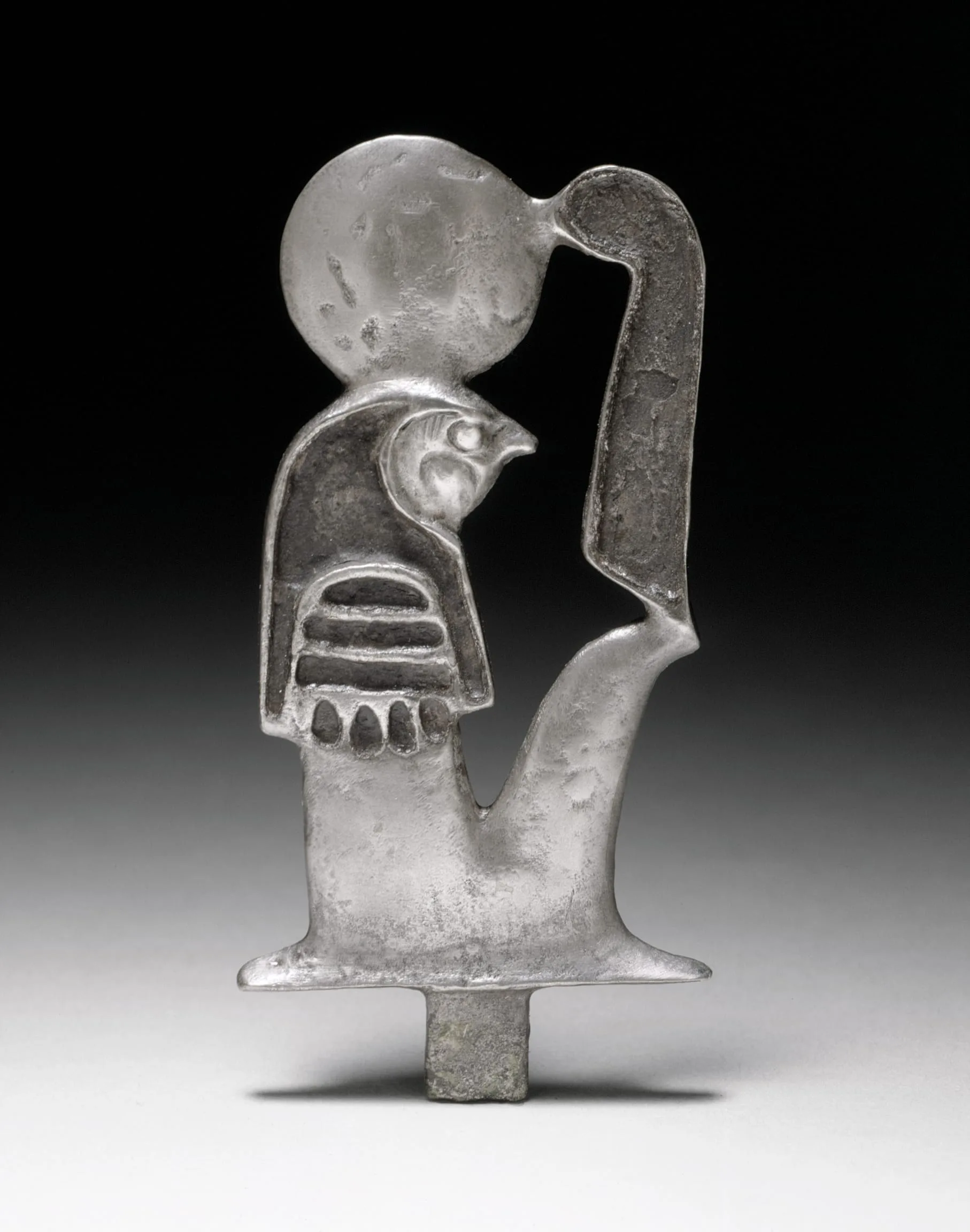
Re the sun god, the supreme Egyptian deity, was often represented as a falcon-headed human wearing a sun disk topped with a cobra. Here, his sun disk is plain. The small silver figure sits in a human posture holding a feather, the emblem of Ma’at, goddess of truth and cosmic harmony, reinforcing Re’s irrefutable authority. The piece has a tang for insertion into a base and a worn suspension loop at the back. Recesses in the hairdo, collar, and feather likely held inlays. A royal stamp seal from the 26th Dynasty reign of Amasis II (570−526 BCE) bears a similar image of Re and is attached by its tang to a bronze base bearing the incised cartouche of the king. Re was closely linked to the notion of kingship; while the king ruled the earth, Re controlled the wider universe. From the Old Kingdom onward, the king was identified in texts as the “son of Re,” defining the relationship and permanently linking Re to the stability and invulnerability of the kingship.
In Egyptian cosmology, Re created the world and formed the pantheon of Egyptian gods known as the Ennead. He first made Shu and Tefnut, the original divine pair, who were the embodiment of air and moisture. They created Geb and Nut, earth and sky, who bore other divine couples—Osiris and Isis, Seth and Nephthys. Ancient Egyptians monitored the daily course of the sun, believing that its regularity was fundamental to life, and that deceased individuals traveled with Re nightly in his solar barque as he followed the nocturnal course of the sun. Like the god Horus, the creator god Re was often merged with other deities to form composite gods such as Amun-Re.