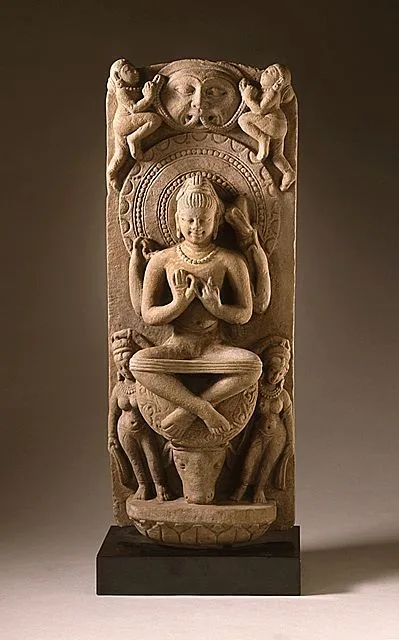
Lakulisha (Lord of the Club) was a Gujarati Shaiva sage (circa 200 CE) who is regarded as Shiva’s 28th avatar and the chief preceptor of Pashupata Shaivism. His four ascetic disciples, Kushika, Garga, Mitra, and Kaurushya or Kanrushya, are believed to have reestablished the Shaiva cult of Pashupati (Lord of the Animals).
Here, Lakulisha has an ascetic’s piled hair (jata mukuta) and a large circular nimbus (shirashchakra). He is four-armed. His principal hands are held in the teaching gesture of Turning the Wheel of the Law (dharmachakra mudra or dharmachakra-pravartana mudra). His upper right hand holds a rosary (akshmala), while his upper left hand carries his club (lakuta or laguda). He is seated on a lotus base above the head of his bull mount, Nandi. His legs are crossed at the ankles, and he wears a meditation band (yoga patta) around his knees. He is conventionally portrayed as ithyphallic (urdhva linga), symbolizing the generative energy of the universe, but here his member may be atypically covered by his garment. Two celestial garland bearers (maladharas) fly above the god holding the end of jeweled garlands being spewed by an apotropaic "Face of Glory" (kirttimukha) at the apex of the relief. He is accompanied by two female attendants each carrying a scarf in one hand and, with the other hand, adjusting their elaborate pearl-decked hair buns (kesa-bandha).
Comparable images of Lakulisha are in the Odisha State Museum, Bhubaneshwar, and perhaps in the British Museum, London (1968,1216.2). For a Lakulisha attributed to Madhya Pradesh, 8th century, see Pratapaditya Pal, The Sensuous Immortals: A Selection of Sculptures from the Pan-Asian Collection (Los Angeles: LACMA, 1977), pp. 75-76, no. 42.