Hip wrapper, m.91.184.24
Overview
Excerpted from Herina, Rens, and Harmen C. Veldhuisen. Fabric of Enchantment: Batik from the North Coast of Java. Los Angeles: Los Angeles County Museum of Art; New York: Weatherhill, Inc., 1996, Catalogue no. 10.
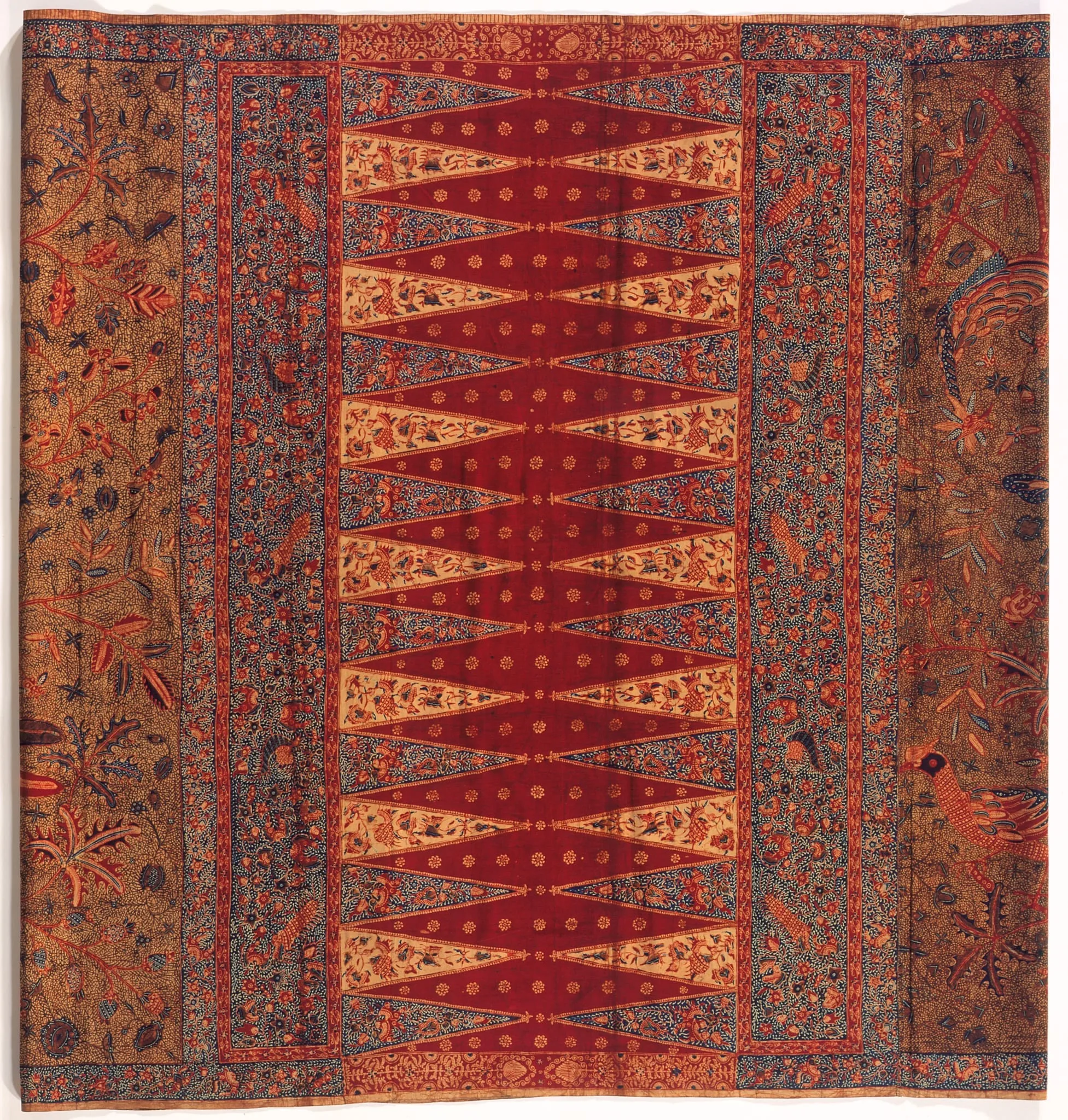
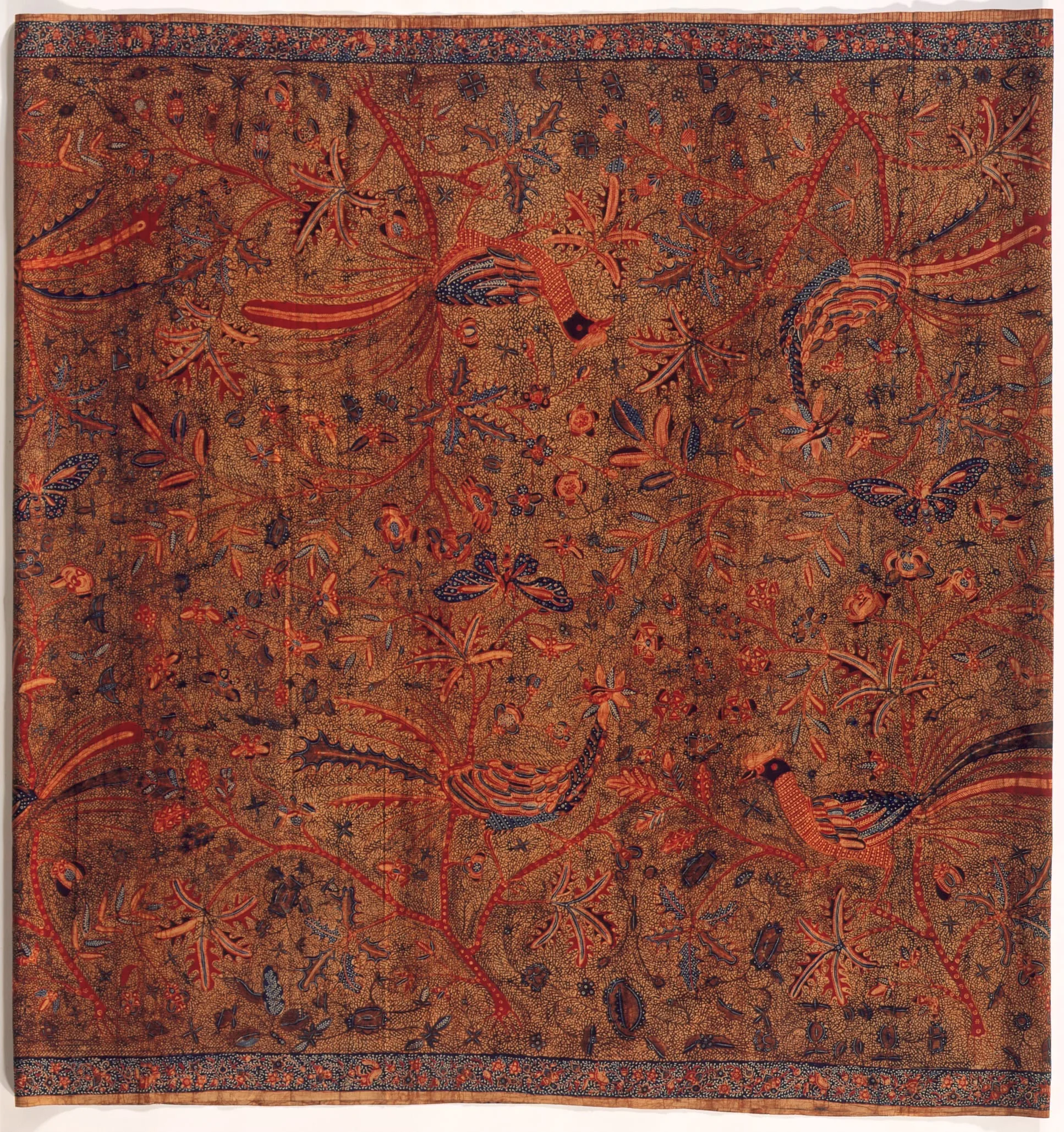
This elaborate batik, executed on heavy cotton cloth imported from England, is an early example of the tiga negeri style. The name tiga negeri (three regions) indicates that three different batik centers, in this case all on the north coast, contributed to its completion; the design and color styles fuse into a singularly prestigious batik. The cloth retains its tubular form, sewn together close to the kepala, where the seam would be invisible when the cloth was folded and worn. Six large birds with long tails perch clumsily on the branches of small, flowering trees, which owe a remote debt to Indian palempore. Butterflies, their wings outspread, flutter among the profuse vegetation, the effect of which is intensified by a background layer of reddish-brown, finely drawn tendrils (ungkeran). At first sight the main motifs appear to mirror each other along an imaginary horizontal line. An interesting vertical balance is attained by the arrangement of the male and female birds. Crested, seated males alternate with standing females, whose heads have turned into flowers. The kepala, with starflowers on a red ground formed by rows of opposing triangles, is in the traditional style, as is the papan, with its centipedes, fruit bats, and birds among small flowers. The symmetrical borders are edged with a plain upper and a finely striped lower selvage border (seret).
The complex use of color forms the main attraction of this batik. The deep orangy red is characteristic of batik made in Semarang; the golden sheen of the background soga differs from the more subdued tones produced in central Java. The borders show vibrant white accents outlining the red flowers and birds on a bright blue ground.
Maker
The basic pattern of the badan and kepala in red on this Peranakan sarung was executed in Semarang; the filler motifs in blue were applied in Kudus; those in the background of the badan in light brown were added in Demak, although Surakarta in central Java was better known for such work (m.91.184.85).
Wearer
Worn primarily by affluent Peranakan matrons, a tiga negeri batik might also be among the gifts for a wedding. It was viewed as an excellent investment, as it remained in fashion for a considerable time. The tree of life appears in many guises throughout the archipelago and may here, in combination with the profuse vegetation, symbolize prosperity and abundance. The long-tailed birds represent a variety of species: to the Javanese, the bird of paradise; to the Chinese and Peranakan, the pheasant, which represents beauty, good fortune, and the high status of the most honorable. It is further associated with the phoenix. Its Chinese name, feng huang, referring to both the male and female of the mythical species, bears the connotation of sexual pairing, which is particularly apt in this context.1 The female bird’s head transmuted into a flower is an instance of the Islamic notion discouraging the recognizable depiction of living beings. It later was adopted as part of the Pasisir design vocabulary. The link between women and flowers is, furthermore, a common concept throughout the archipelago.
Note
1. C. A. S. Williams, Outlines of Chinese Symbolism and Art Motives, 3d ed. (New York: Dover, 1976), 323–25.