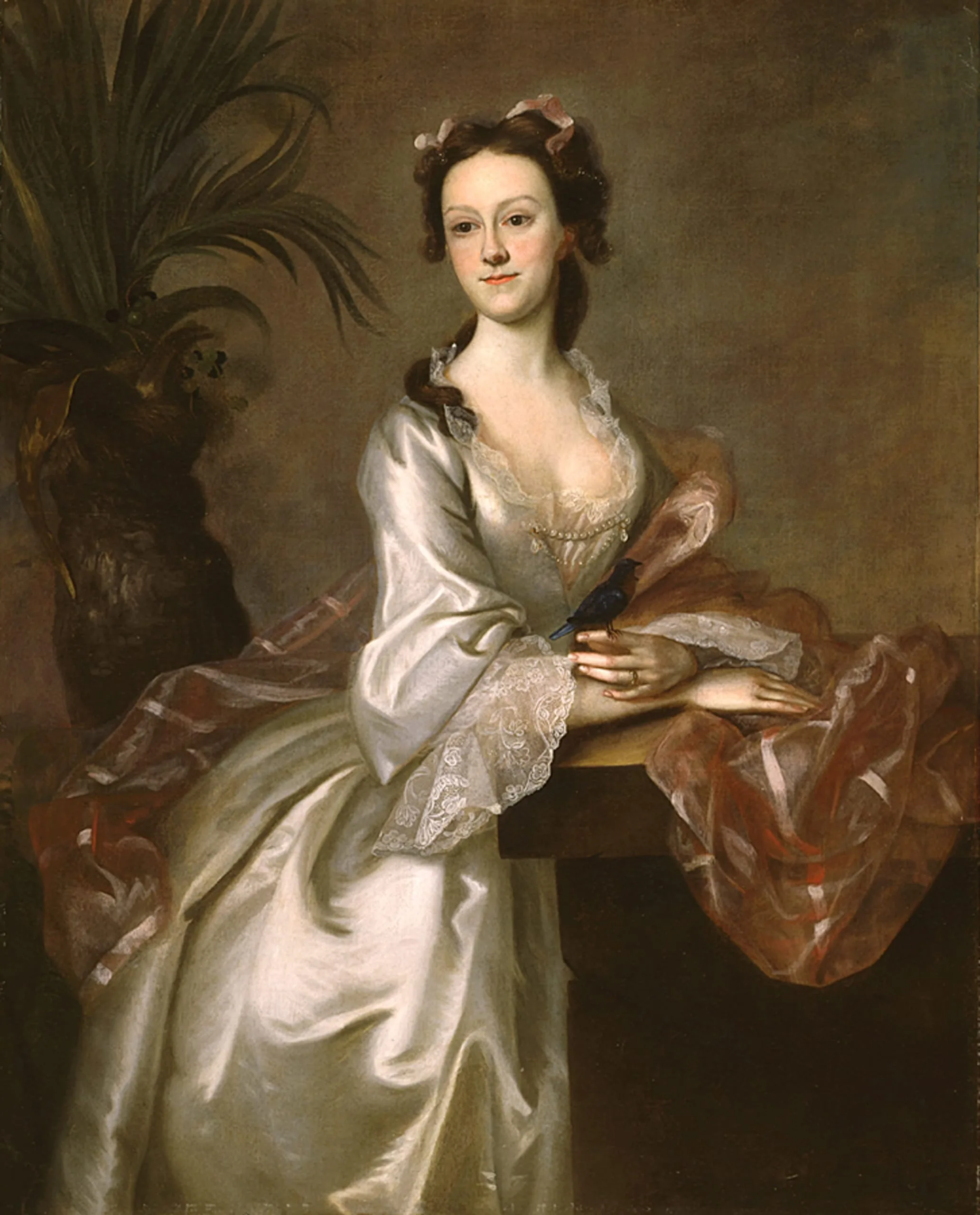
Despite her full, lustrous gown, elaborate lace panels, and diaphanous organza scarf, Fannie Pigott appears in a state of fashionable undress. Although women of the era ordinarily wore stomachers—decorated triangular panels that filled the front opening of a bodice or gown—here she is depicted wearing only a chemise and a strand of pearls. Her open neckline and roomy sleeves add to her loose but sumptuous attire, conveying her status and wealth. The painting itself, one of several portraits that English artist Joseph Blackburn executed of the Pigott family during a stay in Bermuda in 1752−53, was also a luxury ware.
Fannie Pigott was the daughter of the governor of the British colony of Bermuda, and her husband, Captain John Pigott, was a customs collector there. (Blackburn’s companion portrait of John Pigott is also in LACMA’s collection; M.90.210.1.) The portrait connects her to styles of dress popular in Europe at the time, while also revealing the prominent position of her family in the political and economic governance of Bermuda, then one of the British Empire’s colonial outposts. References to Bermuda include the local palmetto plant, which provided the raw material for exports like bonnets and baskets, and the Bermuda bluebird on Pigott’s finger, which at the time was believed to be native to the island. By painting Fannie Pigott in the trappings of the British elite with Bermudian flora and fauna, Blackburn draws a clear connection between the empire’s affluence and its colonization and exploitation of faraway lands.
Selected Bibliography
Colman, Benjamin W. “Joseph Blackburn: A British Portrait Painter in the Atlantic World.” Bulletin of the Detroit Institute of Arts 98, no. 1 (2024): 64–75. https://doi.org/10.1086/734046.
Edwards, Lydia. How to Read a Dress: A Guide to Changing Fashion from the 16th to the 20th Century. Bloomsbury Academic, 2017.
Van Horn, Jennifer. The Power of Objects in Eighteenth-Century British America. University of North Carolina Press for the Omohundro Institute of Early American History and Culture, 2017.