- Title
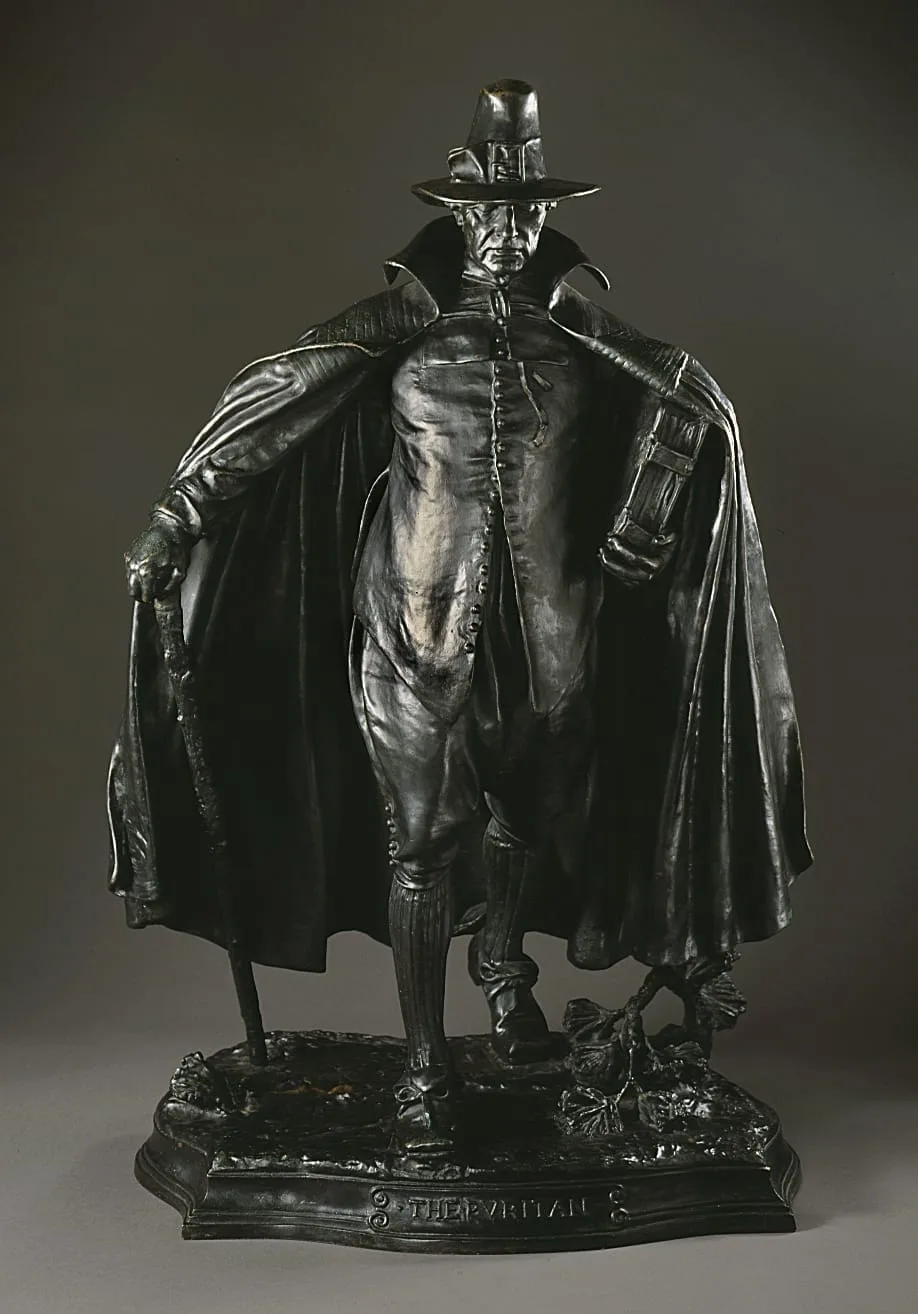
- The Puritan (Deacon Samuel Chapin)
- Date Made
- 1899
- Medium
- Bronze with dark green patina
- Dimensions
- 31 x 20 1/2 x 12 3/4 in. (78.7 x 52.1 x 32.4 cm)
- Accession Number
- M.91.74
- Curatorial Notes
This figure was originally created as a statue in honor of Deacon Samuel Chapin (1595-1675), one of the founders of Springfield, Massachusetts. Unveiled in 1887, the monument immediately confirmed Saint-Gaudens’ reputation as the leading American sculptor of his day. Saint-Gaudens was one of several American artists who in the 1890s began to have their large public sculptures made in reduced size for broader distribution. The Chapin figure was cast in a thirty-inch format and, under the title The Puritan, became one of America’s most popular bronzes at the turn of the century. The museum cast was produced by the short-lived New York foundry Aubry Brothers and Company around 1904.
Dressed in seventeenth-century colonial attire, the deacon carries a large Bible in his left hand and a walking stick in his right. The details of his face were modeled after one of his descendants, but Saint-Gaudens went beyond mere portraiture. The figure’s stern visage and assertive stance convey his political and spiritual authority and suggest the determination of the Puritans who left their homeland in search of religious freedom. The figure is also cloaked in mystery: the shadows cast by the broad-brimmed hat and the heavy cape create an aura of introspection. In transcending the literalism of most sculpture of the time, The Puritan reflects a more general questioning of materialism at the close of the nineteenth century.
- Provenance
[Steve Newman Fine Arts, sold 1991 to]; LACMA.
- Selected Bibliography
- Los Angeles County Museum of Art Members' Calendar 1991. vol. 28-29, no. 12-1 (December, 1990-January, 1992).
- Coleman, Rhoda. "Teaching About Religion through the Visual Arts." Social Studies Review: Journal for the California Council for the Social Studies 40 (2): 44 (Spring/Summer 2001).