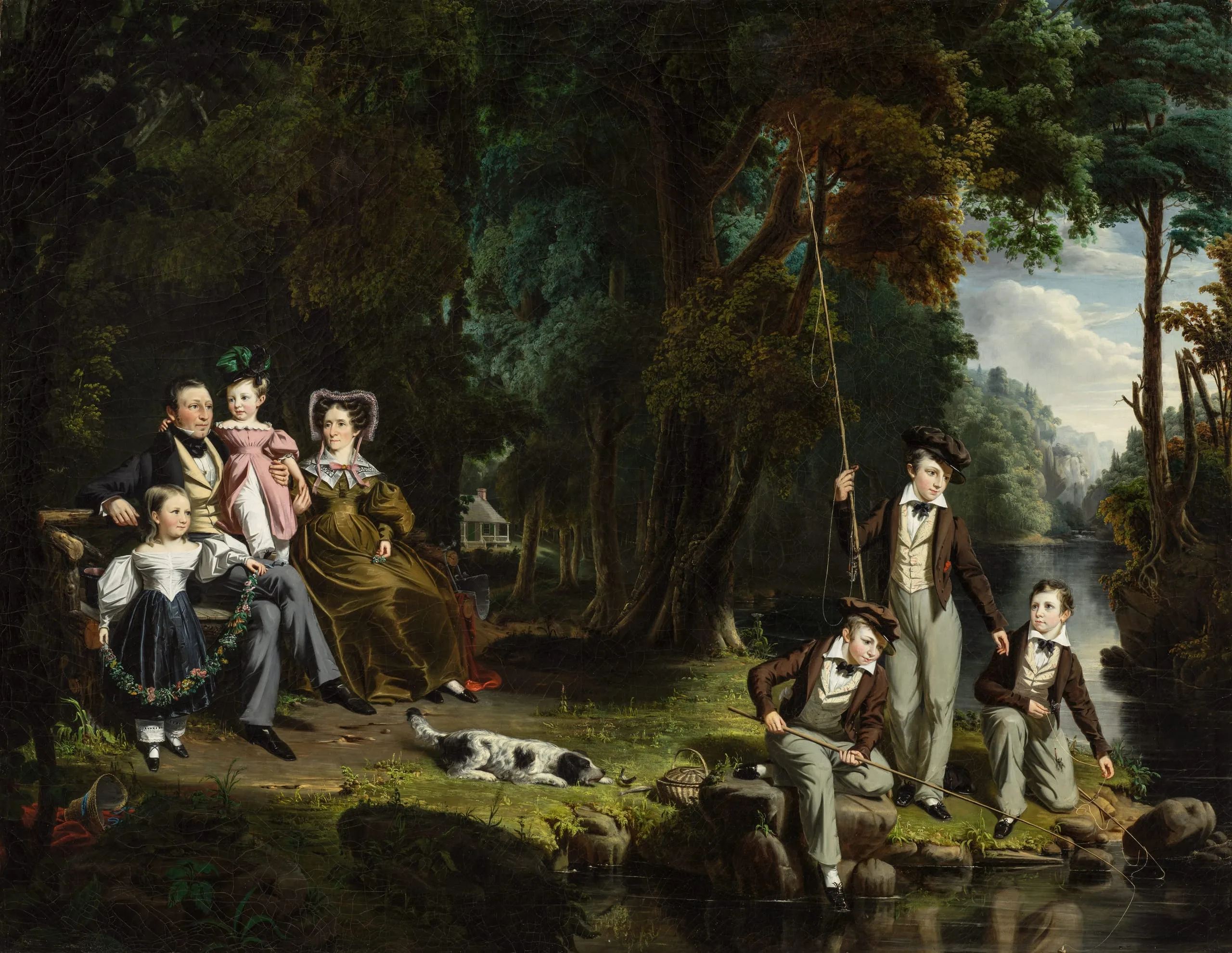
William R. Hamilton’s Alexander Masterton and His Wife and Children is a charming and rare example of the conversation piece in early American art. Most fully developed in 18th-century Britain, the conversation piece was a specific type of group portrait that usually depicted a family involved in some everyday activity. The Museum’s conversation piece is unusual for its large scale and the incorporation of landscape and genre painting into portraiture. Its presence in the 19 th-century American art gallery adds a new dimension to the Museum’s collection. When the Scottish-born William Hamilton arrived in this country in the early 1830s, he brought with him this tradition and used it to demonstrate his talent at the annual exhibitions of the National Academy of Design. His 1833 exhibits included an elaborate group portrait of the James Wotherspoon family; so impressive was the painting that Hamilton was elected an Associate member of the esteemed institution – a great honor for someone new to the New York art scene.
The dearth of conversation pieces in American art is surprising since such family portraits reflected the mores of the rising middle class. The majority of the country’s artists until Hamilton ’s era created modest bus-and half-length depictions of single figures. Due to the expense full-length portraits were primarily the domain of public, commemorative commissions, while group portraits often appealed to private patrons, who were usually wealthy and prominent men.
Alexander Masterton accumulated a fortune as one of the country’s major architect-builders, responsible for the construction of the Bank of the United States , the New York Customs House, and many other important public and private buildings in the Greek Revival style. His marble-quarrying firm was so successful that he could afford to buy a country home in Bronxville and to commission this elaborate portrait, two major status symbols of the period. Masterton may have actually brought Hamilton to this country, for he, like the artist and most of Hamilton ’s other sitters, was Scottish-born.
Hamilton ’s group portraits were known for their outdoor locales and inclusion of picturesque detail. Prior to Hamilton ’s arrival, only Ralph Earl, working in late 18th-century Connecticut, repeatedly incorporated landscapes into his portraits. The setting of the Museum’s painting may have been Masterton’s Bronxville estate, for the portrait remained there with the family until the mid-1980s. Hamilton presented the Masterton family dressed in their Sunday best, enjoying simple country pleasures: the two youngest children remain under the protection of their parents, while the older sons fish, and the family dog takes a nap. The verdant green foliage, garland of flowers, and spacious forest glade all suggest a comfortable life of prosperity and leisure.
Ilene Susan Fort. “Recent Acquisition.” At The Museum 31 (March 1993): 12.