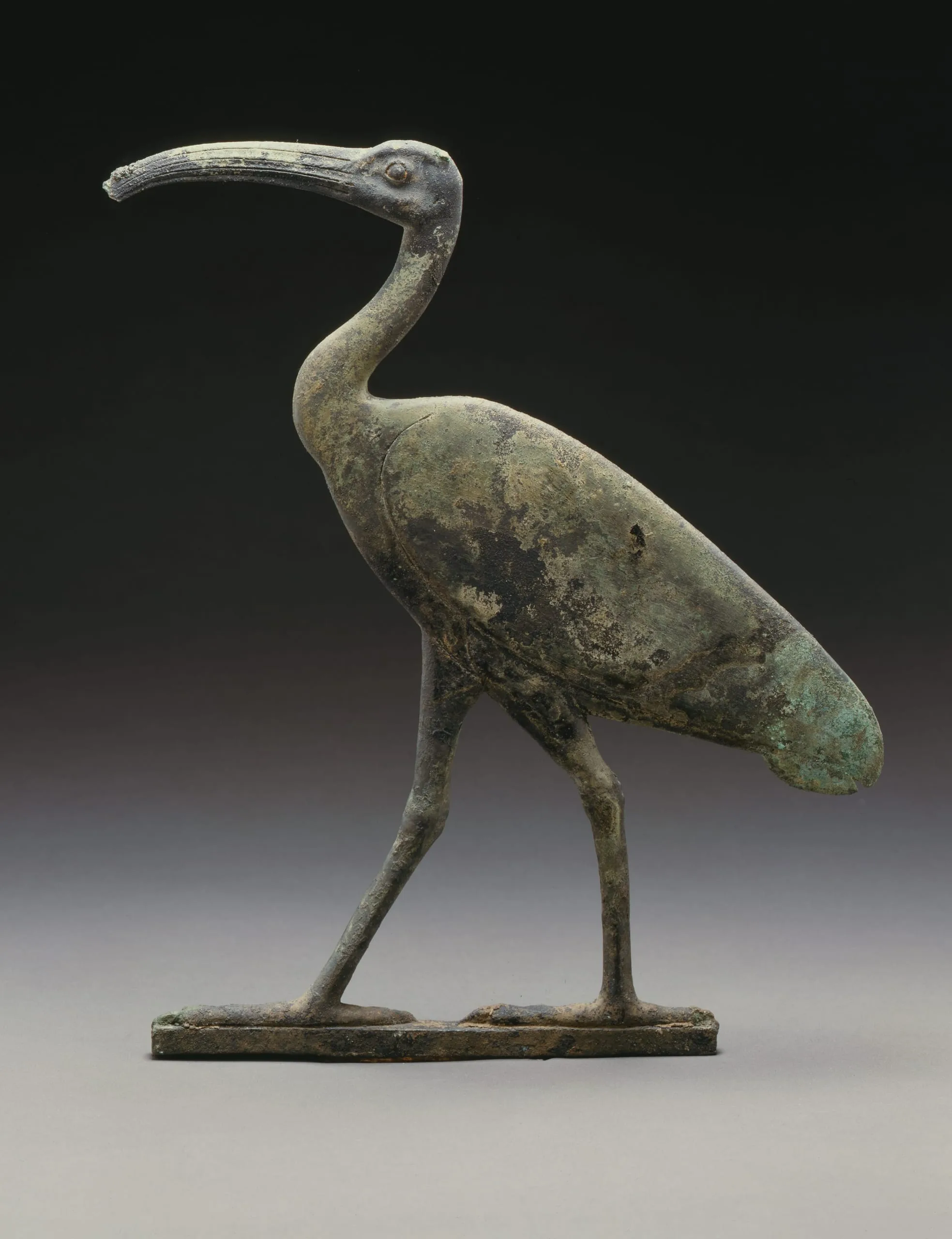
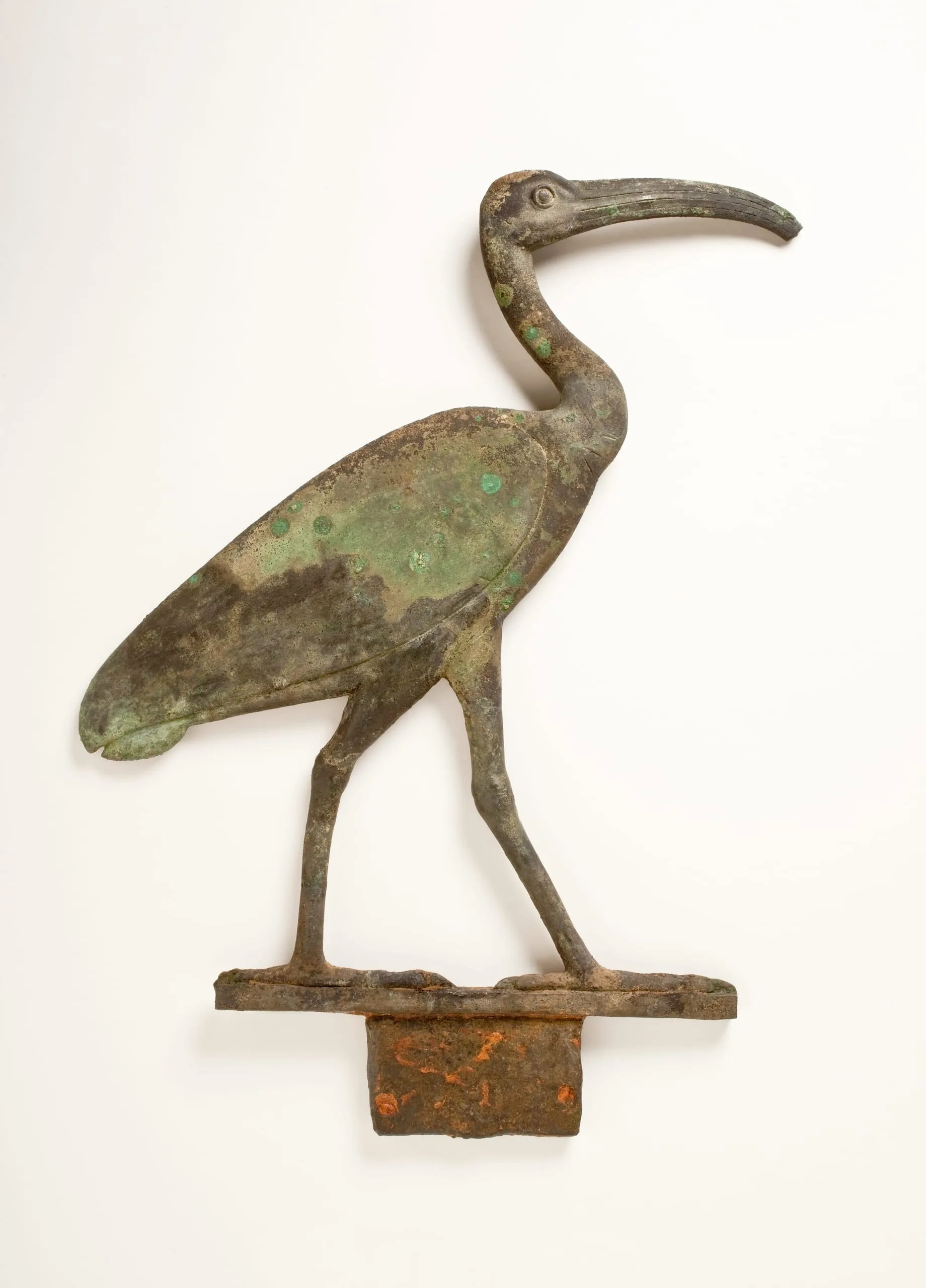
Thoth, the ancient Egyptian god of intelligence and writing, is elegantly depicted in this processional standard. Thoth was alternately portrayed as a baboon or an ibis. Following the unification of Upper and Lower Egypt around 2900 BCE, the country was divided into forty-two administrative districts (nomes), each represented by regional deities and their insignia. Ibis standards such as this one served as the emblem of the eastern Delta nome centered on the town of Hermopolis, which was Thoth’s main cult center. Despite its seeming flatness, this bronze standard was designed as a three-dimensional object. A curious detail is the rendering of the feet, which are shown in profile with only one toe of each foot extending forward. Rather than depict the actual splayed toes of an ibis, the artist produced a strong graphic image that could be clearly distinguished from a distance. Technical studies of the piece have revealed that it was lost-wax cast, and that the eyes were originally enlivened with sheet gold.
Nome standards are shown on a wide range of Egyptian objects, first appearing on Predynastic stone palettes. Later examples include the dramatic group statues of the 4th Dynasty pharaoh Menkaure in the Cairo Museum and the Museum of Fine Arts, Boston, which show the king accompanied by personifications of various nomes, identified by their standards. Scenes found on temple and tomb walls and on statues illustrate standards positioned before the pylon gateways of important buildings or placed around sacred shrines. As documented in Egyptian papyri, an integral part of many religious festivals was the transport of deity images or their insignia in public processions. These emblems also served to designate military divisions and are depicted in royal reliefs and private tomb paintings. Few actual standards have survived. It is possible that many were constructed of perishable materials, such as the gilded-wood hawk standard found in the tomb of Tutankhamun, and have not been preserved.