Astrology has been of paramount importance for Hindus since at least the time of the Rigveda (Knowledge of Hymns) composed in the second millennium BCE. Before undertaking any activity, journey, or ritual, individuals should first consult professional astrologers to take the planetary conjunctions into consideration and thus avoid any inauspicious influences. Consultations with astrologers regarding the birth of a prince or spiritual leader were often depicted in art, with representations ranging from Gandharan sculptures in the second century CE to similar scenes in Pahari paintings in the 18th-19th centuries. Astrological manuscripts and charts were produced by the scores throughout Southern Asia and the Himalayas (see M.72.75.1).
Ritual oil lamps have long been used in South Asia for Hindu and Buddhist religious ceremonies and social rites for weddings, birthdays, and death observances. They are typically made of brass and burn mustard oil in small burner dishes used to contain the oil and a floating wick. Nepalese figural oil lamps are often cast in the form of donors, such as two examples in the UCLA Fowler Museum of Cultural History, Los Angeles (X2001.11.101 and X2001.11.103). They can also be adorned with the deities invoked in the ritual (see M.2011.136).
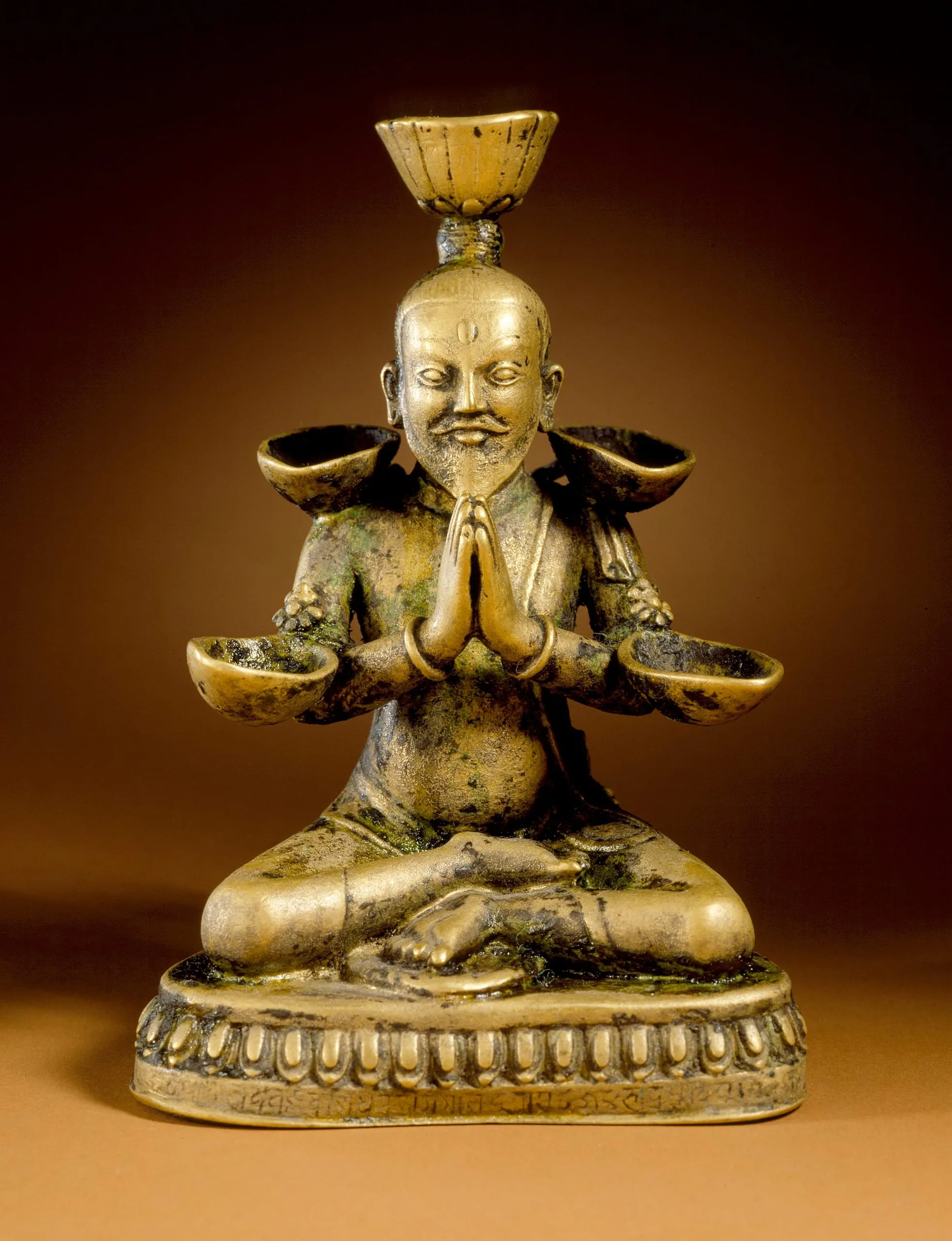
This figural oil lamp is in the rare form of an astrologer with burner dishes attached to his shoulders and elbows. Another burner dish fashioned as a lotiform vessel surmounts his head. The astrologer is represented as an ancient seer with a pointed beard, hair tied in a bun, and an elliptical forehead marking between the eyebrows (bindi or bindu) symbolizing the third-eye chakra (energy and meditation focal point) associated with inner wisdom (ajna chakra). He wears the Brahmanical sacred thread (yajñopavita) over his left shoulder, a dhoti, and flower armlets. His hands are held in the gesture of devotion (anjali mudra) and he sits in the lotus position (padma asana). A carrying handle is attached to the back of his shoulders and the top of the lotus base.
A donatory inscription in Newari is inscribed around the lotus base and on the sides of some of the burner dishes. Although much of it is illegible, the date can be read as, 1734 (Nepal samvat 854) in the bright half of Bhadra (August-September in the Nepali calendar). (Translation by Ian Alsop.)