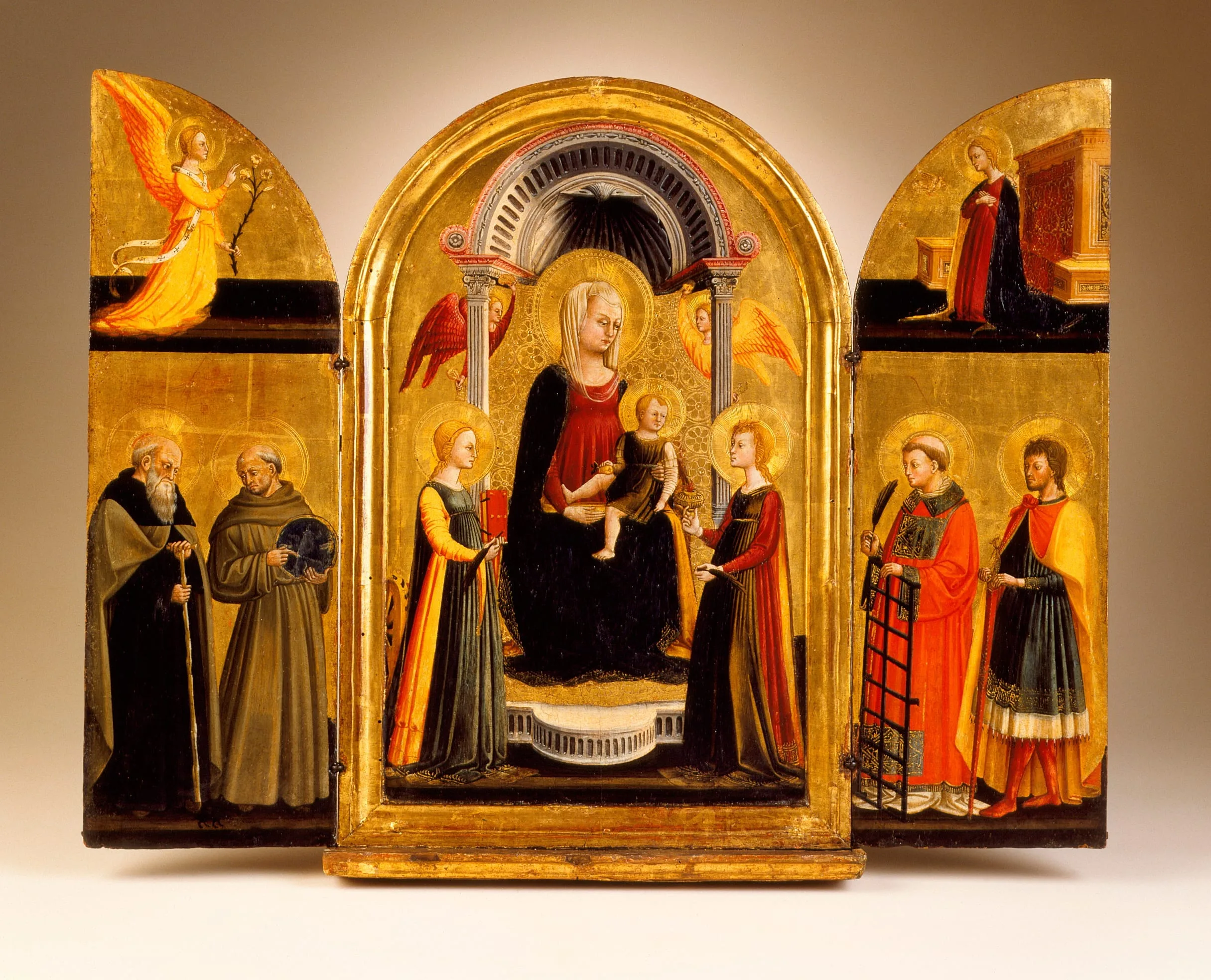
A notable shift in the design of religious altarpieces occurred during the fifteenth century. Instead of the traditional multipaneled structures known as triptychs and polyptychs, artists began creating scenes where the figures interacted within a single, unified space. In this early work, Neri di Bicci still employs the triptych format, but he utilizes the smooth texture of gold ground to emphasize a continuous and cohesive scene that spans all three panels. The even distribution of the flattened gold leaf is interrupted only by Neri’s intricate carving of the saints’ halos and the rosette patterns that surround the Madonna and Child, who are enclosed by an open architectural throne. This treatment of the gold ground is different from that of artists like Giovanni di Paolo (AC1996.139.1a-b), who punched patterns atop flanking saints to create the illusion of a pointed arch.
Descending from a successful family business, Neri di Bicci adeptly met the demand for religious commissions and operated a profitable workshop in Florence. His daily shop journal, or libro di ricordanze, covering the years 1453−75, provides extensive insights into all aspects of his business. It details the training of apprentices, collaborative work, the commissioning process, contracts, evaluations, costs and payments, materials and techniques, and subject matter. The journal reveals that Neri produced several hundred small devotional paintings during his career, including noncommissioned domestic altarpieces marketed to merchants in Florence or Rome. However, a small altarpiece featuring six saints, such as this triptych, would have been a specific commission from a patron who venerated those particular saints. Its compact size allowed for easy portability, enabling its owner to carry it on journeys for private devotion, with hinged doors that fold inward, providing protection for the sacred scene.
2024