- Title
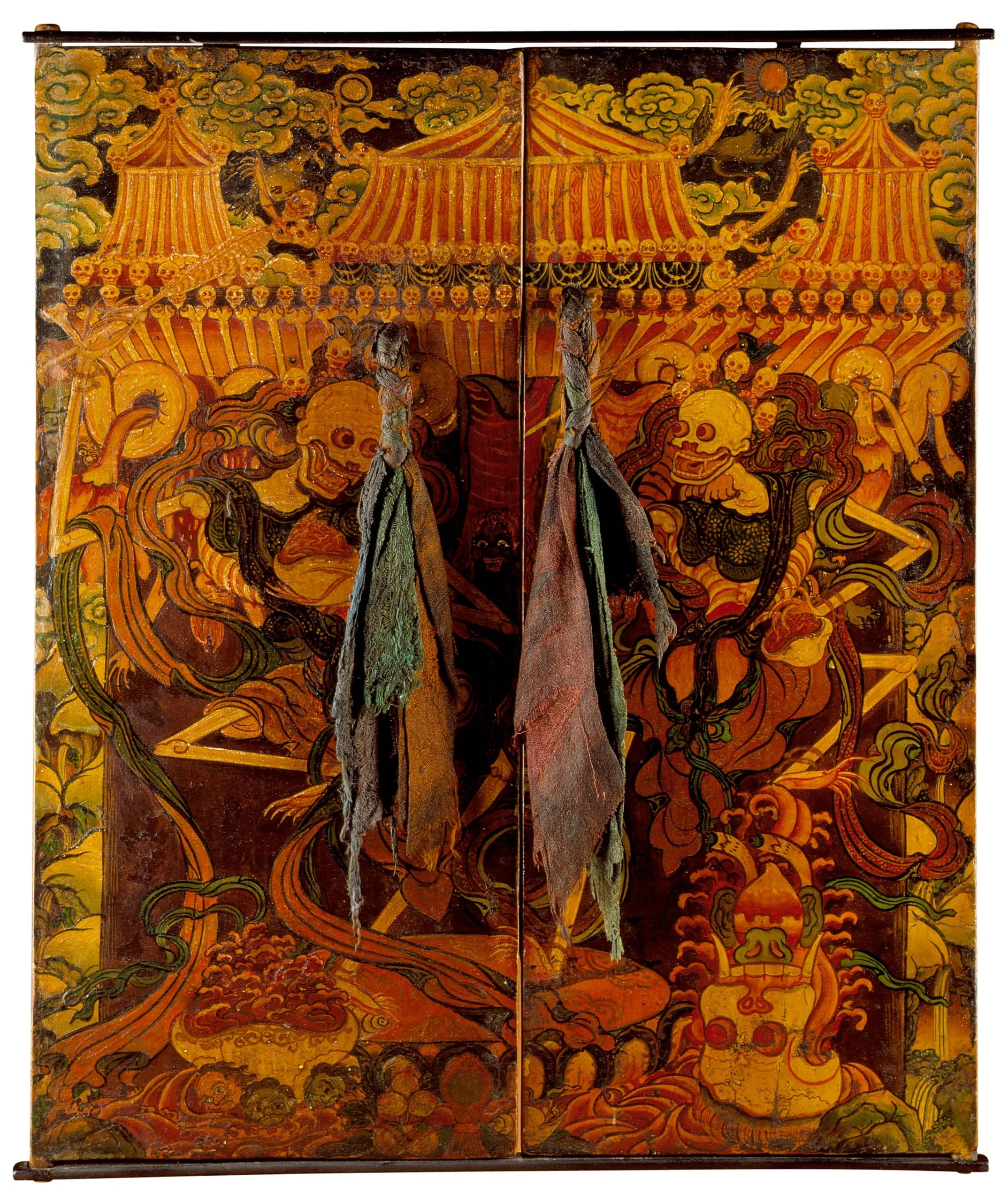
- Doors from an Offering Cabinet (Torgam) with Dancing Skeletons (Chitipati)
- Date Made
- late 18th - early 19th century
- Medium
- Wood with mineral pigments; shellac
- Dimensions
- 21 × 18 × 3 in. (53.34 × 45.72 × 7.62 cm)
- Accession Number
- M.91.203
- Curatorial Notes
These elaborately painted doors from an offering cabinet (torgam) are adorned with dancing skeletons (chitipati; ‘lord of the funeral pile’) who cavort on a lotus base beneath Tibetan pavilions made of human skulls and bones. The grinning skeletons wear skull crowns and ornate robes and scarves. They each carry a ritual staff topped with a skull (khatvanga; ‘cot’s leg’) and a skull cup (kapala) made from human craniums and filled with symbolic offerings of blood and body parts. Behind them is a wall draped with festive swags of flayed skins and entrails emphasizing the association with charnel grounds. In the foreground are a large blood-filled skull cup and an inverted demonic skull with fangs containing the dismembered eyes, ears, tongue, and heart of one’s enemies. See Robert Beer, The Encyclopedia of Tibetan Symbols and Motifs (Boston: Shambala Publications, 1999), pp. 311-315, pls. 135-136. See also M.86.127, M.2002.209, M.2010.78.16, and M.2017.180.1.
The cotton tassel door pulls inserted at uneven heights are likely later additions.
- Selected Bibliography
- Los Angeles County Museum of Art Members' Calendar 1992, vol. 29-30, no. 12-1 (December, 1991-January, 1993).
- Kamansky, David, ed. Wooden Wonders: Tibetan Furniture in Secular and Religious Life. Chicago: Serindia Publications, Inc., 2004.
- Little, Stephen, Tushara Bindu Gude, Karina Romero Blanco, Silvia Seligson, Marco Antonio Karam. Las Huellas de Buda. Ciudad de México : Instituto Nacional de Antropología e Historia, 2018.
- Little, Stephen, and Tushara Bindu Gude. Realms of the Dharma: Buddhist Art across Asia. Los Angeles: Los Angeles County Museum of Art, 2025.
- Selected Exhibition History
- Ritual Offerings in Tibetan Art. Saturday, September 13, 2014 - Sunday, October 25, 2015