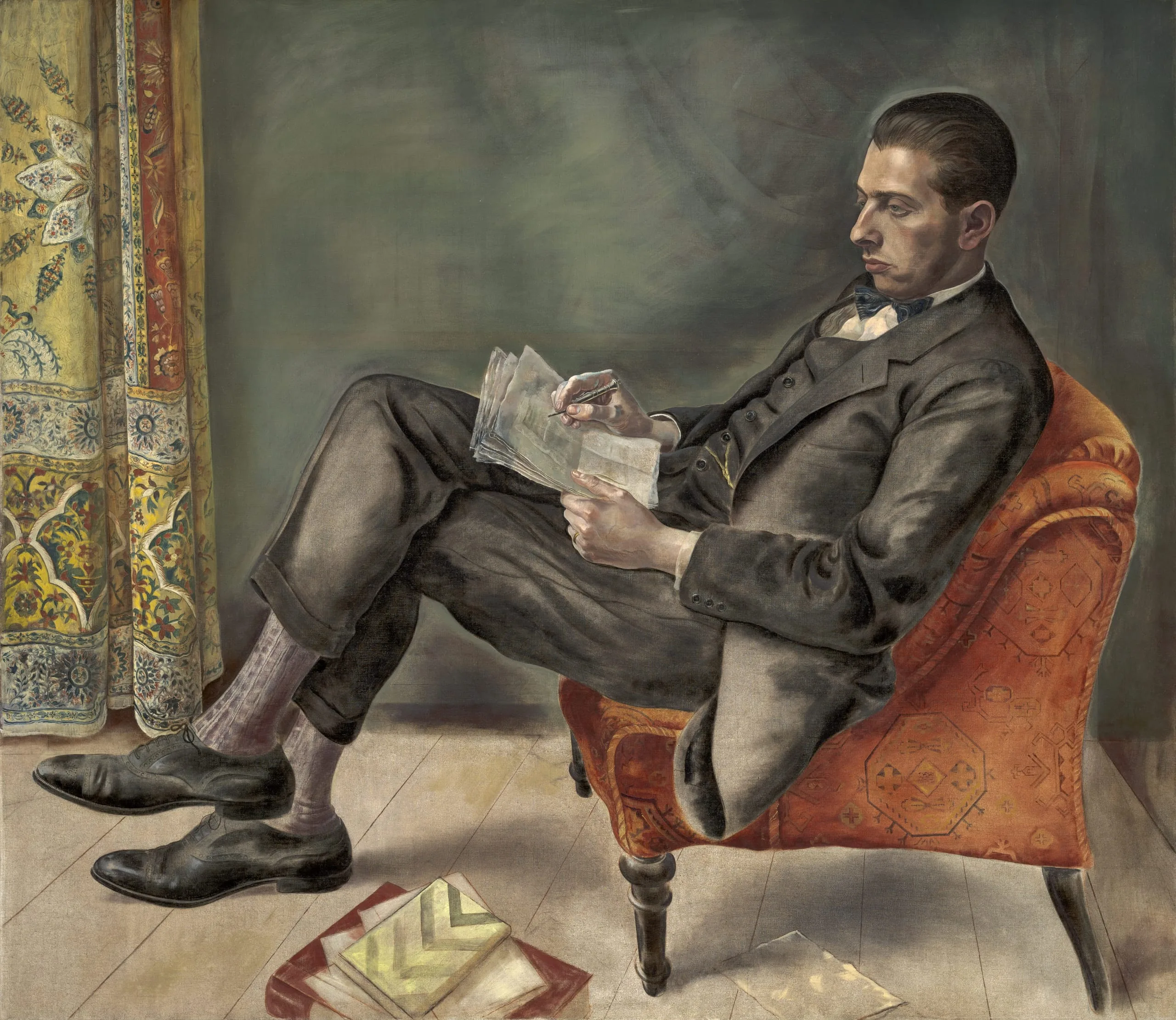
- Artist or Maker
- George Grosz
Germany, also active United States, 1893-1959 - Title
- Portrait of Dr. Felix J. Weil
- Date Made
- 1926
- Medium
- Oil on canvas
- Dimensions
- 53 × 61 in. (134.62 × 154.94 cm)
- Accession Number
- M.76.152
- Curatorial Notes
This George Grosz portrait displays all the hallmarks of New Objectivity, a tendency during the 1920s in Germany characterized by critical and careful attention to detail that depicts subjects in a hyperrealistic, if unidealized, manner. Grosz was friendly with the subject of this portrait, Felix Weil, whom the artist nicknamed “Lix.” Born in Argentina and educated in Germany, Weil was committed to Marxist theory and was one of the founders and funders of the Institute for Social Research, also known as the Frankfurt School. Like a number of Jewish leftist intellectuals, Weil fled Germany after the Nazis came to power, moving from Argentina to New York and, finally, to the Pacific Palisades area of Los Angeles, dubbed “Weimar on the Pacific” for the number of German expatriates who settled there. Weil kept this painting in his collection until his death in 1975.
Wall label, 2021.
- Provenance
The artist (1893-1959); Dr. Felix J Weil (1898-1975), Pacific Palisades, CA; Felix and Anne Weil Trust, Los Angeles; Richard L. Feigen, New York; given in 1976 to LACMA.
- Selected Bibliography
Barron, Stephanie, and Sabine Eckmann. New Objectivity: Modern German Art in the Weimar Republic, 1919–1933. Los Angeles: Los Angeles County Museum of Art and DelMonico Books/Prestel, 2015.
- Copyright
- © Estate of George Grosz / Licensed by VAGA at Artists Rights Society (ARS), New York