- Title
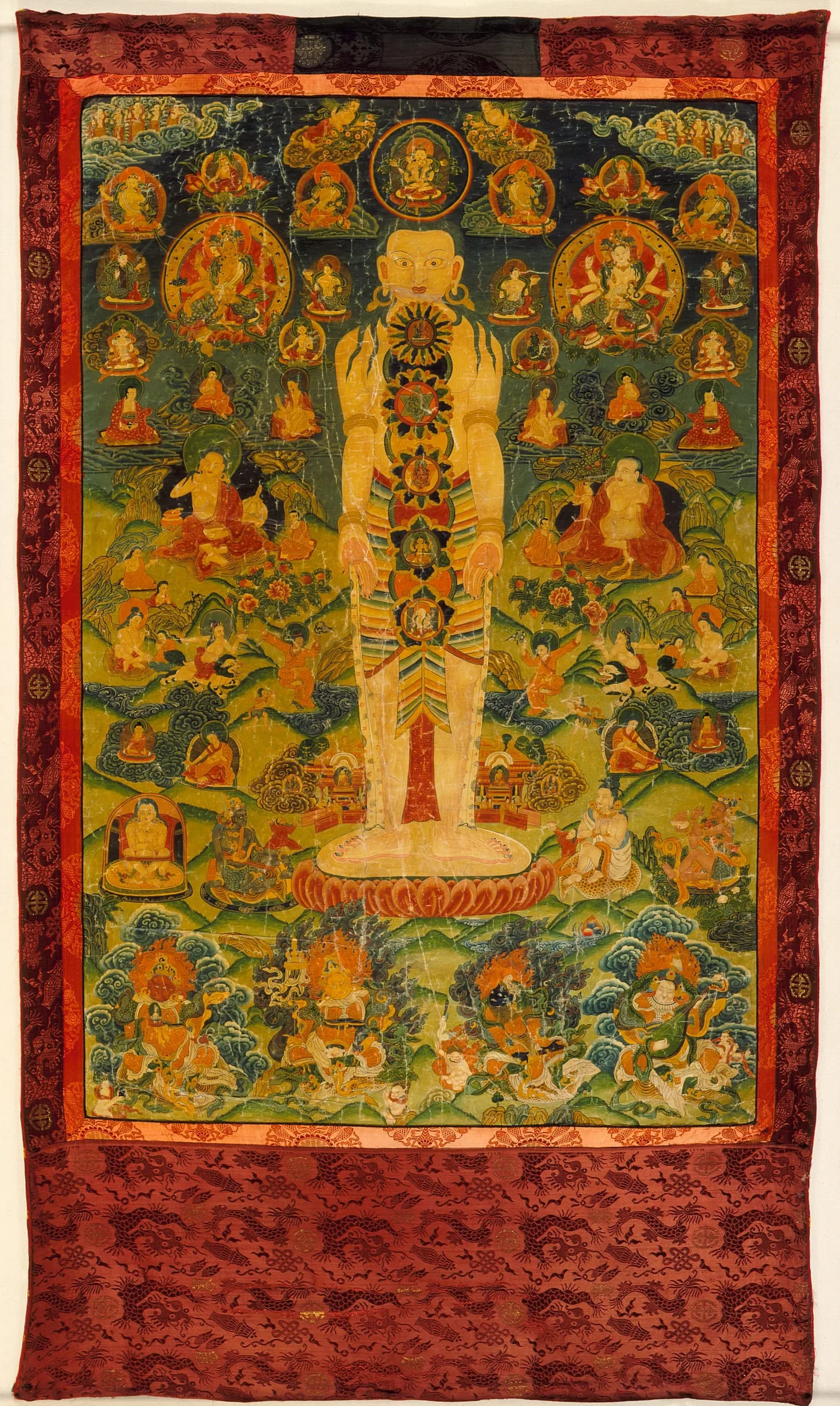
- Cosmic Man with Diagrams of Newar Yogic Six Chakra Transformation
- Date Made
- 19th century
- Medium
- Mineral pigments and gold on cotton cloth; silk borders
- Dimensions
- Overall: 69 x 41 in. (175.26 x 104.1 cm)
- Accession Number
- M.91.118
- Curatorial Notes
To perform the transformative meditations in the Tantric meditations, it is necessary to understand the subtle body of Kundalini Yoga representing the refined energetic field that holds the soul and acts as the seat of intuition, sensitivity, and mastery. Tibetan instructions were usually in books or delivered in the form of oral instructions. Apparently, this painting was used as a meditational training device to illustrate to a novice yogin what should be visualized within the practices of the Kundalini Yogic system. Each of the six chakras of the yogin’s body is marked by a set of deities within a lotus with the specified number of petals signifying the chakras. The yogin himself stands erect on a lotus base and is surrounded by the four heavenly kings, indicating that this meditation takes place in Akanishta paradise on the cosmic Mount Meru. Based on its style and iconography, the painting was likely made by a Tibetan artist working in Lhasa for a Newar patron in the 19th century.
- Selected Bibliography
- Huntington, John C. and Dina Bangdel. The Circle of Bliss: Buddhist Meditational Art. Columbus: The Columbus Museum of Art; Chicago: Serindia Publications, 2003.
- Johne, Isabell. Vasudhārā: A Study of the Origin, Development, and Diffusion of Artistic Representations of the Buddhist Goddess of Prosperity in their Cultural Contexts. Vol. 2, Catalogue. Translated by Rachel Marks-Ritzenhoff. Aachen: Shaker Verlag, 2014.
- Johne, Isabell. Vasudhārā: A Study of the Origin, Development, and Diffusion of Artistic Representations of the Buddhist Goddess of Prosperity in their Cultural Contexts. Vol. 1, Text. Translated by Rachel Marks-Ritzenhoff. Aachen: Shaker Verlag, 2014.