LACMA

ShopMembershipMyLACMATickets
LACMA
Los Angeles County Museum of Art
5905 Wilshire Blvd.
Los Angeles, CA 90036
info@lacma.org
(323) 857-6000
Sign up to receive emails
Subscribe
© Museum Associates 2026
  • About LACMA
  • Jobs
  • Building LACMA
  • Host An Event
  • Unframed
  • Press
  • FAQs
  • Log in to MyLACMA
  • Privacy Policy
© Museum Associates 2026
Collections

Attributed to the Master at the Court of Mankot
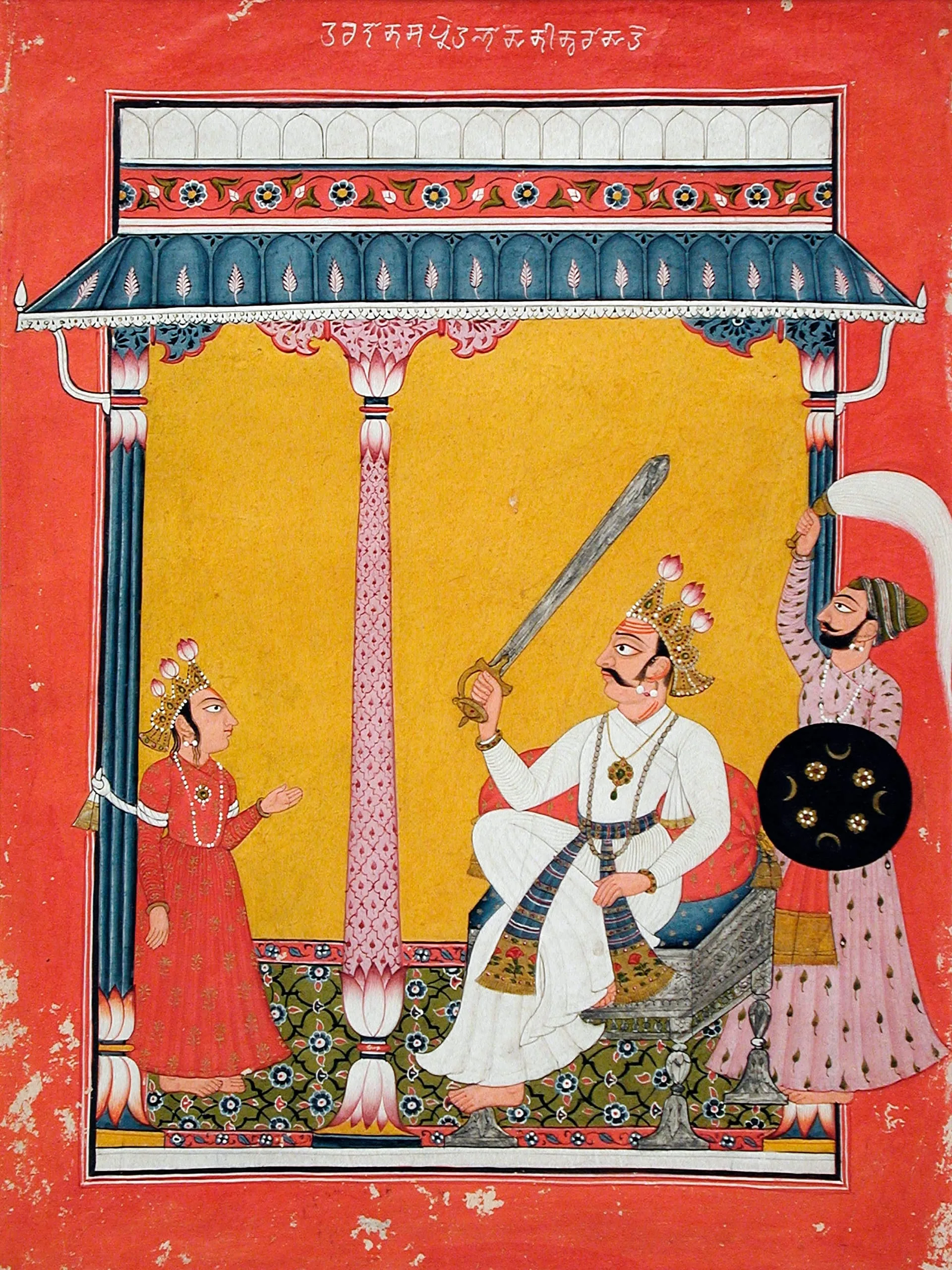
Hiranyakashipu About to Decapitate Prahlada, Folio from a Bhagavata Purana (Ancient Stories of the Lord)circa 1700-1725

Not on view
Indian miniature painting in opaque watercolor, a crowned figure holding a sword sits on a throne flanked by a female attendant and a male attendant with a shield, under a teal canopy against a saffron background

Attributed to the Master at the Court of Mankot, Hiranyakashipu About to Decapitate Prahlada, Folio from a Bhagavata Purana (Ancient Stories of the Lord), circa 1700-1725, Los Angeles County Museum of Art, Gift of Paul F. Walter, photo © Museum Associates/LACMA

Artist or Maker
Attributed to the Master at the Court of Mankot
(India, active circa 1680-1730)
Title
Hiranyakashipu About to Decapitate Prahlada, Folio from a Bhagavata Purana (Ancient Stories of the Lord)
Place Made
India, Jammu and Kashmir, Mankot
Date Made
circa 1700-1725
Medium
Opaque watercolor, gold, and silver on paper
Dimensions
Image: 8 7/8 x 7 7/8 in. (22.54 x 20.0 cm); Sheet: 11 1/4 x 8 1/2 in. (28.58 x 21.59 cm)
Credit Line
Gift of Paul F. Walter
Accession Number
M.88.227
Classification
Drawings
Collecting Area
South and Southeast Asian Art
Curatorial Notes

The Bhagavata Purana (Ancient Stories of the Lord) is traditionally ascribed to the legendary poet-sage Vyasa in the 8th-10th century CE. It stresses the path of devotion (bhakti) to Krishna, the eighth incarnation of Vishnu, the Hindu God of Preservation. To fulfill his role as the guardian of the world and savior of humanity, Vishnu appears as a succession of heroic animals and semi-mortal saviors, called avatars, through which he intervenes in times of crisis or unrighteousness.

The tale of Narasimha, the fourth avatar, embodies the sectarian rivalry present in Hinduism from its earliest times and eventually expressed primarily through Vaishnavism and Shaivism. Vishnu manifested as Narasimha (literally, "man-lion") to save the pious Prahlada from his bigoted father, King Hiranyakashipu, who was angered by his son’s staunch devotion to Vishnu and threatened to behead him (Bhagavata Purana 7:8:1-13).

Here, Hiranyakashipu raises his sword to decapitate Prahlada, who is tied to a pillar. An attendant holds the king’s shield and waves an honorific fly whisk made from the white tail-hairs of a yak (cauri or chowri). A caption in white takri script in the upper border identifies the subject.

See also its series mate M.71.49.1. This dispersed series was formerly in the royal collection of Raja Dhruv Dev Chand of Lambagraon, Kangra. Additional folios are in the British Museum, London (1966,0725,0.2) and the San Diego Museum of Art (1990.1071).
Selected Bibliography
  • Pal, Pratapaditya. The Classical Tradition in Rajput Painting. New York: The Gallery Association of New York State, 1978.