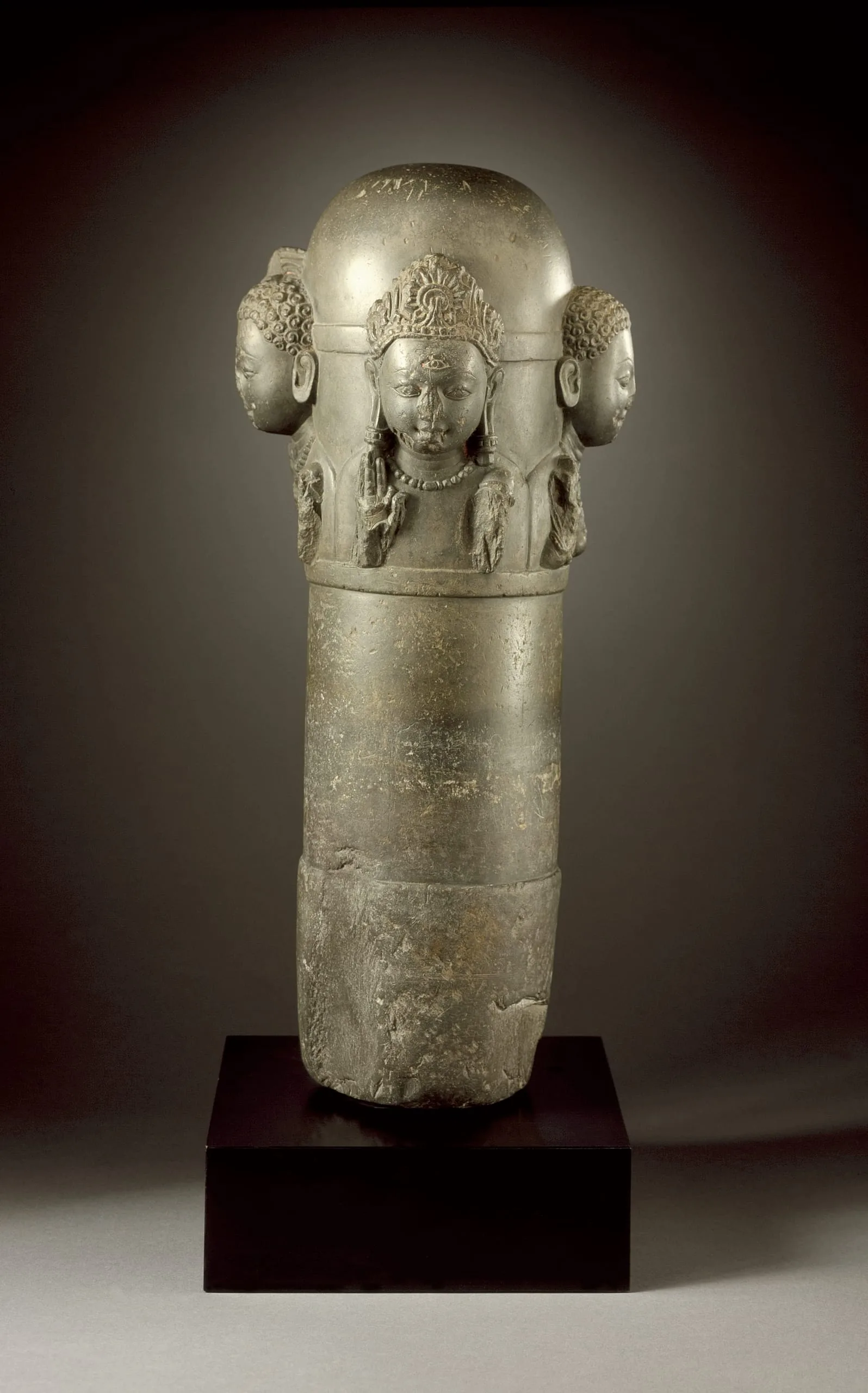
Since around the beginning of the Common Era, the Shivalinga (literally, the "sign" of Shiva) has been the quintessential symbol and artistic form used to represent the major Hindu god Shiva. In its core conception imagined as an aniconic column, the Shivalinga symbolizes the deity’s transcendental nature and primordial potency. As iconic imagery became increasingly prevalent in South Asian art, the Shivalinga was anthropomorphized by the addition of Shiva’s head emerging from the stone column in order to provide worshippers with a physical form that was considered more accessible than the abstract expression of his imperceptible reality. Multiple heads of Shiva were subsequently added to represent different philosophical aspects of the god. To seek blessings from Shiva, devotees worship lingas with ritual offerings of flowers, food, and incense. The deity’s large eyes and welcoming gaze are thought to help worshippers establish a personal spiritual bond, thus strengthening the power of their offering.
Attributed to Nepal, 6th-7th century, this linga is distinctive for each of the four heads represented as a bust with hands held in various gestures (mudras). It is also unusual for having a particularly long shaft, although the lower unfinished section would have been inserted into the usually circular base symbolizing the female principle known as a yoni pitha.