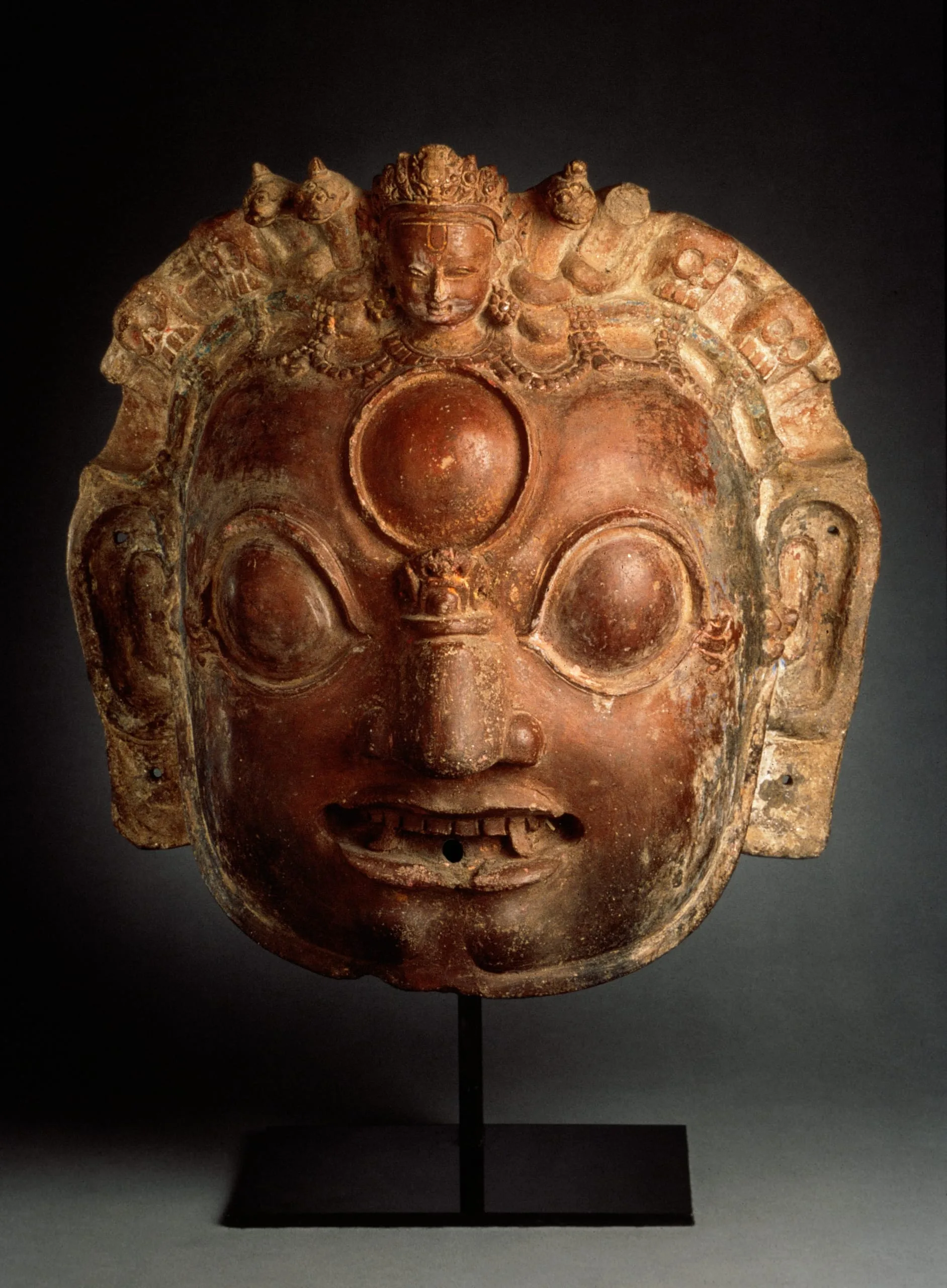
The back of this earthenware sculpture once formed a large personified pot, only parts of which remain. The pot would have been filled with rice beer, which was dispensed from a pipe inserted in the mouth of the face and drunk by devotees as a consecrated beverage during the annual Indra Jatra festival in Nepal. Celebrated principally in Kathmandu, the originally agricultural festival honors Indra, the ancient Hindu and Vedic (proto-Hindu) weather god, as the provider of the life-giving monsoon rains.
The face on the front of the pot depicts the frightful Bhairava, a violent or powerful (ugra) form of Shiva, the Hindu god of destruction. (For the mythological origin of Bhairava, see M.74.138.4.) Bhairava has Shiva’s third eye of wisdom (jñana netra), and the fierce attributes of bulging eyes and fangs. His earlobes are distended and have holes for separate metal earrings that would have been originally attached. He wears a tiara of skulls with the head of the bodhisattva Manjushri (?) flanked by four rearing serpent heads in the center. Bhairava was originally a Hindu deity, but over time was incorporated into the Himalayan Buddhist pantheon, especially as a form of the Dharmapala (Guardian of the Law) Yamantaka, the destroyer of Yama, who is the god and judge of the dead. See also M.70.42.4, M.82.220, M.81.206.2, and M.91.293.1.
The head or a mask of Bhairava was typically used to adorn the dispensing port of Nepalese festival libation vessels and sometimes on the base of full-figural sculptures of Bhairava (see also M.87.279.5 and M.74.10.1).