- Title
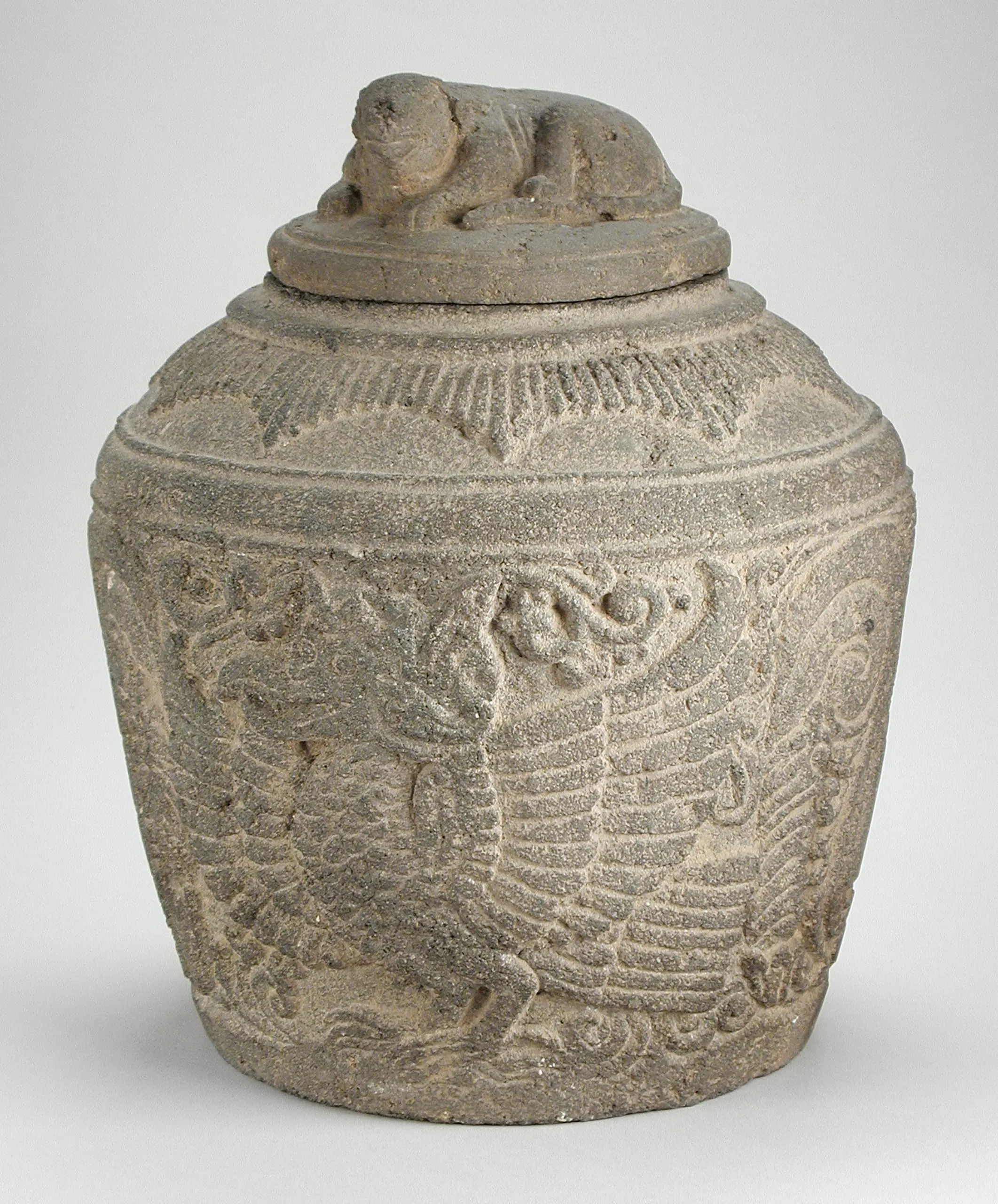
- Funerary Urn
- Date Made
- 14th-15th century
- Medium
- Volcanic stone
- Dimensions
- Overall height: 12 1/8 in. (30.8 cm); (a) Lid height: 2 7/8 (7.3 cm); Diameter: 5 1/4 in. (14 cm); (b) Urn height: 9 1/2 in. (24.1 cm); Diameter: 10 in. (25.4 cm)
- Accession Number
- M.88.170a-b
- Curatorial Notes
In various regions of Indonesia, Southeast Asia, and China from the prehistoric period onward, funerary urns have been used to hold or transport the ashes and bone fragments of the cremated dead in observance with Buddhist cultural conventions (for example, see M.84.151). The burial urns are then interred in the ground along with a grave marker or stored in a place of honor in a family home or shrine.
This funerary urn was fashioned during the Majapahit period (1293–1519) in Eastern Java. Like the museum’s earthenware sculpture of the Bodhisattva Avalokiteshvara from Eastern Java (M.90.196.5), the urn displays assimilated Chinese stylistic imagery carved on the side of the vessel in the form of a large phoenix symbolic of the cycle of death and rebirth. The vessel’s shoulders are adorned with an undulating decorative collar of vertical bars or perhaps solar rays of light. Atop the lid is a domesticated water buffalo common to Southeast Asia that is lying on the ground with its legs tucked alongside its torso.