- Title
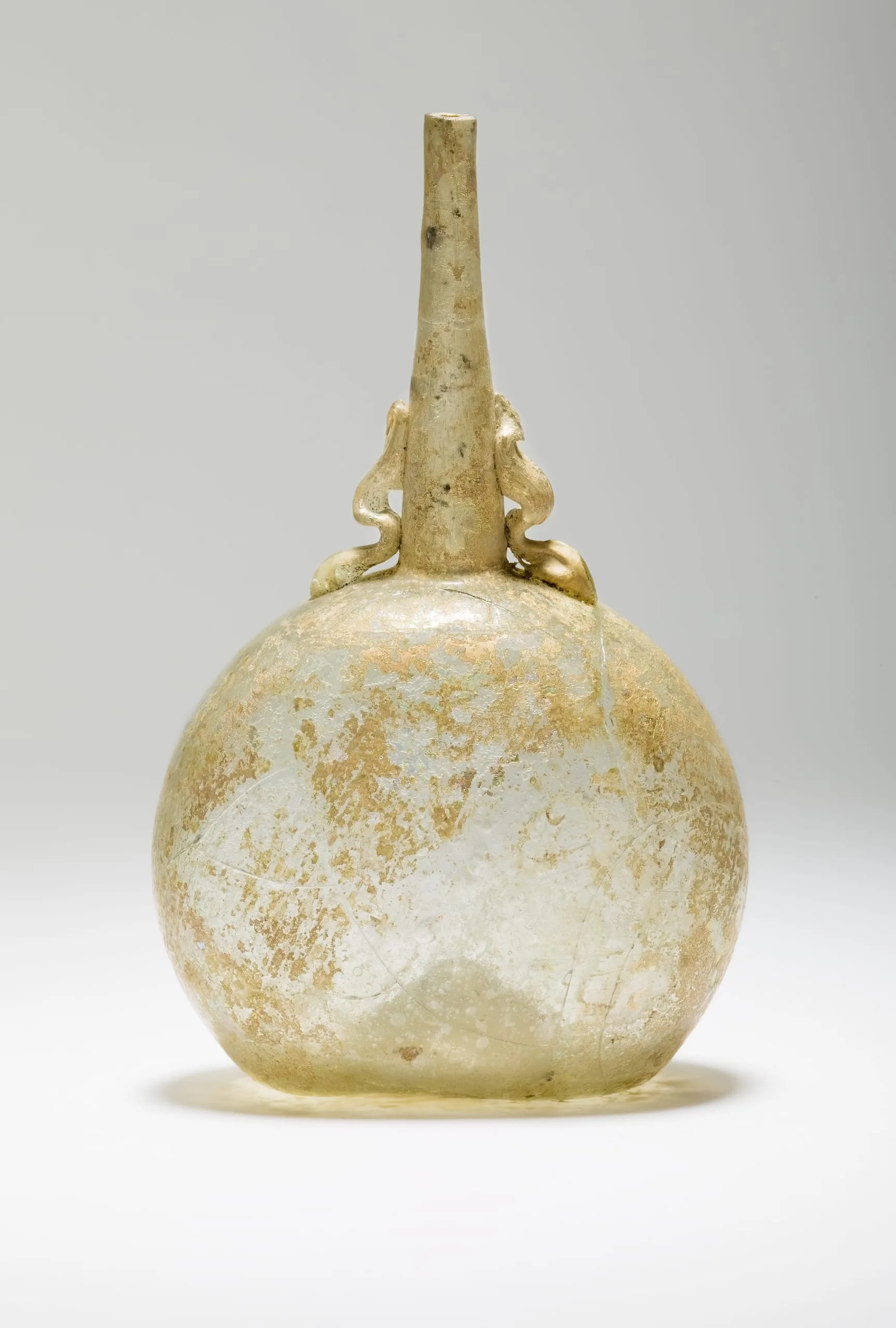
- Perfume Sprinkler
- Date Made
- 12th century
- Medium
- Glass, free-blown, applied handles
- Dimensions
- 4 1/2 x 2 3/4 in. (11.4 x 7 cm)
- Accession Number
- M.88.129.195
- Curatorial Notes
This glass sprinkler is of a common type generally associated with Syria during the Ayyubid period (ca. 1171−1259). Its diminutive scale and narrow tapering spout suggest that it would have been used to dispense, when shaken, precious drops of aromatics distilled from substances like musk, ambergris, or rose. Such perfumes were used by men and women alike, while the practice of perfuming spread from Islamic lands to Europe after the eleventh century. Known as iridescence, the unusual golden coloring on the surface of this vessel is the result of a chemical process that occurs during burial in which salt leaches from the glass and accumulates in thin flaking layers, causing different reflections of light.
2024
- Selected Bibliography
- Saldern, Axel von. Glass 500 B.C. to A.D. 1900: The Hans Cohn Collection. Mainz: Philipp von Zabern, 1980.
- Komaroff, Linda. Beauty and Identity: Islamic Art from the Los Angeles County Museum of Art. Los Angeles: Los Angeles County Museum of Art, 2016.