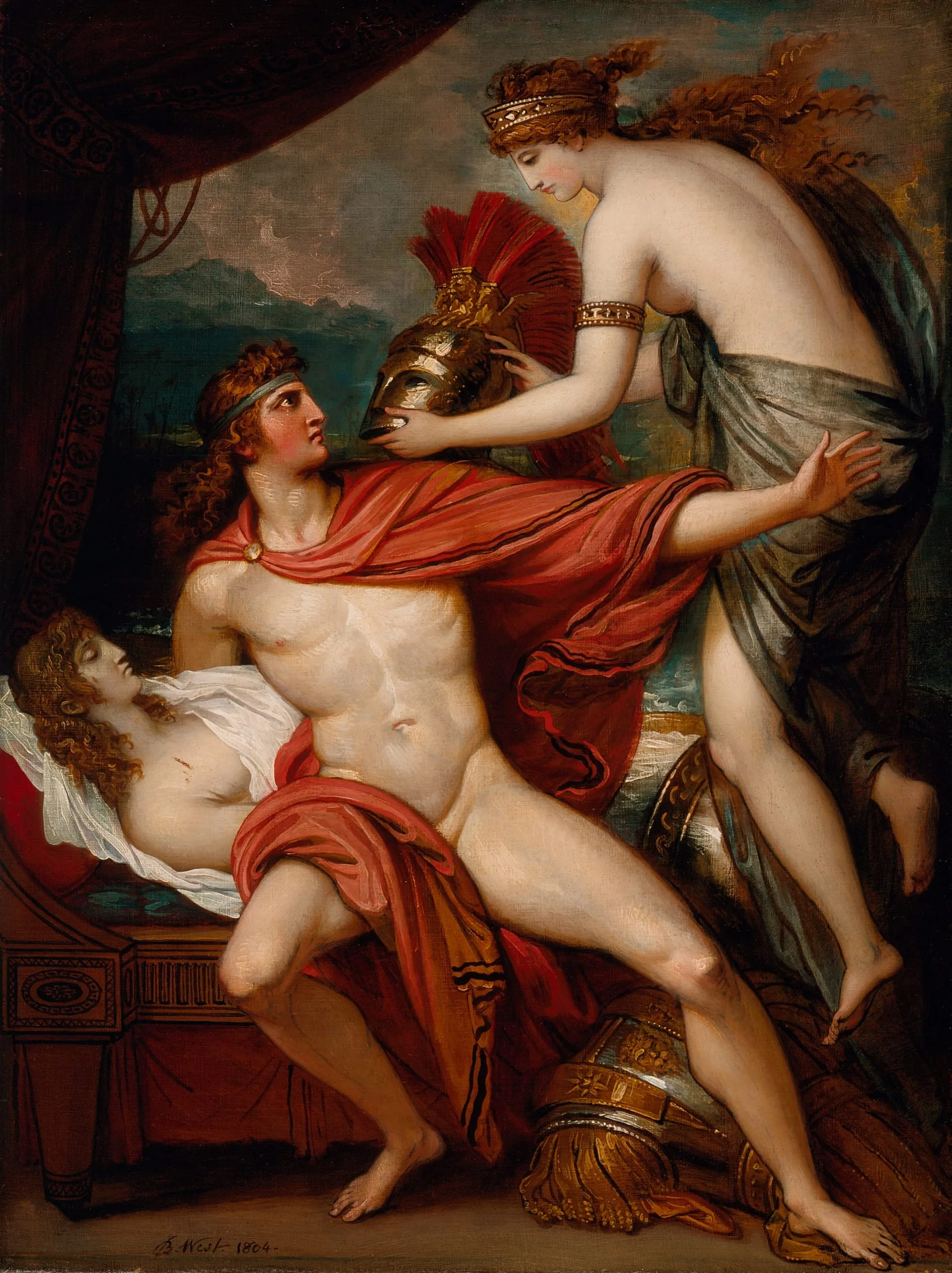
In this painting, Benjamin West employs numerous elements from the classical past, including characters from Greek mythology, plentiful flowing drapery, idealized anatomy, and crisp profiles to set the stage for a dramatic narrative. The scene depicts a moment from Homer’s Iliad (Book XIX), in which the Greek hero Achilles mourns over the body of Patroclus, his closest boyhood friend. As Achilles grieves, his mother, the goddess Thetis, appears with a new set of divine armor so that Achilles can renew battle with the Trojans, whom he later defeats. The story intrigued West, who painted the scene on several occasions between 1804 and 1807.
The work combines two popular subjects in Neoclassical art: a man sacrificing his life for his country and the mourning of a lost hero. Such imagery in English and French paintings of the late eighteenth and early nineteenth centuries often alluded to the constantly changing political situation of the two nations. During West’s lifetime, England not only fought unsuccessfully to retain control of its American colonies but also battled to stop Napoleon’s conquest of continental Europe. Although the subject is drawn from the classical past, West’s work would have resonated with contemporary British audiences. Moreover, his idealized depictions of nearly nude war heroes and a goddess demonstrate his deep knowledge of classical conceptions of beauty and the ideal human body. The figures display sculpted glowing flesh with defined muscles and cascades of golden curls frozen in an orderly composition. The symmetrical, architectural details on the Grecian couch further convey balance and restraint.
A self-taught artist from Pennsylvania, West was among the first American-born painters to achieve international recognition. At the age of twenty-two, he traveled to Italy, where he was introduced to the aesthetics of Neoclassicism. After settling in London in 1763, he became a leading figure in English circles, ascending to the highest echelons of British painting to become an official painter to King George III and president of the Royal Academy of Arts. Moreover, West’s influence on a generation of American painters, including Gilbert Stuart and Thomas Sully, was immense and helped to spread Neoclassical aesthetics to audiences in the United States.
Selected Bibliography
Erffa, Helmut von, and Allen Staley. The Paintings of Benjamin West, cat. 174. Yale University Press, 1986.