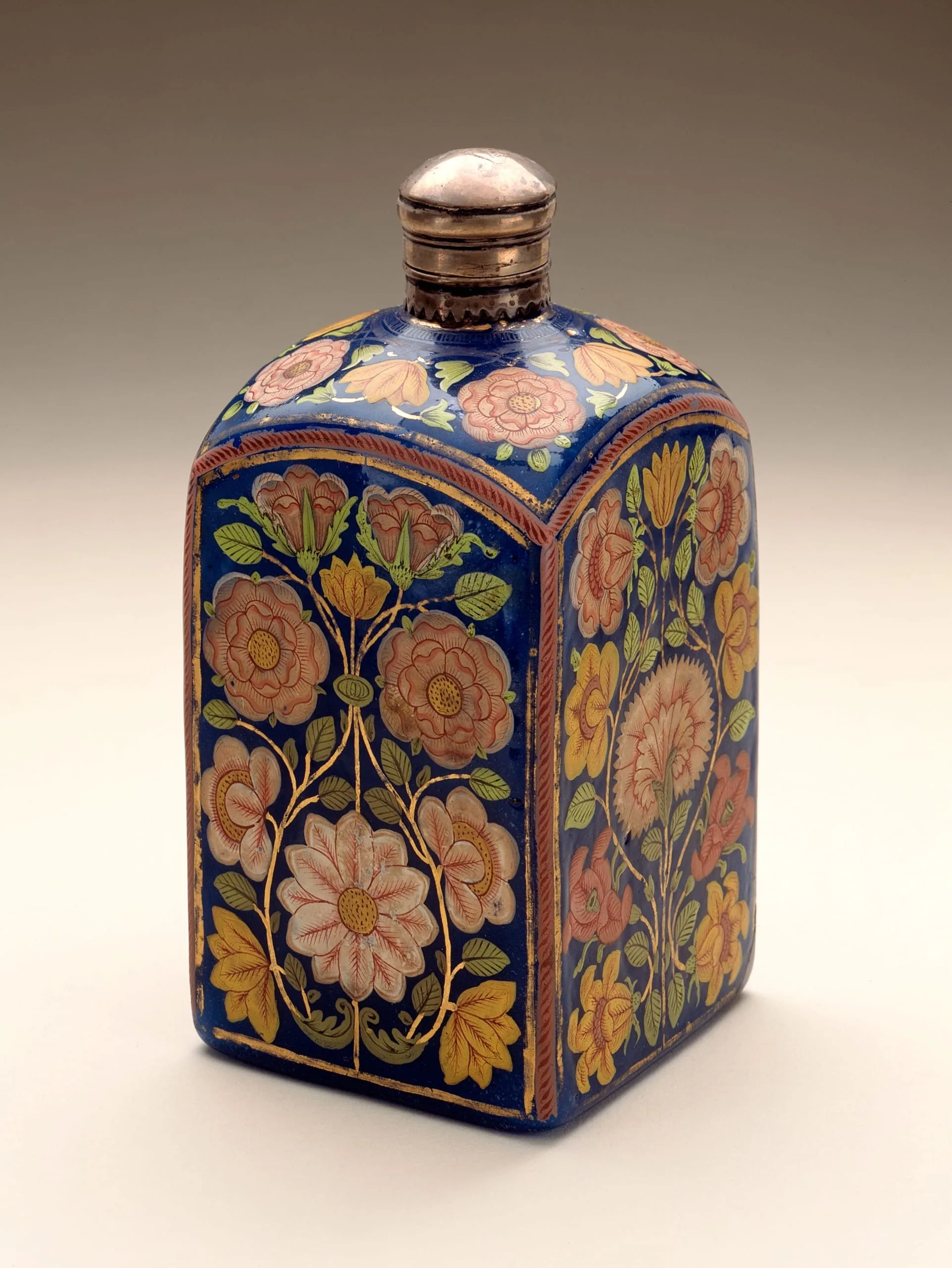
This cobalt blue glass mold-blown square bottle is joined diagonally at the corners with the seams concealed beneath polychrome enameling. It is exuberantly decorated with two fantastical flowering plants repeated on the opposing sides. Stylized carnations, irises, tulips, and daisies all grow from a single stalk. The large pink, red, yellow, and white blossoms have red midrib-to-margin venation, light green oval leaves, and gilded stems. Thickly painted in low relief, the lush flora stands out dramatically against the deep blue glass ground. Exotic bouquets of sundry blossoms developed out of the Mughal leitmotif of a naturalistic flowering plant formally arranged against a plain background. As the multimedia use of the dynastically symbolic motif spread throughout South Asian art and architecture, it morphed into myriad manifestations. Individual plants became fuller and more complex, and hybrid botanical pastiches were imagined (for example, see AC1999.127.14).
The bottle’s current silver cap is probably 19th-century European. It bears a partial heraldic crest of a Talbot's Head and Neck Plain Collared. Unfortunately, according to the College of Arms in London, this particular crest was a commonplace insignia and cannot be associated with a given family without an accompanying arms and motto. In the 18th–19th centuries, European silver coins were often converted to decorative bottle caps. Similarly, heraldic emblems were frequently engraved on bottle caps.
A comparable bottle with similar decoration is in the British Museum, London (SLMisc.341).