- Title
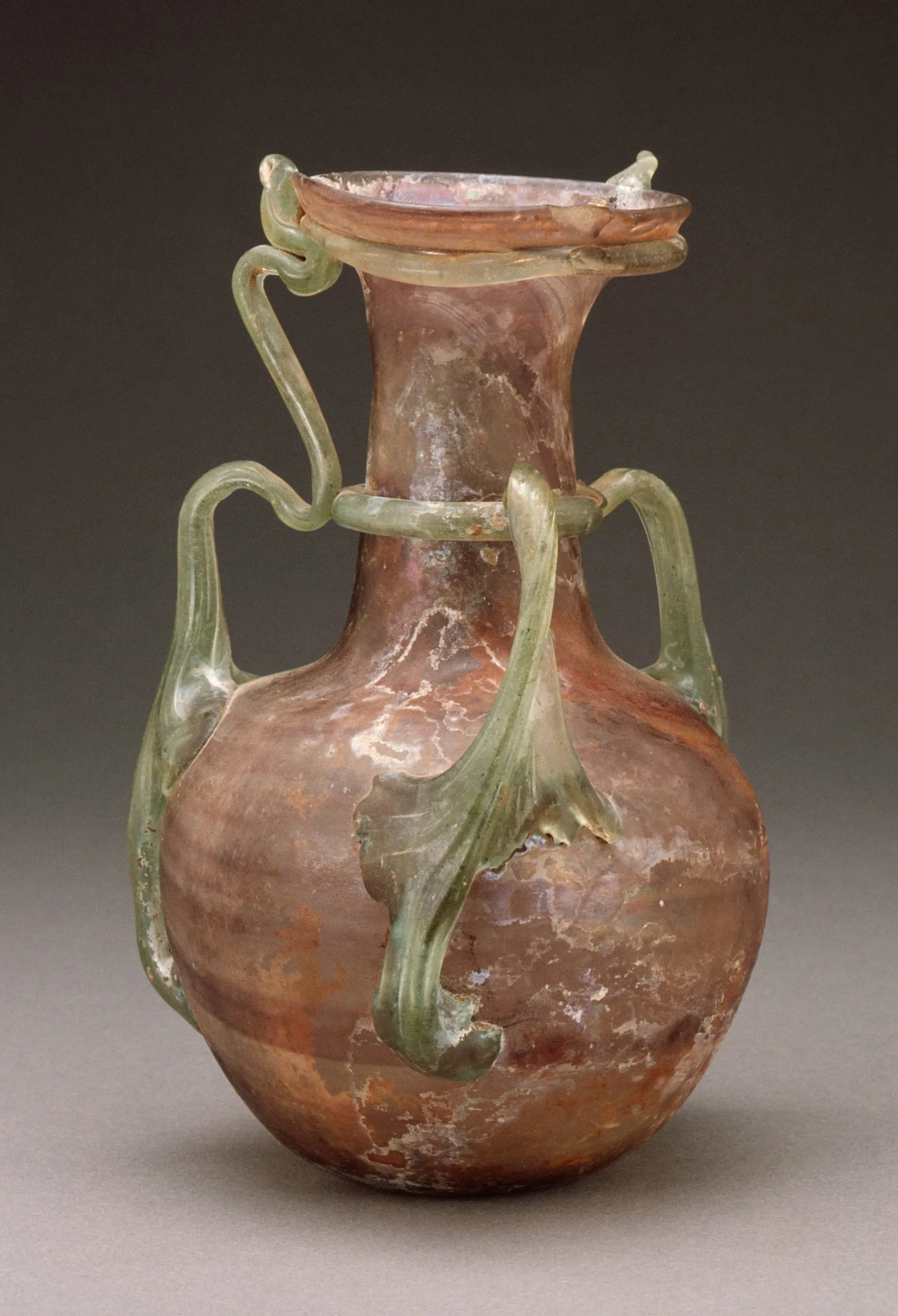
- Bottle
- Date Made
- about 4th century
- Medium
- Thread decorated glass
- Dimensions
- 6 1/4 x 3 7/8 in. (15.9 x 9.8 cm)
- Accession Number
- M.88.129.102
- Curatorial Notes
Syrian craftsmen are generally credited with the invention of the glass blowpipe in the first century BCE. Whether free-blown or mold-blown, this revolutionizing practice allowed for the manufacture of a greater variety of shapes, and for lighter and more transparent glassware. With the Roman annexation of Syria in 64 BCE, the glassblowing technique spread quickly, while the expanding borders of the empire created new markets for utilitarian as well as luxury glassware. Small, delicate vessels such as this bottle are primarily associated with personal hygiene, as they were used to hold perfumes or oils; such aromatics also played a role in preparation of the deceased for burial or cremation. Here, the basic form of the purple-colored bottle is enhanced through the application of green glass for the handles, transforming a practical object into something more luxurious.
2024
- Selected Bibliography
- Saldern, Axel von. Glass 500 B.C. to A.D. 1900: The Hans Cohn Collection. Mainz: Philipp von Zabern, 1980.