LACMA

ShopMembershipMyLACMATickets
LACMA
Los Angeles County Museum of Art
5905 Wilshire Blvd.
Los Angeles, CA 90036
info@lacma.org
(323) 857-6000
Sign up to receive emails
Subscribe
© Museum Associates 2026
  • About LACMA
  • Jobs
  • Building LACMA
  • Host An Event
  • Unframed
  • Press
  • FAQs
  • Log in to MyLACMA
  • Privacy Policy
© Museum Associates 2026
Collections

Unknown
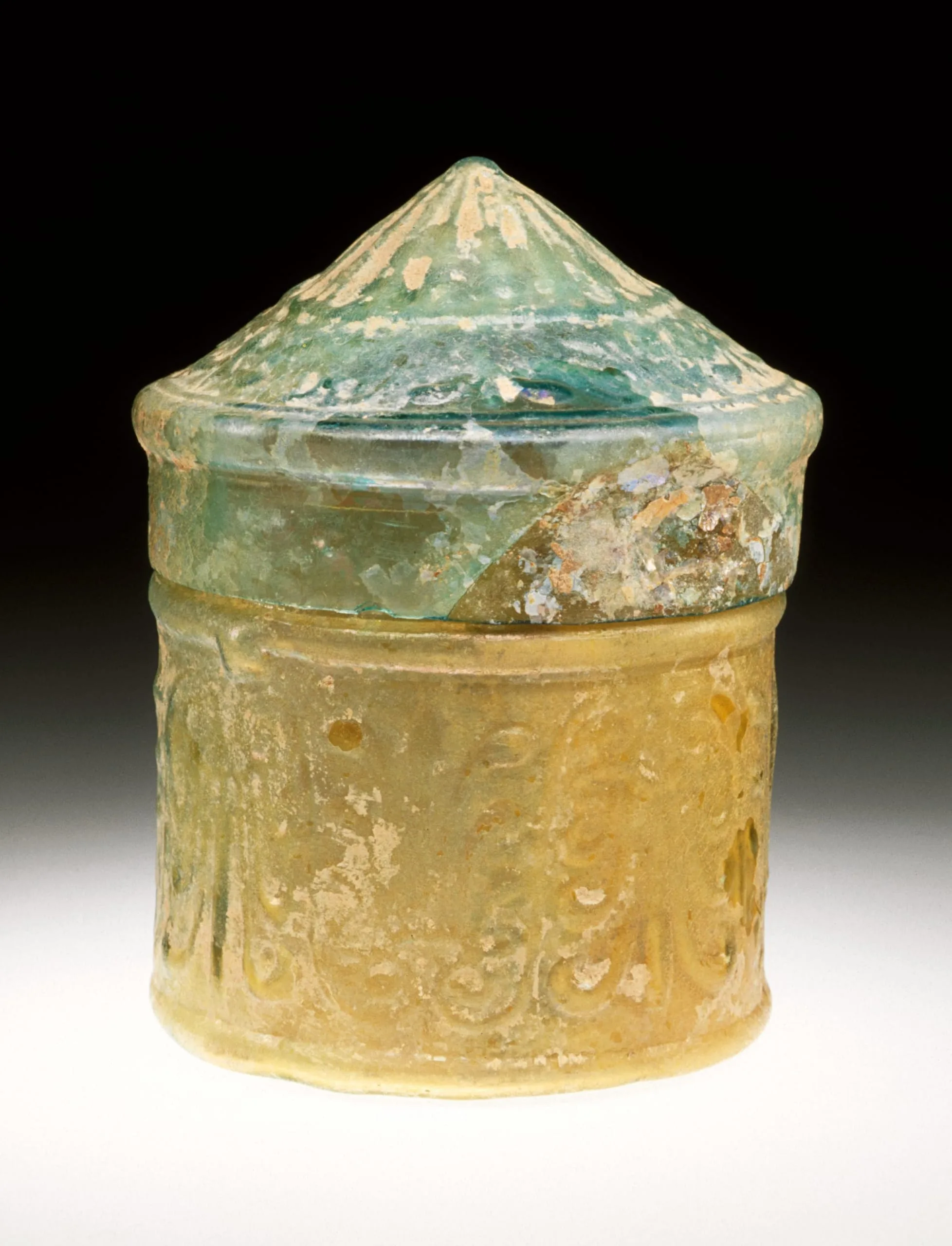
Pyxis1st century

On view:
Geffen Galleries, The Ancient Mediterranean: Merging Beliefs
Ancient glass vessel with cylindrical body decorated in molded Arabic-script relief, topped with a conical sea-green lid showing significant weathering and loss
Artist or Maker
Unknown
Title
Pyxis
Place Made
Syria or Italy
Date Made
1st century
Medium
Mold-blown glass
Dimensions
A) Lid: 1 5/8 x 2 3/8 in. (4.2 x 6.1 cm) b) Body: 2 1/8 x 2 1/8 in. (5.4 x 5.4 cm)
Credit Line
Gift of Varya and Hans Cohn
Accession Number
M.88.129.48a-b
Classification
Furnishings
Collecting Area
European Painting and Sculpture: Greek and Roman
Curatorial Notes

The pyxis is a lidded vessel typically used to hold cosmetics or jewelry, and could be made of materials like wood, ceramic, metal, or glass. This small example is made of pale olive green−colored glass, though the iridescence and cream-colored areas are the result of devitrification, a process by which a glassy substance transforms into a crystalline solid. The body is cylindrical with a flat base and features a frieze of palmettes that alternate upward and downward and is separated by ribs. The conical lid is made of plate green glass instead of the olive green, which indicates that it may not be original to the pyxis. The lid similarly features a frieze of palmettes.

This pyxis was created using the mold-blowing method, a technique that developed at the beginning of the first century CE after the invention of glass-blowing half a century prior. This technique involved placing a lump of molten glass on the end of a blowpipe and then inflating it into a ceramic, metal, or wood mold. When the glass cooled, the mold was then removed to reveal the final shape.
Selected Bibliography
  • Saldern, Axel von. Glass 500 B.C. to A.D. 1900: The Hans Cohn Collection. Mainz: Philipp von Zabern, 1980.