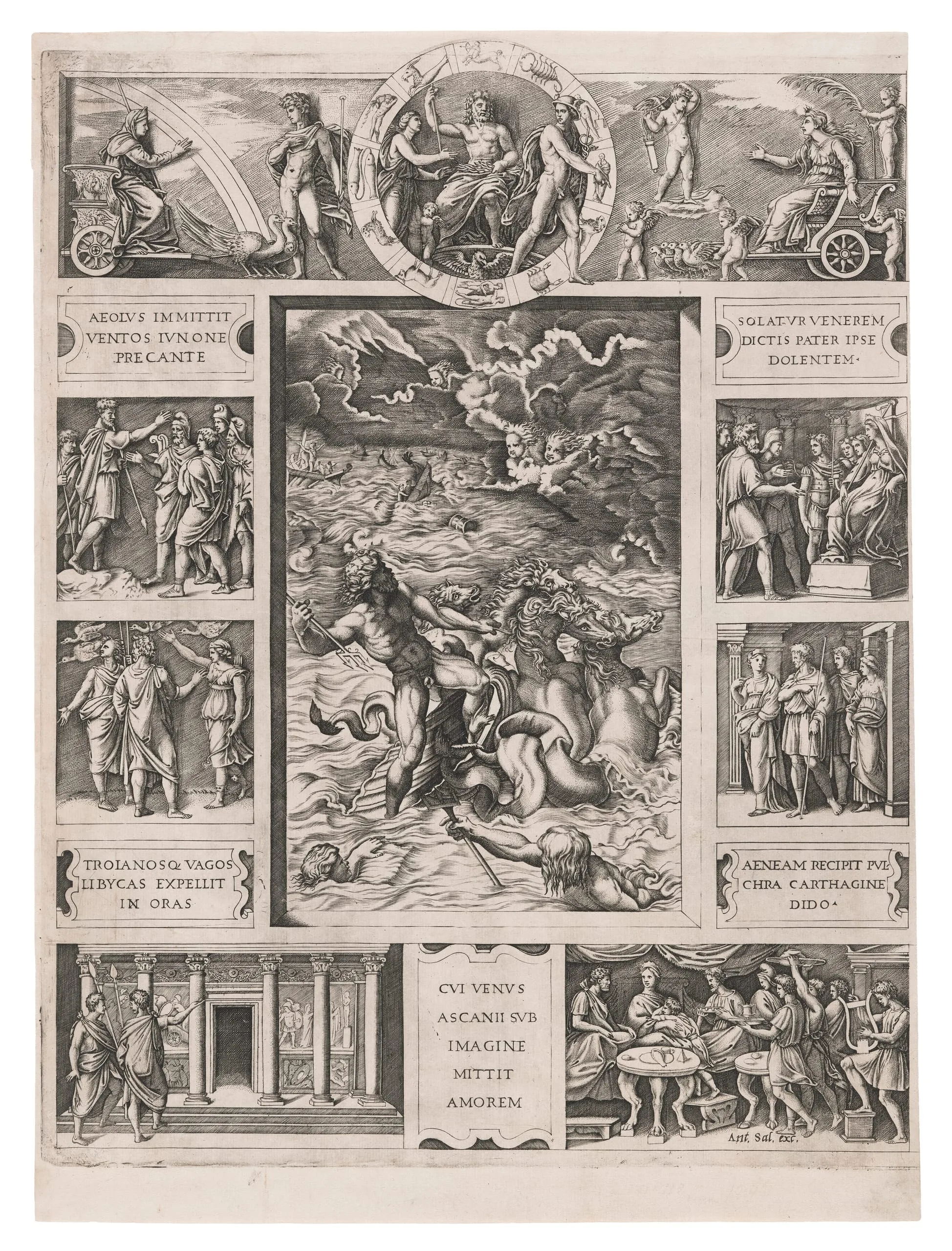
This ambitious engraving illustrates episodes from Virgil’s epic the Aeneid. It is arranged in a format that resembles a type of ancient Roman sculptural relief known as a tabula iliaca, in which a narrative is told through a dramatic central panel and elaborated upon by scenes surrounding it. The designs for this print almost certainly originate with Raphael, whose style is discernible in the harmonious yet dynamic central image of the god Neptune atop his seahorse-drawn chariot, shown calming the wild sea after a storm, making the water safe for the hero Aeneas and the Trojans to continue their journey. Raphael’s authorship is supported by the existence of sketches in his hand depicting figures from the side panels and reinforced by the resemblance of Neptune’s pose to that of figures from the ancient sculpture the Laocoön, which had been unearthed in Rome during Raphael’s lifetime. It has been proposed that Raphael intended these designs for print from the outset and worked collaboratively with the engraver Marcantonio to produce a series on the Aeneid, which went only partially fulfilled before the master’s death in 1520.
LACMA’s impression can be identified as the second state of this engraving due to the addition of the name Antonio Salamanca, a prolific Roman publisher. As their accessibility grew through the efforts of figures like Salamanca, prints were increasingly used in the decoration of objects such as ceramic or enamel tableware. For example, figures from Quos Ego were used to decorate a grisaille enamel platter made by Jean de Court (48.2.17), a French court painter who produced portraits and decorated ornate, luxurious service ware.
Claire Spadafora Baes
2025