LACMA

ShopMembershipMyLACMATickets
LACMA
Los Angeles County Museum of Art
5905 Wilshire Blvd.
Los Angeles, CA 90036
info@lacma.org
(323) 857-6000
Sign up to receive emails
Subscribe
© Museum Associates 2026
  • About LACMA
  • Jobs
  • Building LACMA
  • Host An Event
  • Unframed
  • Press
  • FAQs
  • Log in to MyLACMA
  • Privacy Policy
© Museum Associates 2026
Collections

Enea Vico
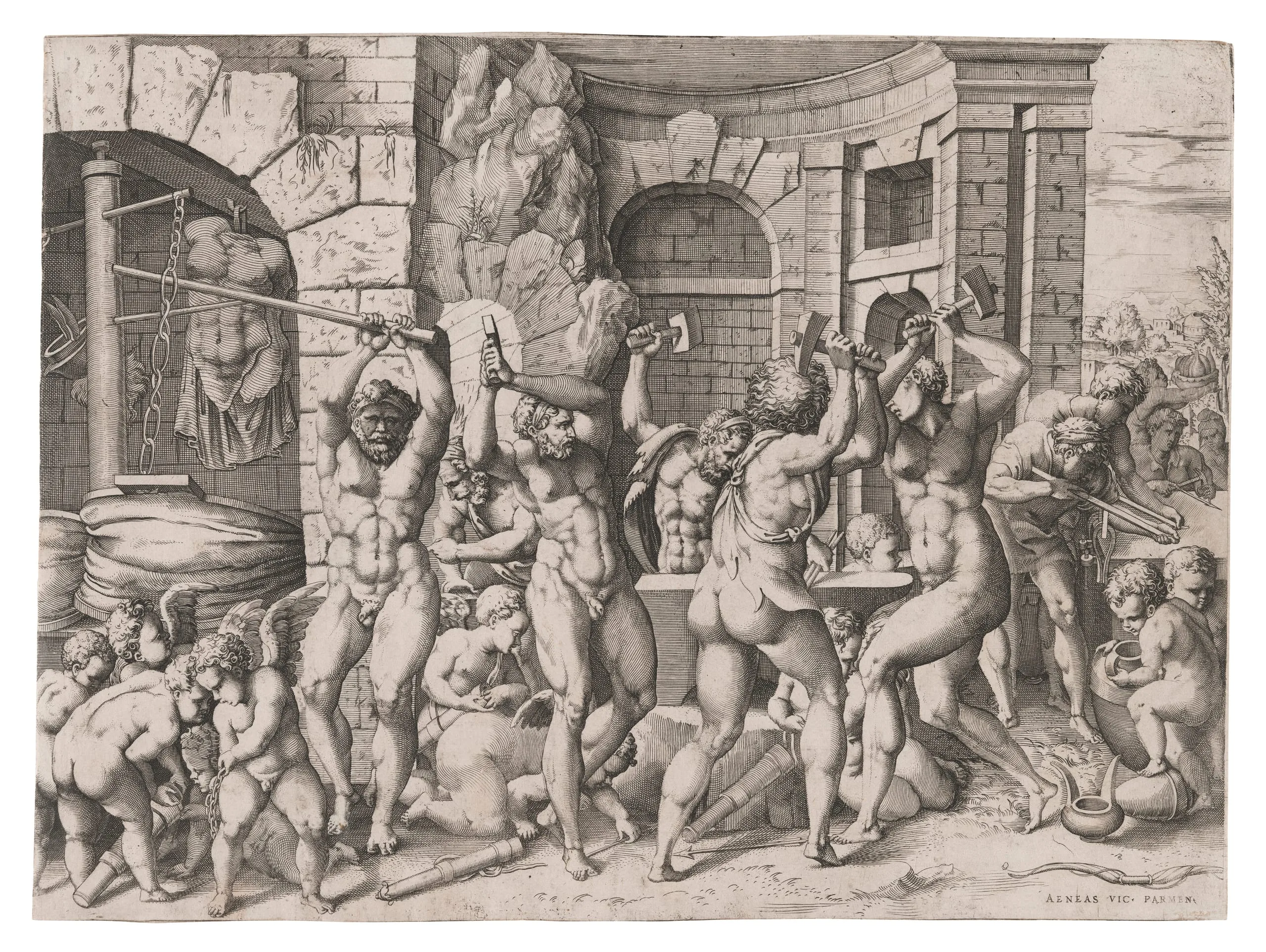
The Forge of Vulcanc. 1543-1545

On view:
Geffen Galleries, floor 2
Engraving on cream paper depicting muscular nude male figures hammering at anvils in a stone forge, with winged infants at their feet and a distant landscape to the right
Artist or Maker
Enea Vico
Italy, Parma, 1523-1567
After
Francesco Primaticcio
Italy, Bologna, 1504-1570
Title
The Forge of Vulcan
Place Made
Italy
Date Made
c. 1543-1545
Medium
Engraving
Dimensions
Sheet: 12 1/8 × 16 3/8 in. (30.8 × 41.59 cm) Image: 12 1/8 × 16 3/8 in. (30.8 × 41.59 cm)
Credit Line
Mary Stansbury Ruiz Bequest
Accession Number
M.88.91.55
Classification
Prints
Collecting Area
Prints and Drawings
Curatorial Notes

Vulcan, the Roman god of fire and metalwork, labors in his forge, assisted by muscular Cyclopes who hammer on an anvil and operate a bellows. They are producing arrows for the Cupids gathering in the foreground at left with empty quivers. The dramatic positioning of the Cyclopes’ bodies infuses the scene with a sense of powerful activity. Their anatomical uniformity suggests that the artist worked from a small three-dimensional model, perhaps with the intention of showing the male body from multiple angles simultaneously.

Vico’s print was produced after a lost painting by Francesco Primaticcio that once hung above the mantel in the Cabinet du Roi at Fontainebleau. Italian artists like Primaticcio created innovative Mannerist decorations at the French court of Francis I (r. 1515−47), many of which were later reproduced in print by artists who took inspiration from their designs. In this instance, it is likely that Vico’s engraving was done after another artist who reproduced Primaticcio’s work in print, as it is in reverse from others of same subject, showing the rapidity with which designs could spread across physical boundaries, and ideas could be elaborated upon beyond their initial production, all through the medium of print.

Claire Spadafora Baes

2025
Selected Bibliography
  • Davis, Bruce. Mannerist Prints: International Style in the Sixteenth Century. Los Angeles: Los Angeles County Museum of Art, 1988.

  • Bartsch, Adam von. The Illustrated Bartsch. New York: Abaris Books, 1978.