- Title
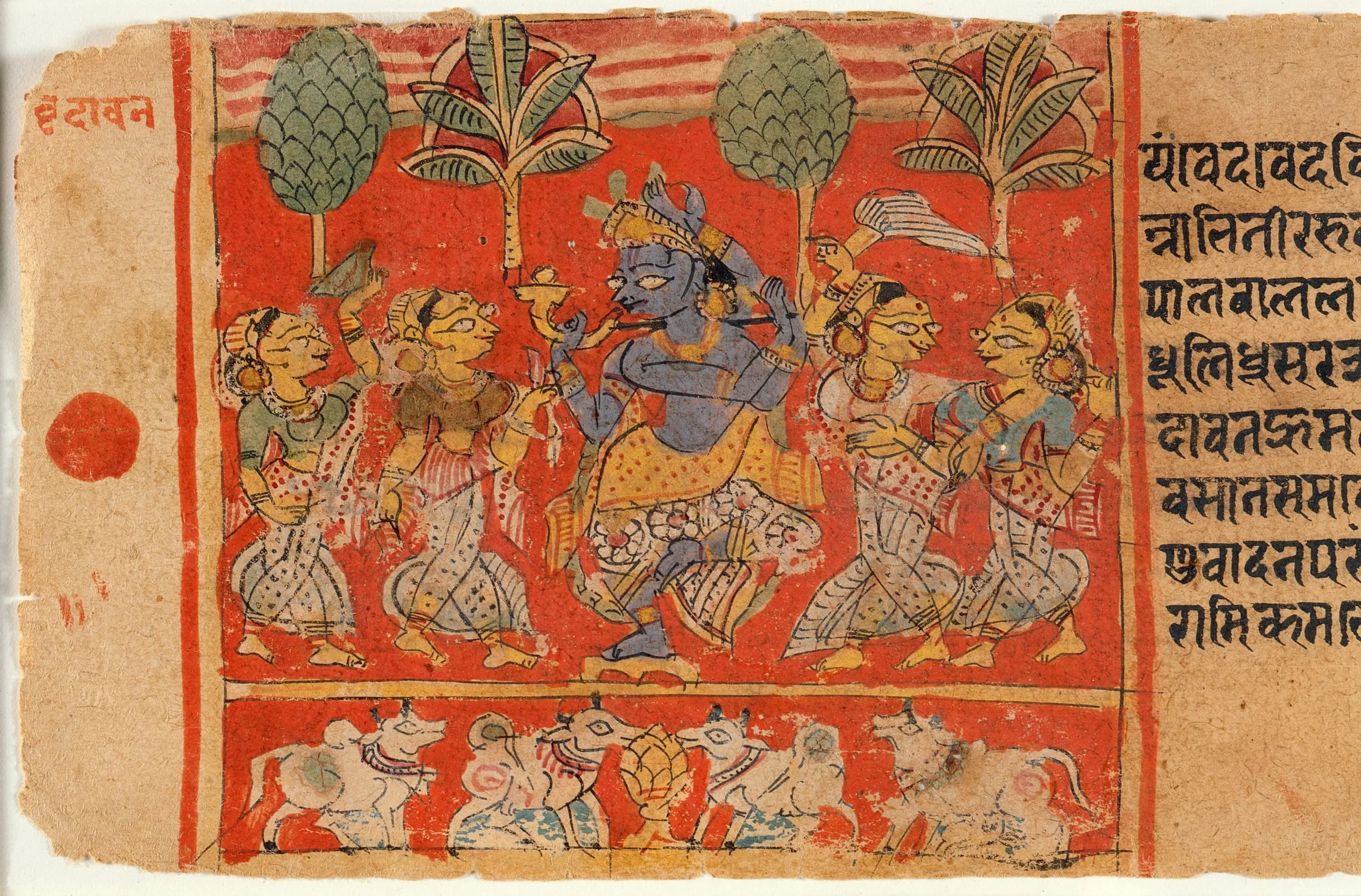
- Krishna Dancing with Gopis in Vrindavan, Folio from a Balagopalastuti (Praise for the Young Lord of the Cowherds)
- Date Made
- circa 1450-1475
- Medium
- Opaque watercolor, ink, and touches of gold and silver on paper
- Dimensions
- Image: 4 1/8 x 4 1/4 in. (10.48 x 10.8 cm); Sheet: 4 1/8 x 9 1/8 in. (10.48 x 23.18 cm)
- Accession Number
- M.88.49
- Curatorial Notes
The Balagopalastuti (Praise for the Young Lord of the Cowherds) was composed in Sanskrit by the Vaishnava saint Bilvamangala Swami, who probably lived in Kerala in the 13th century. It is a devotional (bhakti) text in praise of Krishna. A closely related illustrated manuscript of the Balagopalastuti, attributed to Gujarat, Surat (?) or western Rajasthan, circa 1425, is the Museum of Fine Arts, Boston (30.106). The Boston manuscript is incomplete, but the LACMA folio does not appear to have been part of it originally due to minor variances in the script and the presence of an image caption (no image captions are present in the Boston manuscript). The image caption in the LACMA folio (#3) reads, Vrindavan. Another folio from the same dispersed manuscript as LACMA's is in the Victoria and Albert Museum, London (IS.82-1963).
In the center of the illustration, the four-armed Krishna dances with four cowherdesses (gopis) in the forest of Vrindavan near Mathura. Krishna plays his flute (shown crossing behind his neck) and a curved horn. He has a hand held above his head in a dancing gesture. One of the gopis waves an honorific fly whisk made from the white tail-hairs of a yak (cauri or chowri). Another holds aloft a ritual fan or possibly a vessel. In the lower panel, four cows flank a lotus-petal stand which likely contains a fossilized stone sacred to Vishnu (shaligrama shila).
- Selected Bibliography
- Pal, Pratapaditya. Indian Painting, vol.1. Los Angeles: Los Angeles County Museum of Art, 1993.
- McGill, Forrest, editor. Beyond Bollywood: 2000 Years of Dance in the Arts of South Asia, Southeast Asia, and the Himalayan Region. San Francisco, CA: Asian Art Museum, 2022.