LACMA

ShopMembershipMyLACMATickets
LACMA
Los Angeles County Museum of Art
5905 Wilshire Blvd.
Los Angeles, CA 90036
info@lacma.org
(323) 857-6000
Sign up to receive emails
Subscribe
© Museum Associates 2026
  • About LACMA
  • Jobs
  • Building LACMA
  • Host An Event
  • Unframed
  • Press
  • FAQs
  • Log in to MyLACMA
  • Privacy Policy
© Museum Associates 2026
Collections

Giulio di Antonio Bonasone
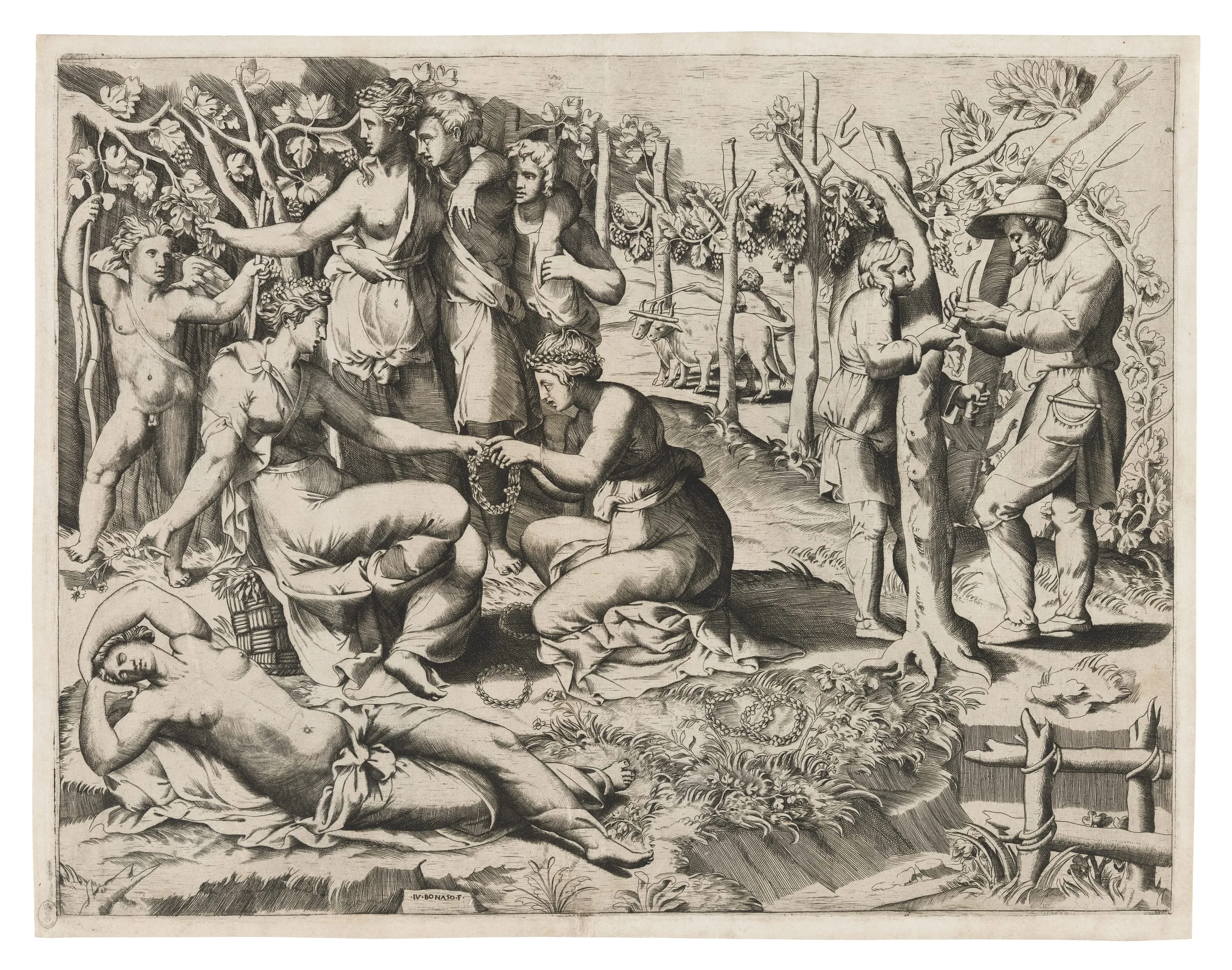
Flora and Her Nymphscirca 1546

Not on view
Engraving on cream paper depicting a vineyard scene with classical nude and draped figures grouped around a reclining man, flanked by clothed laborers among grapevines

Giulio di Antonio Bonasone, Giulio Romano, Flora and Her Nymphs, circa 1546, Los Angeles County Museum of Art, Mary Stansbury Ruiz Bequest, photo © Museum Associates/LACMA

Artist or Maker
Giulio di Antonio Bonasone
Italy, Bologna, circa 1498-1580
After
Giulio Romano
Italy, Rome, probably 1499-1546
Title
Flora and Her Nymphs
Place Made
Italy
Date Made
circa 1546
Medium
Engraving
Dimensions
Sheet: 13 7/8 × 17 3/4 in. (35.24 × 45.09 cm) Image: 13 × 17 in. (33.02 × 43.18 cm)
Credit Line
Mary Stansbury Ruiz Bequest
Accession Number
M.88.91.11
Classification
Prints
Collecting Area
Prints and Drawings
Curatorial Notes

Populated with elegantly long-limbed figures, this highly stylized engraving typifies a Mannerist approach to the composition of prints. It is based on the painted fresco decoration in the Sala dei Venti in the Palazzo Te, the pleasure palace of Federico II Gonzaga, ruler of Mantua in the mid-sixteenth century. So called because of the presence on its walls of decorative masks personifying the winds, the Sala dei Venti was designed by Raphael’s pupil Giulio Romano, who made his modelli, or highly finished preparatory drawings, available to printmakers for their translation into engravings, as Raphael had done earlier in the century.

In this case, Bonasone probably had access to Giulio’s designs, as both print and drawing set the mythical scene within a grape arbor, distinct from the fresco, which situates the Roman goddess of spring and her nymphs in a forest. The nude reclining in the foreground at left resembles an ancient marble statue of the Cretan princess Ariadne that was displayed in the Belvedere Court at the Vatican in the first decade of the sixteenth century, positioning Bonasone in a direct line of stylistic inheritance from Raphael, whose designs after ancient Roman sculptures were produced in print by the engravers with whom he collaborated.

Claire Spadafora Baes

2025
Selected Bibliography
  • Bartsch, Adam von. The Illustrated Bartsch. New York: Abaris Books, 1978.
  • Davis, Bruce. Mannerist Prints: International Style in the Sixteenth Century. Los Angeles: Los Angeles County Museum of Art, 1988.

  • Mortals, Maidens and Mothers; Re-presenting Women in Renaissance Print. Fresno, CA: California State University, Fresno, 1996.