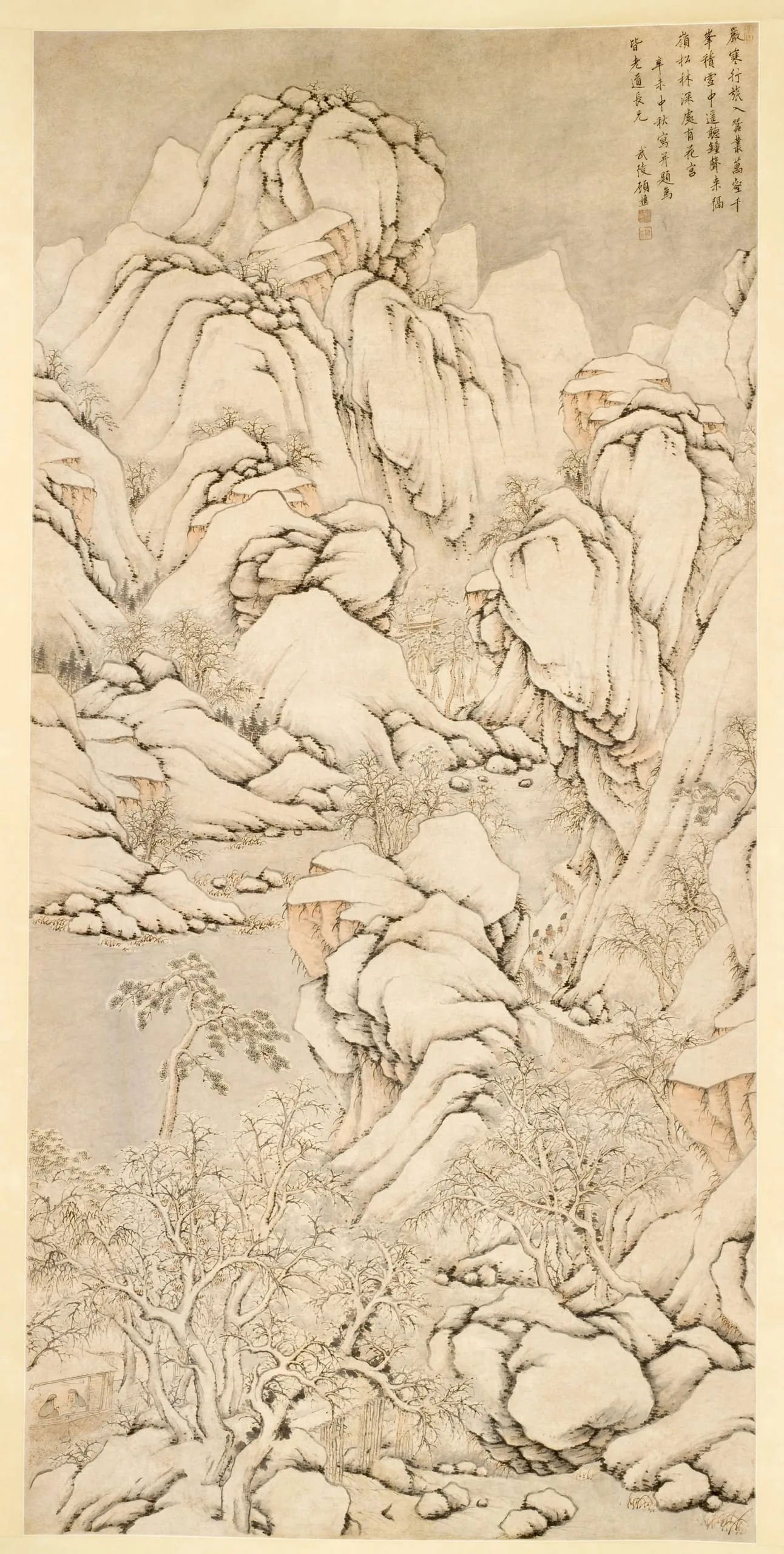
The evaluation system of Chinese painting was established in the mid-eighth century by Tang-dynasty calligrapher and critic Zhang Huaiguan. In Opinions on the Judgment of Paintings (Huapin duan), Zhang divided works into three categories, ranked lowest to highest: capable (neng), wondrous (miao), and divine (shen). Gu Qiao achieved the capable classification. His painting Snowy Mountains, however, far exceeds wondrous. Magnificent in size, the composition is masterfully executed. The trees and boulders, each cluster varying from the others, are rendered in outline, leaving the surface empty to create the visual effect of snow. Touches of ochre on the sides of the plateaus add color to the otherwise monochromatic picture. At the lower left corner, two figures sit in a thatched hut, possibly playing chess. In the middle ground, dwarfed by the towering rocks, a team riding donkeys ascends a trail, possibly to the temple tucked into the precipitous cliffs.
The inscribed poem provides important clues to the scene’s location: “Traveling in the severe cold into the silkworm bush [cancong], / Ten thousand valleys and a thousand peaks are covered in snow, / Far away, the sound of bells is carried from the neighboring mountain, / Deep in the pine forest, there is a floral palace. / In mid-Autumn in the year xinwei [1691], I wrote and inscribed [this] for old brother Jielao daochang.—Gu Qiao of Wulin.” Cancong is a legendary king named in the chronicles of the ancient Shu kingdom, present-day Sichuan Province. The inscription thus confirms that Gu’s landscape is set along the Shu Dao, or the Road to Shu.
Wan Kong
2024