- Title
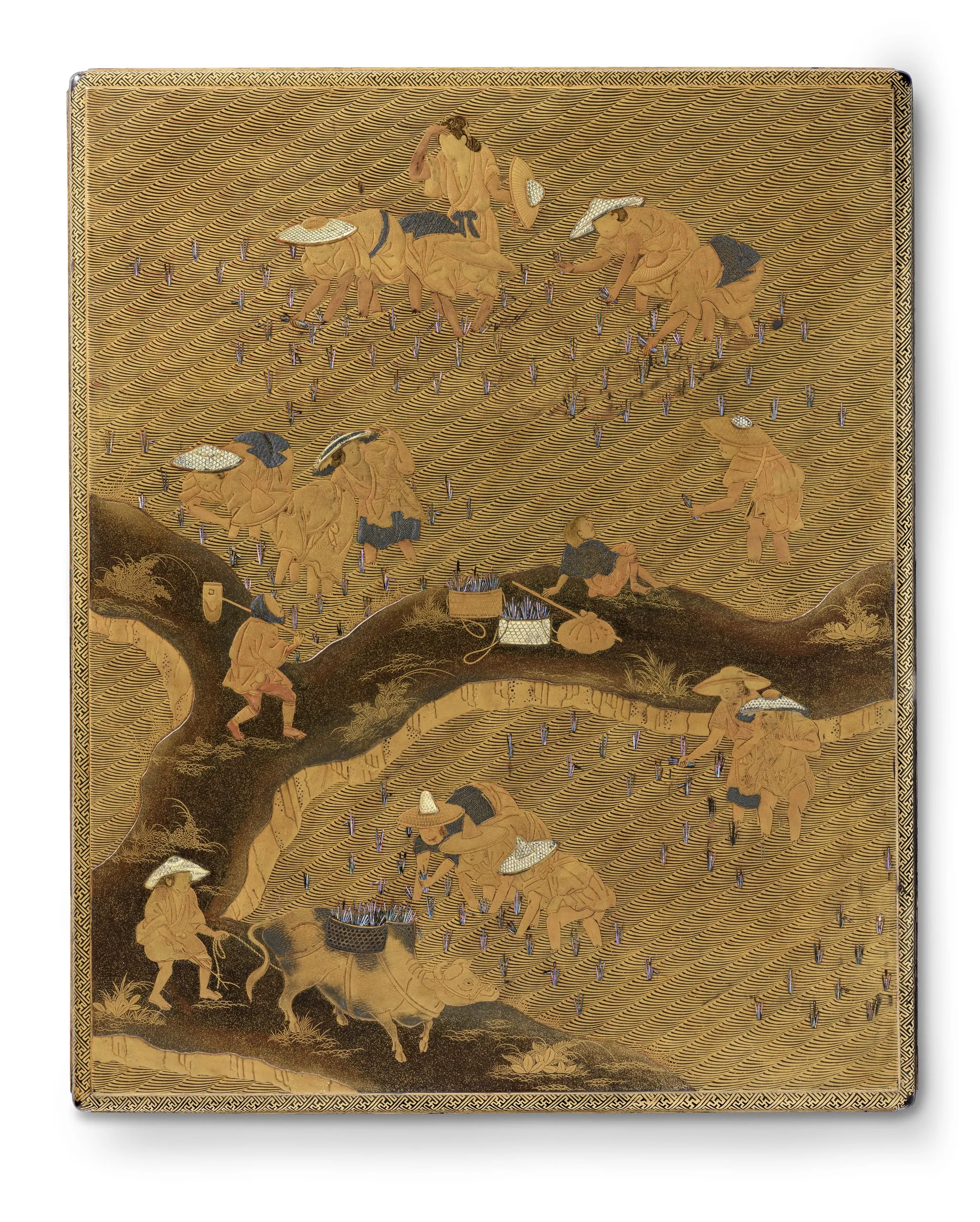
- Stationery Box with Design of Rice Replanting
- Date Made
- 17th century
- Medium
- Lacquer with maki-e (sprinkled powder design) and mother-of-pearl inlay over wood core
- Dimensions
- Overall: 5 1/4 x 13 1/4 x 16 1/4 in. (13.3 x 33.7 x 41.3 cm); a) Lid: 1 3/4 x 13 1/4 x 16 1/4 in. (4.4 x 33.7 x 41.3 cm); b) Base: 4 9/16 x 13 1/4 x 16 1/4 in. (11.6 x 33.7 x 41.3 cm)
- Accession Number
- M.88.83a-b
- Curatorial Notes
Reverence for the written word is one of the distinctive features of East Asian civilization. Enormous attention was lavished on the utensils associated with writing: the stationery box, writing box, brush, inkstone, and the ink itself. In Japan, this embellishment of writing utensils was often achieved with lacquer techniques such as makie (sprinkled pictures), which stand among Japan's greatest contributions to the decorative arts. Mother-of-pearl inlay on this box transforms it into a work of great beauty.
This large stationery box was made to hold sheets of handmade Japanese paper and was probably accompanied by a smaller box of similar design to hold the inkstone, brushes, and ink. Boxes of this type were often made for presentation to high officials or aristocrats, and the design scheme was typically of some auspicious motif such as birds and flowers. This box is covered instead with a scene of farmers transplanting seedlings into flooded paddies, a design known to occur on only three other boxes from the seventeenth century. From the late 11th century, courtiers who comprised the class of poets began to take summer residences outside of Kyoto, becoming familiar for the first time with the process of rice farming and the peasants who cultivated rice. This led to the appearance of farm villages and mountain towns in their poems, and later in imagery on painting and decorative arts. Another unusual feature of this box is the artist's three-dimensional composition: the path between the rice paddies (with their stylized ripples) meanders down three sides of the box, emphasizing the volume and mass of the object.
Re-edited 1/5/2019, hg.