LACMA

ShopMembershipMyLACMATickets
LACMA
Los Angeles County Museum of Art
5905 Wilshire Blvd.
Los Angeles, CA 90036
info@lacma.org
(323) 857-6000
Sign up to receive emails
Subscribe
© Museum Associates 2025

Museum Hours

Monday

11 am–6 pm

Tuesday

11 am–6 pm

Wednesday

Closed

Thursday

11 am–6 pm

Friday

11 am–8 pm

Saturday

10 am–7 pm

Sunday

10 am–7 pm


  • About LACMA
  • Jobs
  • Building LACMA
  • Host An Event
  • Unframed
  • Press
  • FAQs
  • Log in to MyLACMA
  • Privacy Policy
© Museum Associates 2025
Collections

Unknown
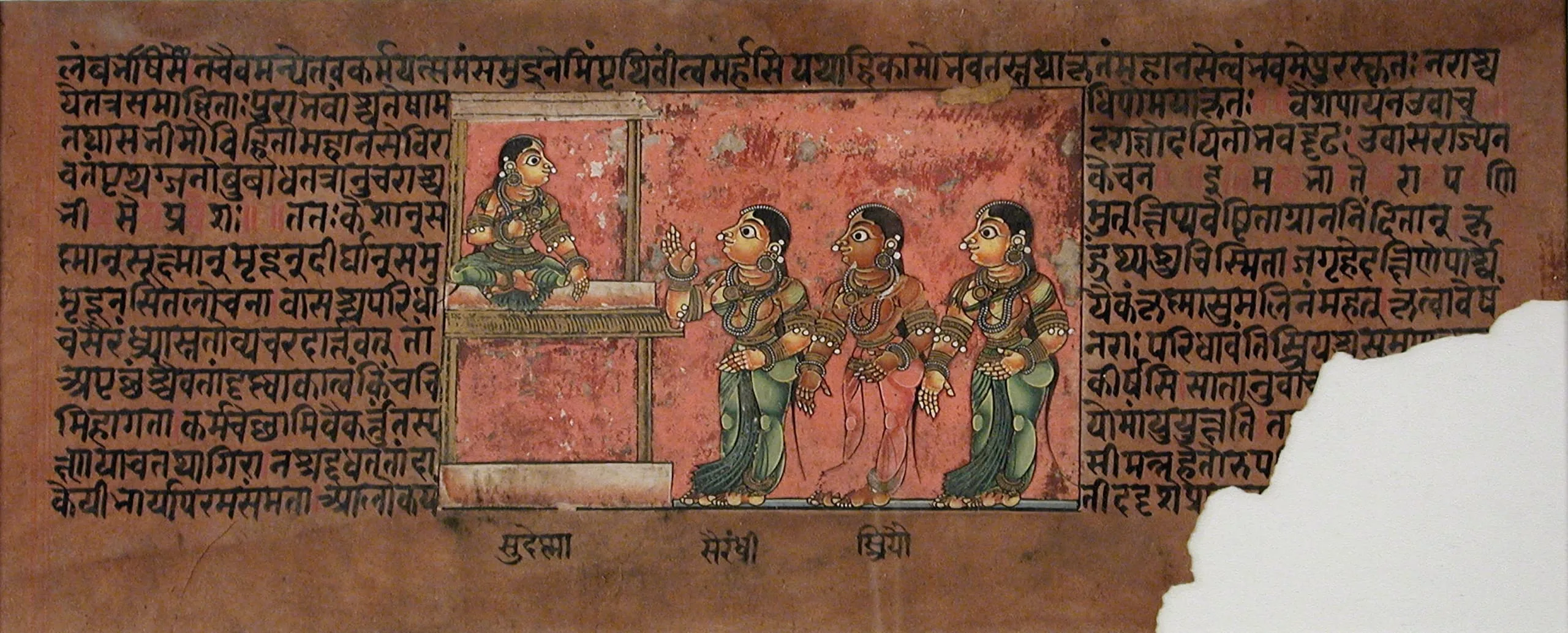
Draupadi's Meeting with Queen Sudeshna, Folio from a Mahabharata ([War of the] Great Bharatas)1670

Not on view
Illustrated manuscript page with South Asian script, featuring a painted scene of a seated figure gesturing toward three standing figures in coral-red setting
Artist or Maker
Unknown
Title
Draupadi's Meeting with Queen Sudeshna, Folio from a Mahabharata ([War of the] Great Bharatas)
Place Made
India, Karnataka, Mysore, Srirangapatna (Seringapatam) (?)
Date Made
1670
Medium
Opaque watercolor, gold, and ink on paper
Dimensions
Image: 4 1/8 x 6 1/2 in. (10.48 x 16.51 cm); Sheet: 8 x 19 1/4 in. (20.32 x 48.9 cm)
Credit Line
Purchased with funds provided by Dorothy and Richard Sherwood
Accession Number
M.88.29.2
Classification
Manuscripts
Collecting Area
South and Southeast Asian Art
Curatorial Notes
This folio from a dispersed Mahabharata ([War of the] Great Bharatas) has been attributed by Stuart Cary Welch (1985) to Srirangapatna (formerly Seringapatam), which was the capital of the Mysore kingdom under Sultan Hyder Ali (r. 1761–1782) and Tipu Sultan (r. 1782-1799). The Sanskrit manuscript’s colophon states that it was copied by Govind Sharma, son of Ratnaker, from the village of Chalitgram in 1670. The episode is from the Book of Virata, chapter eight. It depicts Queen Sudeshna, the wife of King Virata, seated on a balcony. Before her stands Draupadi, the common wife of the five Pandava brothers who is disguised as the chambermaid Sairamdhri seeking employment, and two accompanying women. Queen Sudeshna doubts Sairamdhri’s identity because she is too beautiful and cultivated to be a servant, but hires her as her handmaiden. The illustration differs from the textual account in that Sairamdhri is dressed in similar finery as Queen Sudeshna and the two woman rather than in a “long, black, very dirty robe.” (Mahabharata 4.8.1; translation by J. A. B. van Buitenen, 1978.) Additional folios are in the Jagdish and Kamla Mittal Museum of Indian Art, Hyderabad (76.528 and .529), Freer Gallery of Art, Washington (F1975.5), Salar Jung Museum, Hyderabad, and National Museum, New Delhi.