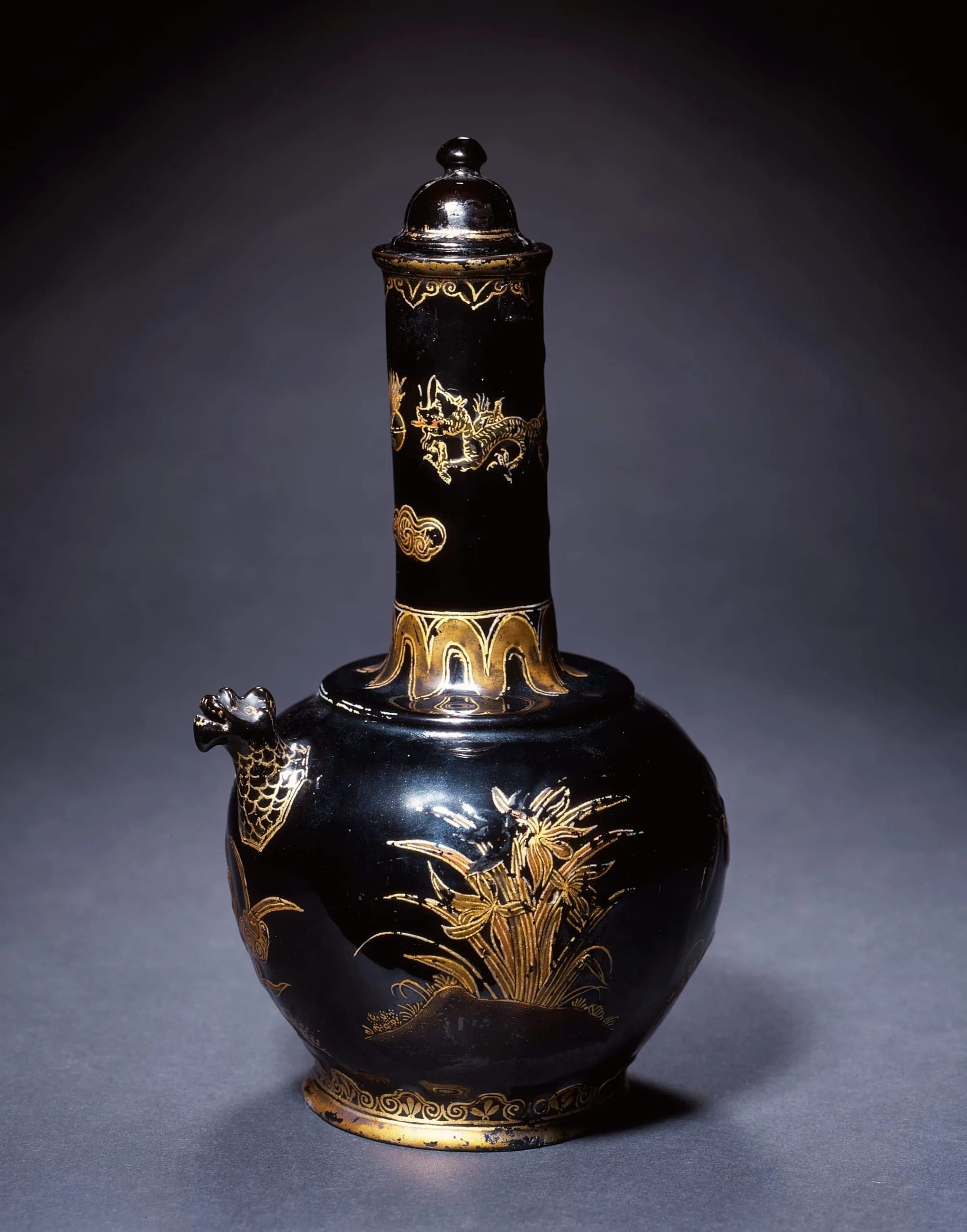
Alchemist Johann Fredrich Böttger produced this ewer for Augustus II the Strong, elector of Saxony and king of Poland (r. 1697−1733). Böttger, along with scientist Ehrenfried Walther von Tschirnhaus, is credited with inventing hard-paste porcelain in Europe by adding the essential ingredient of kaolin, a type of clay, to their porcelain recipe. After Böttger refined the formula, the king established the Royal-Polish and Electoral-Saxon Porcelain Manufactory (Königlich-Polnische und Kurfürstlich-Sächsische Porzellan-Manufaktur), better known as the Meissen Porcelain Manufactory, which officially began production in 1710.
Early on, Böttger produced refined red stoneware, now known as “Böttger ware,” that could be carved and polished on a wheel. He modeled such ceramics after Chinese Yixing originals, which were likewise brown or red in color and typically left unglazed. Meissen produced this rare ewer form as both a glazed and unglazed type. LACMA’s example is modeled after a kendi, or water vessel, and has an animal-mask spout. Rather than an exposed red body, it is covered in black glaze and gold ornamentation, possibly painted by Augustus II’s lacquerer Martin Schnell (c. 1675−1740). The ewer’s shape, glaze, and gilding—which features dragons pursuing a flaming pearl and sprays of flowers among rocks—all imitate East Asian lacquerware. The ewer also bears the mark of ceramist Georg Kittel.
Böttger’s red stoneware represents an early moment in European porcelain. The ewer was likely initially intended for Augustus’s Japanese Palace, whose 1721 inventory listed almost 100 black-glazed ceramics and noted that four rooms were dedicated to Meissen porcelain. While it is unclear how the black-glazed pieces were initially displayed, the ewer now has a Royal Saxon inventory number from the Johanneum, once the royal picture gallery, when the Meissen porcelains were catalogued and exhibited in the 1870s.
Cynthia Kok
May 2025