LACMA

ShopMembershipMyLACMATickets
LACMA
Los Angeles County Museum of Art
5905 Wilshire Blvd.
Los Angeles, CA 90036
info@lacma.org
(323) 857-6000
Sign up to receive emails
Subscribe
© Museum Associates 2026
  • About LACMA
  • Jobs
  • Building LACMA
  • Host An Event
  • Unframed
  • Press
  • FAQs
  • Log in to MyLACMA
  • Privacy Policy
© Museum Associates 2026
Collections

Unknown
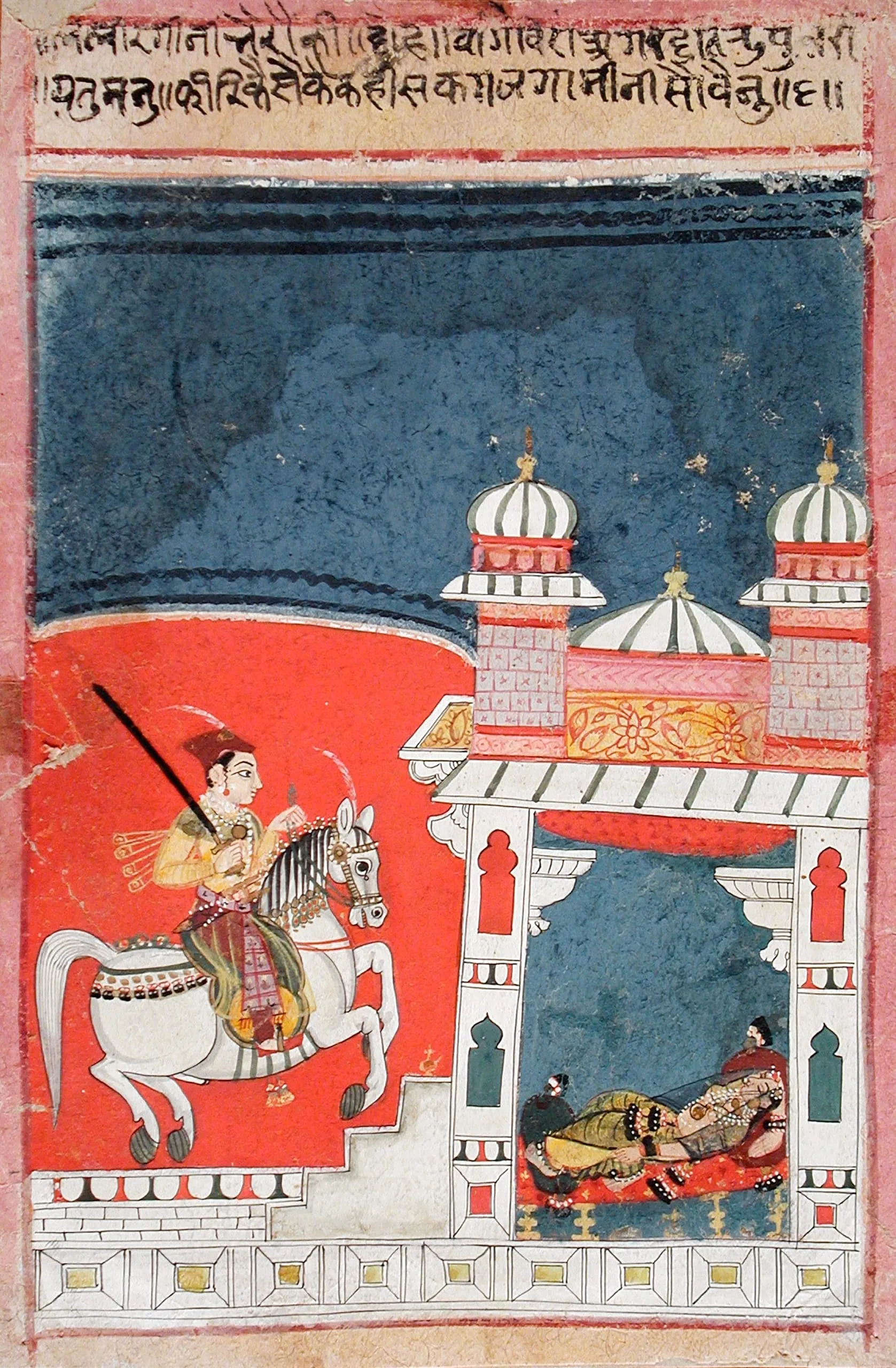
Lalita Ragini, Fifth Wife of Bhairava Raga, Folio from a Ragamala (Garland of Melodies)circa 1650

Not on view
Indian manuscript painting with Devanagari text border, a rider on a rearing white horse against a red ground, and a reclining figure in a white domed pavilion

Unknown, Lalita Ragini, Fifth Wife of Bhairava Raga, Folio from a Ragamala (Garland of Melodies), circa 1650, Los Angeles County Museum of Art, Gift of Paul F. Walter, photo © Museum Associates/LACMA

Artist or Maker
Unknown
Title
Lalita Ragini, Fifth Wife of Bhairava Raga, Folio from a Ragamala (Garland of Melodies)
Place Made
India, Madhya Pradesh, Bundelkhand or Malwa
Date Made
circa 1650
Medium
Opaque watercolor, gold, and ink on paper
Dimensions
Sheet: 9 3/4 x 6 1/2 in. (24.77 x 16.51 cm); Image: 8 1/8 x 6 in. (20.64 x 15.24 cm)
Credit Line
Gift of Paul F. Walter
Accession Number
M.87.278.11
Classification
Drawings
Collecting Area
South and Southeast Asian Art
Curatorial Notes

The Hindi inscription in the header is the first couplet of the Lalita Ragini section of the influential ragamala (garland of melodies) by the 17th-century poet Lachiman Das:
A tiger hero, swaggering and truculent, seeming to be the slave of Love,
Who can tell when he returns, roaring like an elephant?
(Translation by A. K. Coomaraswamy.)

Lalita Ragini is the fifth wife of Bhairava Raga in the predominant ragamala classification system generally known as the Rajasthani system. It is a devotional melody associated with the early morning. It is personified as the arrival of the errant lover.
Here, the returning lover rides his white stallion up the steps of a palatial pavilion in which the heroine lies sleeping in a bedchamber. He carries a sword against his right shoulder and has a punch dagger (katar) tucked into his waist sash. His left hand holds the reins of the horse. A water ewer is incongruously placed on the top step.

A comparable Lalita Ragini, attributed to Orchha, Madhya Pradesh, circa 1640-1650, is in the Museum of Fine Arts, Boston (17.2384). It is inscribed on the reverse with the same above verse by Lachiman Das, but varies visually by the returning lover being on foot instead of on horseback.