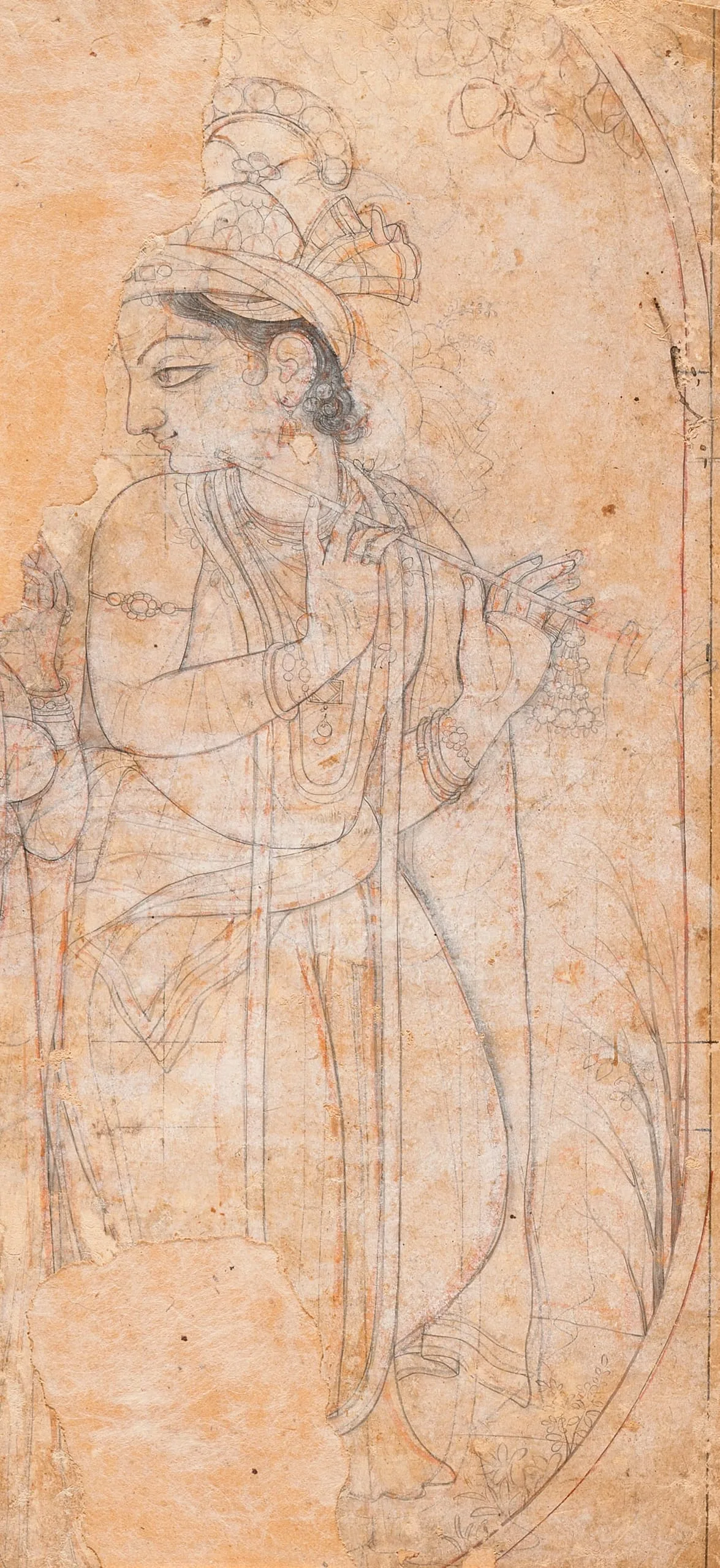
Krishna, the 8th incarnation of Vishnu, is widely beloved as the Hindu god of devotion. The evolved religious conception of Krishna incorporates several distinct strata and a mixture of historical and mythological personalities, including his probable mortal life as a minor clan chieftain in the Mathura region of northern India, whose ethnic heritage is evidenced and retained by Krishna’s blue skin; his youthful exploits as a pastoral demi-god that engendered the bhakti (devotion) movement; his pivotal advisory role as Arjuna’s cunning charioteer in the epic Mahabharata ([War of the] Great Bharatas); and his subsequent adult career as an ill-fated monarch who brought about the destruction of his own people.
Krishna embodies Vishnu’s protective nature. He is a savior who is worshipped variously as a child-god, divine lover, or regal monarch. He may be depicted as a cowherd, with a flute or staff, or wearing princely dress and a crown. Because Krishna spent his early life as a cowherd, themes of the innocence and playfulness of his childhood abound in legends and images of the god.
Krishna is renowned for playing his flute to call Radha and his female devotees to dally with him in spiritual bliss. In this context, Krishna's flute playing is used as a metaphor for the attraction of the human soul to divinity. Its sound disrupts all social strictures and allows the worshipper to aspire freely towards enlightenment and religious rapture.
Radha’s figure has been mostly cropped. See also M.75.4.13.