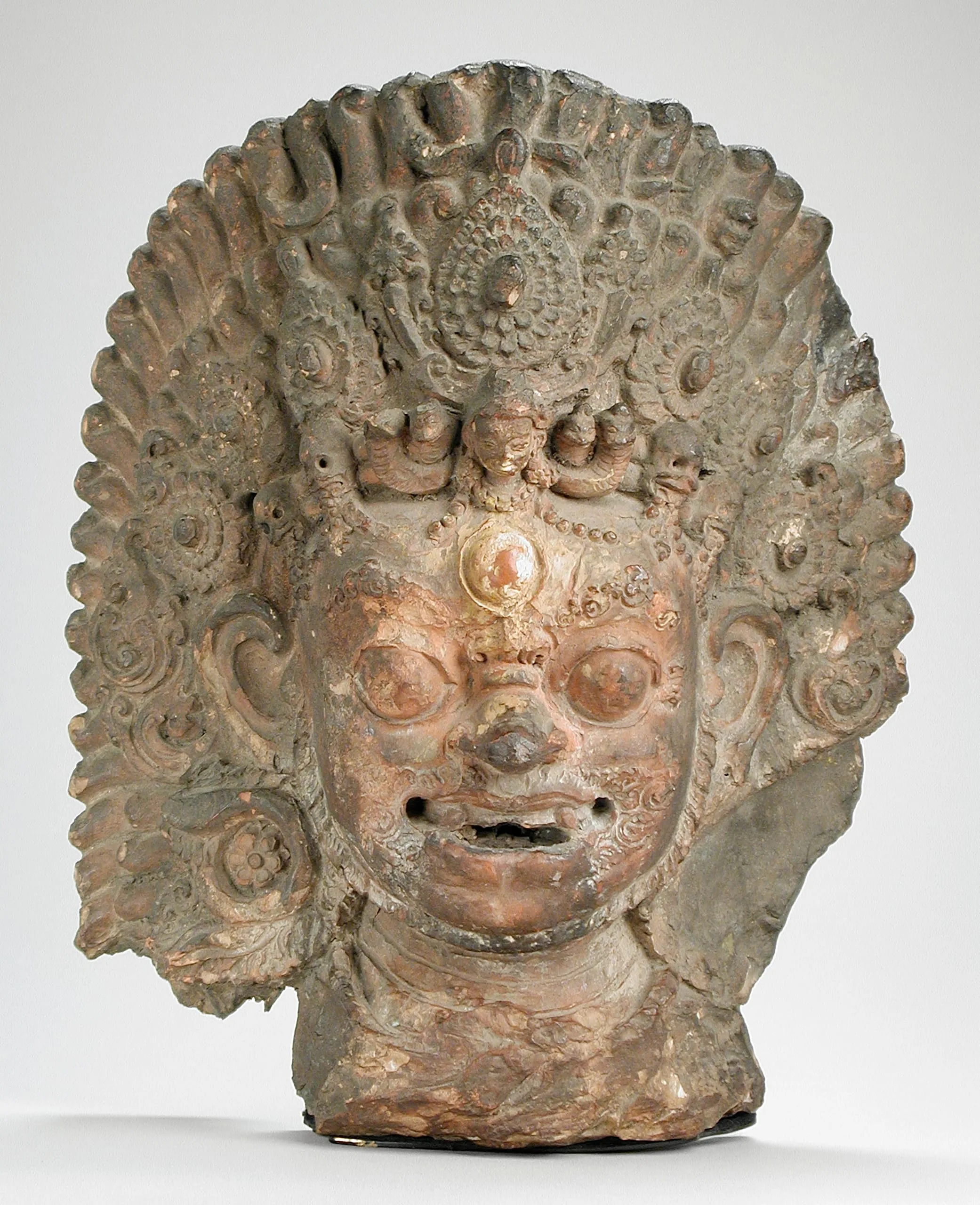
Consecrated libation vessels in Nepal are often furnished with a spout or port made of earthenware, wood, or copper alloy that is adorned with the head or full figure of Bhairava, a violent or powerful (ugra) form of Shiva, the Hindu god of destruction. (For the mythological origin of Bhairava, see M.74.138.4.). The vessel is filled with rice beer (chhaang/chhyang or thwon) and dispensed by a filtered bamboo straw (pipsing or pipli) inserted into the mouth of the Bhairava or a special port on the image base. It is drunk by devotees as a consecrated beverage during the annual Indra Jatra festival in Nepal. Celebrated principally in Kathmandu, the originally agricultural festival honors Indra, the ancient Hindu and Vedic (proto-Hindu) weather god, as the provider of the life-giving monsoon rains. See also M.74.10.1, M.77.7.2, M.81.146, M.81.210, and M.88.224.1.
This head of the frightful Bhairava has Shiva’s third eye of wisdom (jñana netra), and the fierce attributes of bulging eyes and fangs. His earlobes are distended with the right ear having a circular earring (kundala). The left earring is now damaged and lost. He wears a tiara of skulls with the head of the bodhisattva Manjushri (?) flanked by four rearing serpent heads in the center. Above the tiara is a crown with replicas of jewel-studded ornaments. Bhairava’s flying hair frames the god’s face and rises in thick strands like serpents or flames. He has bushy eyebrows and a stylized florid moustache and beard. The three incised rings around Bhairava’s neck represent the coils of the serpent king Vasuki, who voluntarily coiled himself around Shiva’s neck. They symbolize Shiva’s and Bhairava’s mastery over the three tenses of time (past, present, and future). Bhairava was originally a Hindu deity, but over time was incorporated into the Yajrayana Buddhist pantheon, especially as a form of the Dharmapala (Guardian of the Law) Yamantaka, the destroyer of Yama, who is the god and judge of the dead. See also M.70.42.4, M.82.220, M.81.206.2, and M.91.293.1.