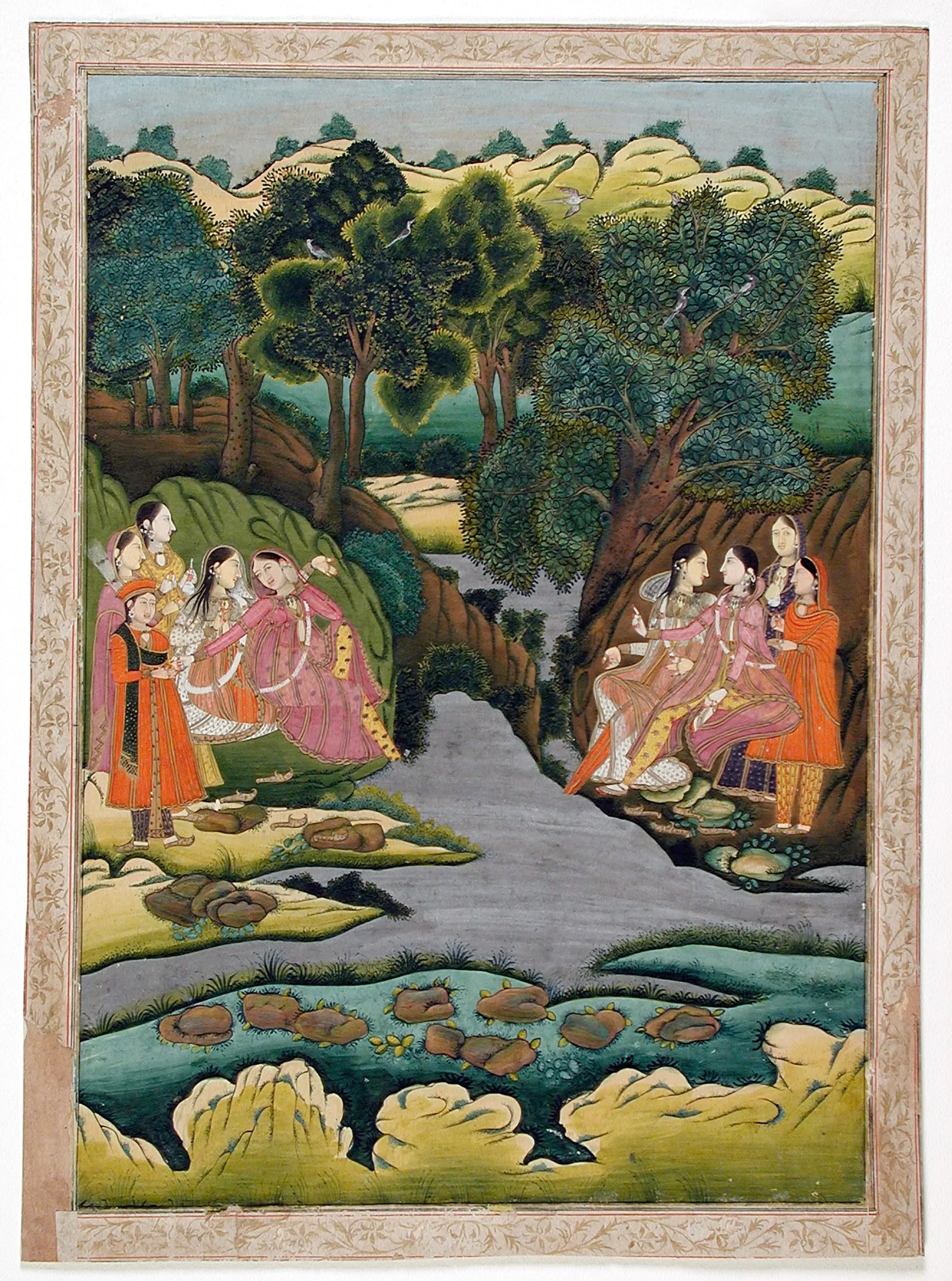
Images of royal or courtly women enjoying an outing by a stream was a popular genre of Farrukhabad painting. Released from the seclusion of the zenana (women’s quarters), the wives, concubines, widows, unmarried sisters and cousins, and female attendants reveled in private picnics and lounging along a waterside. (Compare a related painting in the Chester Beatty Library, Dublin, 11A.58.)
In this painting, two groups of elegantly attired women sit across a forest stream and engage in a conversation. On the right, the principal lady dressed in a pink outer garment raises an accusatory finger towards her similarly clad counterpart on the left, who covers her ear and extends her right arm to a maidservant for support. Their companions, both in white outer garments, share in the banter.
The painting is attributed to Muhammad Faqirullah Khan (active circa 1720-1770), who was known for his distinctive elongated figures and oval faces with an aquiline nose. Named in 1714 for the Mughal Emperor Farrukhsiyar (r. 1712-1719), Farrukhabad was a small principality only 80 mi. NW of Lucknow. During the peaceful and stable rule of Ahmad Khan Bangash (r. 1750-1771), Farrukhabad painting developed its own idiom that was heavily influenced by the neighboring Lucknow court’s sophisticated aesthetic traditions.
See also M.2005.159 and M.72.2.1.