- Title
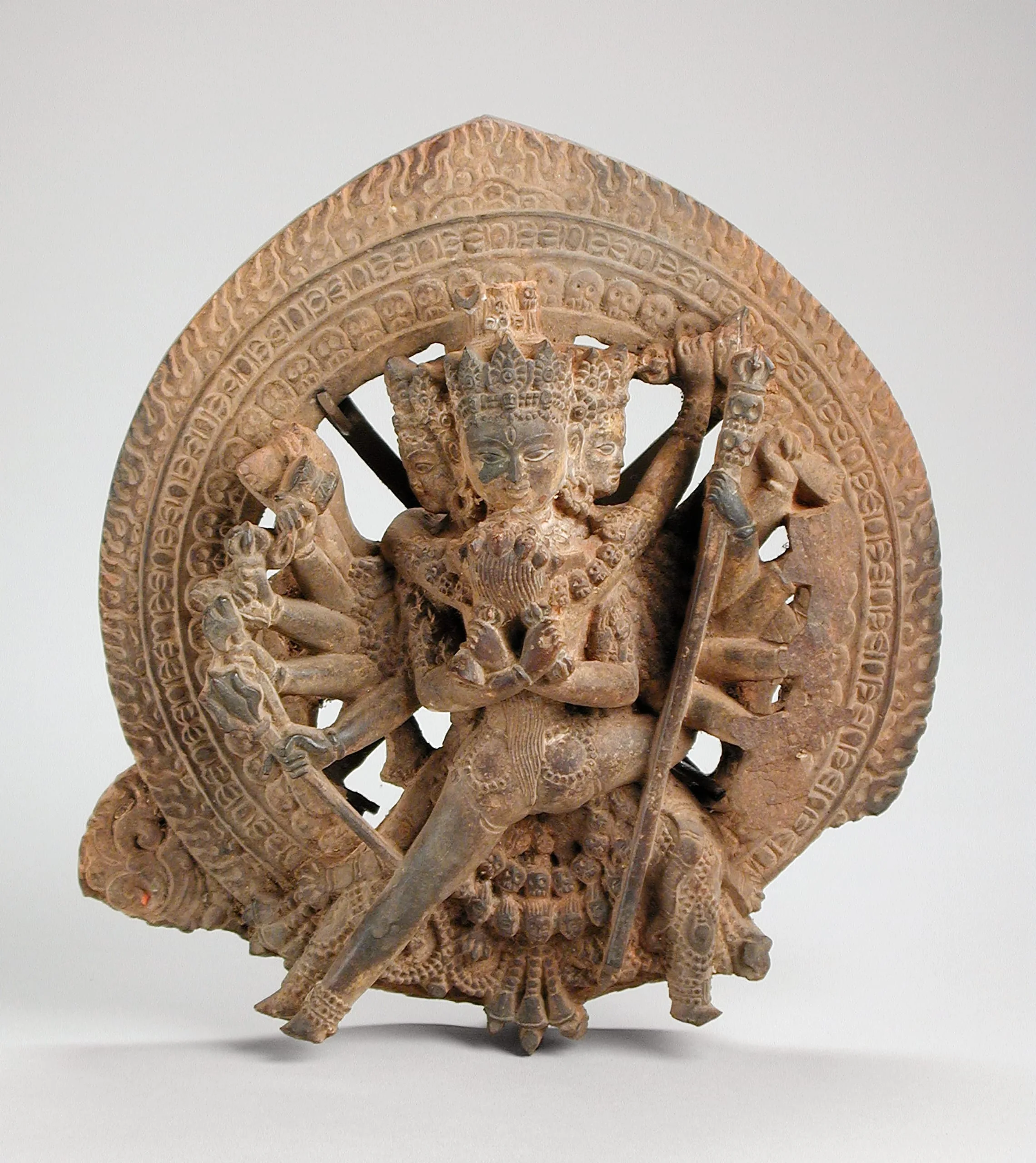
- Chakrasamvara and Vajravarahi
- Date Made
- 16th century
- Medium
- Stone
- Dimensions
- 7 1/2 x 7 1/2 in. (19.05 x 19.05 cm)
- Accession Number
- M.87.272.7
- Curatorial Notes
This complex sculpture of the Buddhist Vajrayana deities Chakrasamvara (Circle of Bliss) embracing his consort Vajravarahi (Diamond Sow) perfectly captures the bliss of the enlightened mind. Chakrasamvara is shown with his standard iconography of four heads and twelve arms, indicating the twelve-fold chain of causation in the phenomenal world. Vajravarahi blissfully looks up into Chakrasamvara’s front face, offering him a skull-cup (kapala) filled with purified ambrosia (amrita) with her left hand, and holding a flaying knife (kartrika), symbolizing the severing of conceptual thought with her right hand. Their dynamic, passionate energy in perfect union is further articulated by their lunging stance (pratyalidha asana) as they dance entwined originally atop the bodies of the emaciated Kalaratri and the fierce Bhairava. Behind the transcendental couple is a flaming aureola (prabhavali) with inner rings of skulls and thunderbolts (vajras). In the traditional Newari iconographic convention, Vajravarahi embraces Chakrasamvara with only her right leg rather than both legs as in the Tibetan fashion. On a conceptual level this dramatic image of Chakrasamvara and his spouse Vajravarahi symbolizes the union of Wisdom and Compassion. It would have served as a visualization tool for the meditative practices, in which the practitioner realizes his or her own identity as the fully enlightened Buddha.
See also M.70.1.3, M.1.73.131, and M.80.110.