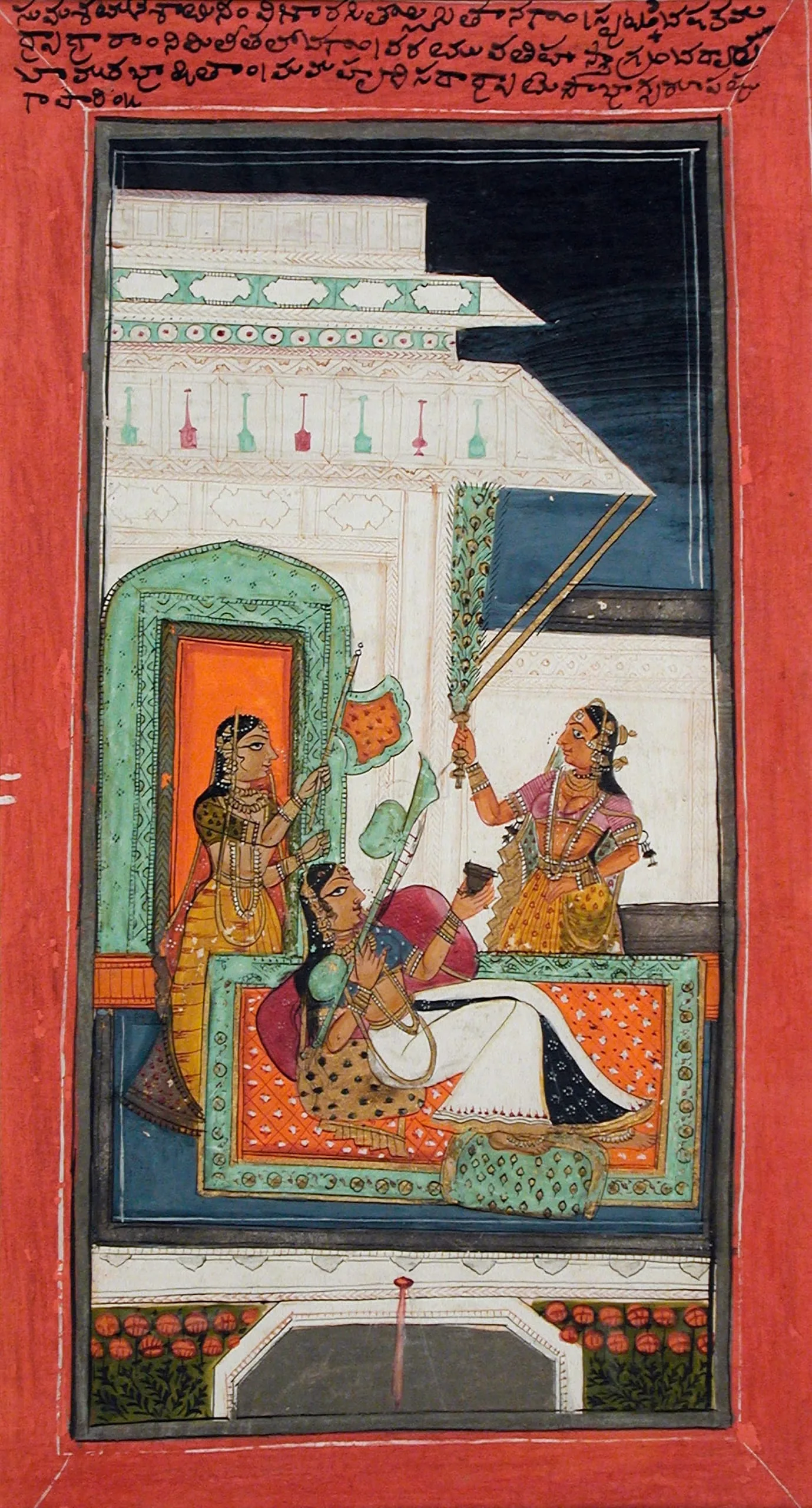
This painting is from a dispersed manuscript of thirty-four folios originally attributed to circa 1750 and presumed to be a ragamala (garland of melodies). It is now believed to be invocations (dhyana shlokas) to gods and goddesses, and has been re-attributed to circa 1775. (Seyller and Mittal, 2018)
The Sanskrit inscription in Telegu script in the upper red border reads, “In my heart I am always thinking of [?], who reclines on a bed of flowers, has a shining face with eyes closed, enjoys playing the vina and holding a crystal pitcher in her hand is in conversation with two young women who hold fly whisks in their hands. [She] is a figure of beauty.” (Translation by Professor P. Aithal and Dr. H. Metzger.) The illustration generally accords with the inscribed description, except that the personified goddess holds what appears to be a metal cup or goblet rather than a crystal pitcher. Moreover, only one of the female attendants holds an honorific fly whisk, which is represented here as a peacock feather fly whisk (morchal) rather than a fly whisk made from the white tail-hairs of a yak (cauri or chowri). The other attendant holds a fan.
Additional folios from this series, formerly in the collection of the Raja of Wanaparthy, are in the Jagdish and Kamala Mittal Museum of Indian Art, Hyderabad (76.449–76.454 D48–D53), Brooklyn Museum (79.266), San Diego Museum of Art (1990.537), and Museum Rietberg, Zurich (RVI 2062).