- Title
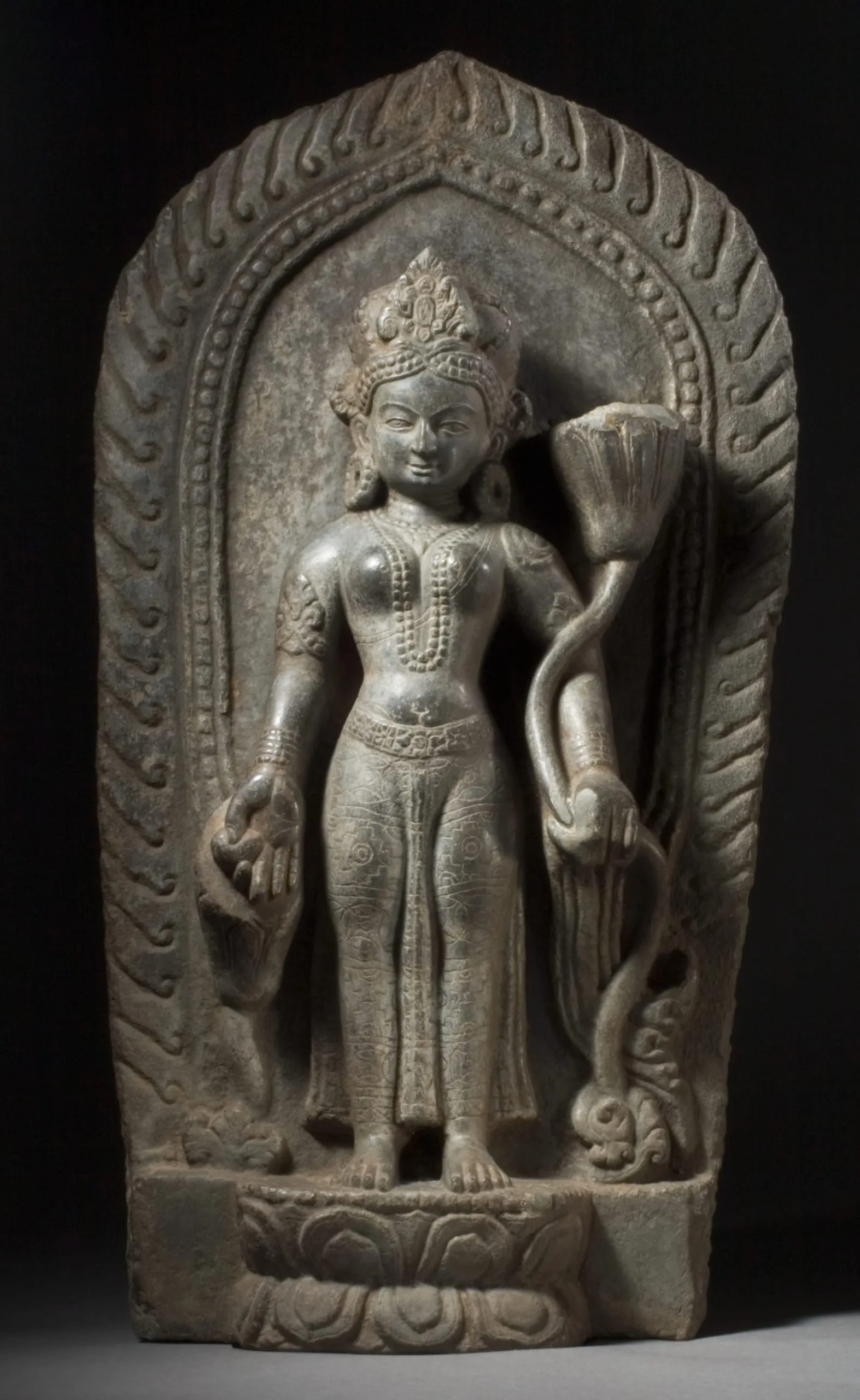
- The Buddhist Goddess Green (Shyama) Tara
- Date Made
- 11th-12th century
- Medium
- Stone
- Dimensions
- 23 x 9 3/4 x 4 5/8 in. (58.42 x 24.77 x 11.75 cm)
- Accession Number
- M.87.277.1
- Curatorial Notes
The Buddhist goddess Tara is the female Bodhisattva of Compassion. She is said to have been born from the Bodhisattva Avalokiteshvara’s tears of compassion. There are many forms of Tara, all of whom help practitioners overcome hindrances and difficulties on the path to Enlightenment. Each Tara has a different symbolic character and associated color. This sculpture likely represents Green (Shyama) Tara, one of the most popular Buddhist protective goddesses. Green Tara is a gracious form of the goddess regarded as the protectress from all suffering and the symbol of Enlightenment in female form. She is often propitiated for longevity. Green Tara is also the wisdom component of Enlightenment (prajna) associated with the transcendental Jina Buddha Amoghasiddhi.
In this representation, Green Tara is crowned, has two arms, and stands in a stiff, frontal pose (samapada sthanaka) on a lotus based in front of a flaming aureola (prabhavali) with a pearl border. She smiles gracefully to reveal her benevolent nature and wears copious jewelry and elegant patterned textiles. Her left hand holds the stalk of a blossoming blue lotus (Nymphaea nouchali) that grows out of the lotus base and rises to the level of her head. Her right hand is held in the gesture of charity (varada mudra) and holds in the open palm a healing myrobalan fruit or Medicinal Seed (arura) to emphasize her role as a savior who cures spiritual and physical suffering. A second blue lotus on a short stalk grows beneath her right hand. See also M.76.2.30 and M.91.232.7.